

When Disaster Strikes: From Power Outage to Outdoor Survival, How a Good Flashlight Can Save Your Life
✔ Anyone who has experienced a multi‑day power outage
✔ Preppers and survivalists
✔ Families living in regions prone to winter storms, hurricanes, or wildfires
1. The Night the Lights Went Out — Real 2026 Disasters

On the night of January 23, 2026, Winter Storm Fern slammed into the southeastern United States. Ice accumulation rates exceeded 1 inch per hour — heavy enough to snap aging wooden power poles designed to withstand only about 10 pounds per foot. By Sunday afternoon, utility tracking site PowerOutage.us reported that more than 823,000 customers were without power. Tennessee alone saw roughly 248,401 outages, followed by Mississippi with about 157,516 and Louisiana with around 123,929.
In Nashville, nearly 172,000 customers lost electricity. Officials warned that restoration could take days, especially where thick ice had brought down trees and power lines. The storm claimed at least 25 lives nationwide, including two in Mississippi, where more than 160,000 outages persisted days later. Wind chills plunged as low as minus 40 degrees Fahrenheit — conditions where frostbite can develop within minutes.
Then, in early April 2026, another ice storm struck Wisconsin. Residents in Waupaca and Portage Counties awoke to trees crystallized with nearly half an inch of ice. Tree branches broke under the weight, sounding like rifle shots, followed by the thunderous crash of power lines snapping. Over 25,000 individuals lost electricity, and power restoration took days. The Stevens Point Fire Department responded to 76 calls, including downed trees over power lines, fire alarms, and other weather‑related emergencies. The Waupaca County Sheriff's Office handled approximately 400 calls related to the ice storm.
Between January and April 2026, millions of Americans experienced extended blackouts. According to the U.S. Energy Information Administration (EIA), average annual outage duration in the U.S. reached 11 hours in 2025 — the highest in a decade, driven largely by extreme weather. Those prepared with reliable lighting navigated safely; those who relied on cheap lights stumbled in darkness. The difference wasn't luck — it was preparation.
2. What Different Disasters Demand From Your Light
❄️ Winter Storm / Ice Storm
Extended blackouts in sub‑freezing temperatures. Requires: ultra‑long runtime (days, not hours), cold‑resistant battery chemistry, rugged construction to survive ice and falls.
🌊 Hurricane / Flood
Wet conditions, potential submersion, need to signal for help. Requires: IP68/IPX8 waterproofing, high lumens for signaling, durable housing.
🔥 Wildfire Evacuation
Rapid evacuation, smoke, potential night travel. Requires: compact size, instant activation, long throw to see through haze, high‑visibility strobe.
🌲 Lost in Wilderness
Unpredictable duration, need for both close‑up and distance illumination. Requires: multi‑mode (low for battery conservation, high for signaling), long throw for scanning terrain.
Every disaster scenario shares one requirement: a light that you can rely on without question. When you're navigating around downed power lines in the dark, climbing over ice‑covered debris, or evacuating through smoke, you don't have time to wonder if your flashlight will work. Reliability is the most important feature of any emergency light.
3. Emergency Flashlight Selection Criteria — What to Look For
| Criteria | Why It Matters | Brinyte Solution |
|---|---|---|
| Long Runtime | Power outages can last days. You need a light that won't die after a few hours. | PT16A: 300 hours low mode; PT16: 31 hours low mode. |
| Brightness & Throw | High lumens for signaling, long throw for scanning hazards. | PT16A: 3000 lm / 458m; ZT40: 1650 lm / 490m. |
| Durability | Drops, impacts, extreme temperatures. | 6061‑T6 aluminum, 1m drop, IP68/IPX8. |
| Battery & Charging | Off‑grid power needed. | 21700 USB‑C batteries – recharge from power bank/solar. |
| Ease of Use | Stress impairs fine motor skills. Controls must be intuitive. | Dual tail switches (PT16A), memory mode, rotary zoom (ZT40). |
Emergency management agencies recommend every household have multiple light sources stored in accessible locations. The key word is "multiple" — one light isn't enough. A layered lighting system includes a primary high‑runtime light for sustained use, a secondary light for scanning and signaling, and a compact backup for each family member.
4. Brinyte Emergency Lighting Lineup — Built for When It Matters
Brinyte designs lighting tools for professionals who demand reliability — law enforcement, military, hunters, and emergency responders. Independent reviewer 1Lumen describes the PT16A's build quality as "top notch" – machining, anodizing, threads, and switch feel all feel "very premium"[1].
| Model | Max Lumens | Throw | Low Mode Runtime | Waterproof | Best Use |
|---|---|---|---|---|---|
| PT16A | 3000 lm (Turbo) | 458m | 300h (5 lm) | IP68 | Home primary |
| ZT40 | 1650 lm | 490m | 5h 20min (500 lm) | IPX8 | Yard / property scanning |
| PT16 | 2000 lm | 608m | 31h (10 lm) | IP68 | EDC / always with you |
🔦 Brinyte PT16A — The Endurance Champion (Home Primary Light)

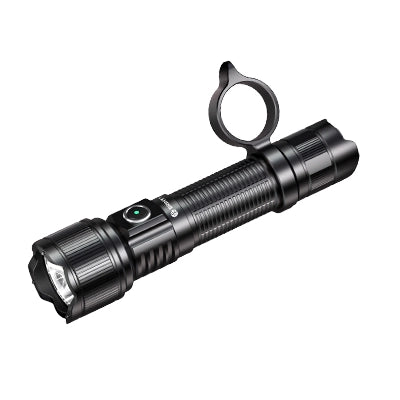
The Brinyte PT16A is the ultimate home emergency light. Its 5‑lumen low mode lasts 300 hours — nearly two weeks. Turbo mode delivers 3000 lumens (458m throw, 52,500 cd). IP68 waterproof, 1m impact resistant, built‑in 5000mAh 21700 with USB‑C charging.
- 300 hours on Low (5 lm) – read, navigate, nightlight for nearly two weeks.
- 900 lm on High (3h50m) – sustained brightness for active tasks.
- Dual‑tail switches – independent strobe access for signaling.
- Strike bezel with tungsten steel tips – emergency glass breaker.
🔦 Brinyte ZT40 — The Zoomable All‑Rounder (Secondary / Yard Light)

The Brinyte ZT40 has a 6°–70° zoom beam. At 1650 lumens and 490m throw, it scans yards and property. IPX8 waterproof, hidden USB‑C.
- 1650 lumens peak / 490m throw – scan fence lines from your porch.
- Adjustable focus – spotlight for distance, flood for whole yard.
- IPX8 waterproof (2m) – rain, snow, accidental drops.
🔦 Brinyte PT16 — The EDC Light (Always‑With‑You Backup)
The Brinyte PT16 is your daily carry. When the power fails at 2 AM, you don't have time to find the emergency bin. 2000 lumens, 92,500 candela, 608m throw, and a 10‑lumen low mode that runs 31 hours.
- 2000 lm – instantly illuminate any room or disorient a threat.
- 92,500 cd / 608m throw – scan the street from your porch.
- 31 hours on low – enough for extended emergencies.
- Instant‑access strobe – dedicated tail switch for signaling.
5. Battery & Power Strategy — Why 21700 Wins
| Battery Type | Capacity | Rechargeable | Shelf Life | Best Use |
|---|---|---|---|---|
| 21700 Li‑ion (Brinyte) | 5000 mAh | ✅ USB‑C | 2‑3 years | Home primary, EDC, vehicle |
| 18650 Li‑ion | 2500‑3500 mAh | ⚠️ External charger | 2‑3 years | Budget/compact lights |
| CR123A Primary | ~1500 mAh per cell | ❌ Single use | 10+ years | Vehicle kits, extreme cold |
| AA Alkaline | ~2500 mAh | ❌ Single use | 5‑7 years | Low‑demand devices (radio) |
All three Brinyte emergency lights use the same 21700 battery format with USB‑C charging. One spare battery backs up every light in your system. In a prolonged outage, you can rotate batteries between lights — the PT16A sips power on low mode, while the PT16 stays ready for high‑output tasks. This interchangeability is a critical advantage that most emergency kits overlook.
6. Building a Redundant Emergency Lighting System
- Choose a primary high‑runtime light: The cornerstone of your emergency kit should be a flashlight with 100+ hours of runtime on its lowest usable mode. The Brinyte PT16A provides 300 hours on its 5‑lumen low mode — enough for nearly two weeks of continuous light on a single charge.
- Add a secondary zoomable light: A zoomable flashlight like the ZT40 bridges the gap between close‑up tasks and long‑distance scanning. Its 6°–70° beam adjustment covers everything from reading a map to scanning a darkened street for hazards.
- Carry a compact EDC backup: When the power fails at 2 AM, your emergency kit might not be within reach. A pocket‑sized light like the PT16 stays on you at all times — 2000 lumens, 92,500 cd, and 31 hours of low‑mode runtime in a package you won't leave behind.
- Unify your battery platform: All three lights — PT16A, ZT40, and PT16 — use standard 21700 batteries with USB‑C charging. One spare cell can power any of them, and a single solar panel or power bank can recharge them all. This interchangeable battery system eliminates the need for multiple battery types when every gram and cubic inch counts.
- Store spare cells and charging gear: Keep at least one extra charged 21700 battery in your emergency kit. Add a small USB power bank or portable solar panel for indefinite off‑grid recharging. Test your gear quarterly — replace batteries showing reduced capacity.
Ready to Build Your Emergency Lighting Defense?
Don't wait for the lights to go out. Shop Brinyte PT16A, ZT40, and PT16 — professional‑grade emergency lights built for when it matters most.
🔦 Shop Emergency Lights →❓ Frequently Asked Questions
What is the best emergency flashlight for home power outages?
The Brinyte PT16A offers 3000 lumens and a 300‑hour low mode — nearly two weeks of continuous light on one charge. The ZT40 provides a zoomable 6°–70° beam for both close flood and long‑distance scanning. For EDC, the PT16 fits in a pocket with 2000 lumens and 92,500 candela.
How long will a flashlight last during a power outage?
The Brinyte PT16A on its 5‑lumen low mode runs up to 300 hours (nearly two weeks) on a single charge. The PT16 on low mode runs 31 hours. For extended outages, a small solar panel or power bank paired with USB‑C rechargeable lights ensures indefinite runtime.
Are 21700 batteries better than AA for emergency flashlights?
Yes. 21700 rechargeable batteries offer 5000mAh capacity — roughly 5‑10× the energy of a standard AA. They also feature USB‑C charging, eliminating the need to store disposable batteries that can leak or degrade. For home emergency kits, a 21700 light is the superior choice.
Why should I avoid cheap flashlights in my emergency kit?
Cheap flashlights often fail when you need them most — weak beams, short battery life, and unreliable switches. During the January 2026 winter storm, thousands of households discovered that their discount lights couldn't handle sub‑freezing temperatures or provide usable light for more than an hour. A professional‑grade light is an insurance policy, not a luxury.
What makes Brinyte flashlights different from other emergency lights?
Brinyte lights feature aerospace‑grade aluminum, IP68/IPX8 waterproofing, 1m impact resistance, and USB‑C charging on high‑capacity 21700 batteries. Independent reviews consistently praise their build quality — "top notch" from every aspect. They're built for the real world, not just a spec sheet.
Can I charge Brinyte flashlights from a power bank or solar panel?
Yes. All Brinyte emergency lights feature USB‑C charging on the battery itself. You can recharge from any USB power source — power banks, vehicle USB ports, laptop, or small solar panels. This off‑grid charging capability is essential for extended outages.
About Brinyte
Founded in 2009, Brinyte designs tactical and outdoor lighting for professionals who demand reliability when it matters most. Our products are field‑tested, built to exacting specifications, and trusted by hunters, law enforcement, and emergency preparedness experts. We don't chase trends — we build tools that work in the real world. Brinyte holds 30+ patents and ISO9001 certification.
👉 About Brinyte | About the Author | Emergency Lights | All Guides
🔍 Fact‑Checking Policy: All power outage data sourced from PowerOutage.us, NOAA, EIA (U.S. Energy Information Administration), and news reports from January–April 2026. Product specifications based on published manufacturer data and independent reviews including 1Lumen.
"Professional tools for responsible preparedness."
Founded 2009 · 30+ Patents · ISO9001