

Duty-Grade Reliability: What Makes Brinyte the Trusted Tool for Law Enforcement and Professional Users
Bottom line: If you wouldn't trust it on a night patrol or a search-and-rescue callout, it's not duty-grade.
✔ Fire, rescue, and EMS personnel selecting scene lighting
✔ Security professionals building a duty belt or vehicle kit
✔ Military and tactical users who demand MIL-SPEC durability
✔ Anyone who wants to understand the engineering behind professional-grade flashlights

1. Duty-Grade Defined: Beyond Consumer Flashlights
Most flashlights are built to be purchased. A duty flashlight is built to be trusted. The distinction is not a marketing label — it's a set of engineering decisions that separate a tool from a toy.
A law enforcement-grade tactical flashlight must meet a standard that consumer lights never face: it must function identically on the first activation and the ten-thousandth. It must survive being dropped onto pavement while running, submerged in a flooded drainage ditch, and left in a cruiser trunk through a Minnesota winter and an Arizona summer — without any change in beam quality, switch feel, or output intensity.
An illumination tool engineered to meet or exceed the operational demands of law enforcement patrol, fire rescue, emergency medical services, search and rescue, and military applications. A duty-grade light is characterized by certified impact resistance (≥1.5m), IP68 or IPX8 waterproofing, a regulated constant-current driver that maintains consistent output through the battery discharge cycle, a standardized field-replaceable battery system, and a minimum 5-year manufacturer warranty.
The consumer flashlight market optimizes for initial brightness — the number on the package. Professional-grade flashlight engineering optimizes for sustained reliability, consistent output, and intuitive operation under stress. This article breaks down exactly how Brinyte achieves that standard, from material selection to driver design to battery architecture.
2. Durability: The Engineering Behind IP68 and Drop Resistance
When a patrol officer clears a building at 3 AM or a SAR team searches a collapsed structure, the last thing they should think about is whether their light will survive the next impact. Brinyte's durability starts with material selection and ends with verified testing.
6061-T6 Aluminum: The Foundation
All Brinyte professional-series lights use aerospace-grade 6061-T6 aluminum — the same alloy specified for aircraft structural components. It offers an optimal balance of strength, weight, and thermal conductivity. After CNC machining, every body tube undergoes Type III hard anodizing, which creates a surface layer harder than the raw aluminum itself — resistant to scratches, corrosion, and the kind of holster wear that accumulates over years of daily carry.
IP68 Waterproofing: More Than a Rating
IP68 is the highest practical waterproof rating for a handheld light — complete dust-tightness (6) plus continuous submersion beyond 1 meter (8). Brinyte tests to 2 meters. But the rating is only as good as the seals that maintain it. Dual O-rings at every opening create redundant barriers against water ingress. The USB-C charging port uses a hidden, gasket-sealed design — not a flimsy rubber flap that degrades over time.
For maritime patrol, flood rescue, and operations in heavy precipitation, the difference between IPX8 (submersion only) and IP68 (submersion plus certified dust protection) is significant. Fine particulate — sand, dust, debris — is as damaging to switch mechanisms and O-ring surfaces as water. IP68 addresses both threats.
Impact Resistance: Tested at 1.5 Meters
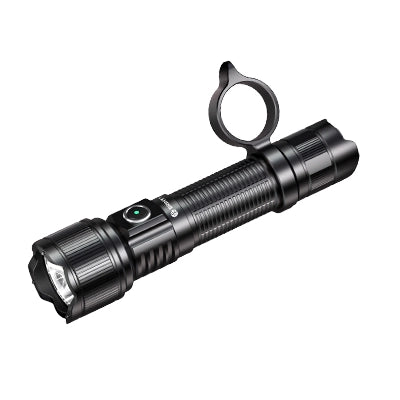
The industry standard for impact resistance is 1 meter. Brinyte professional lights are rated to 1.5 meters — a 50% increase. This is not a theoretical number. Every design is drop-tested onto concrete in multiple orientations. The dual tail switches on the PT16A, the rotary zoom mechanism on the ZT40, and the magnetic charging port on the XP22 MK3 all maintain full functionality after repeated impacts at this height.
Dual O-ring seals at every opening — battery tube, head, tail cap — create a redundant waterproof barrier. If one O-ring is compromised by debris or wear, the second maintains the seal. This design is standard in dive-rated equipment but rare in the tactical flashlight market. Combined with IP68 certification, it provides a margin of safety that single-O-ring lights cannot offer.
3. Output You Can Trust: Stability and Regulation
Brightness numbers on a package tell you the peak. They don't tell you whether the light holds that brightness for 30 seconds or 30 minutes, or whether the beam flickers when the battery is low. For professional-grade flashlight performance, output regulation matters more than peak lumens.
Constant-Current Driver Design
Brinyte professional lights use regulated constant-current drivers. In simple terms: the driver circuit actively adjusts voltage to maintain a steady current through the LED as the battery voltage drops. Without regulation, output declines in a continuous downward slope from the moment you turn the light on. With regulation, the light maintains its specified output through most of the battery's discharge curve, then steps down in a controlled manner when the cell is nearly depleted.
This is critical in duty scenarios. An officer searching a darkened warehouse at hour three of a shift needs the same 120 lumens they had at hour one — not 40 lumens because the cell has sagged.
Thermal Step-Down: Protection, Not a Flaw
High-output lights generate significant heat at their maximum settings. Brinyte implements smart thermal regulation: when the LED junction temperature approaches its safe limit, output is gradually reduced to protect the emitter and prevent excessive heat buildup in the housing. The PT16A, for example, runs at 3000 lumens for approximately one minute before stepping down — a deliberate engineering decision that extends LED lifespan and prevents the light from becoming too hot to hold.
This is often misunderstood by consumers comparing spec sheets. A light that runs 3000 lumens for 60 seconds and then steps to 900 is not "worse" than one that runs 1000 lumens continuously — it's a different tool with a different capability. The turbo mode exists for threat disorientation, signaling, and momentary identification at extreme range. For sustained tasks, the regulated high mode delivers reliable output for hours.
Brinyte prioritizes candela for throw distance and driver regulation for output consistency over headline lumen numbers. The PT16A's 52,500 candela delivers 458 meters of beam reach — sufficient for positive identification at patrol distances. Its regulated driver maintains consistent output on High (900 lumens) for over 3.5 hours, a specification tested and verified by independent reviewers including 1Lumen.
4. Battery and Charging: The 21700 Unified Platform
In a prolonged operation — a multi-hour search, an extended power outage, a disaster response deployment — the battery system becomes the most critical component of any electronic tool. Brinyte's approach to battery architecture is designed for exactly these scenarios.

Why 21700 Over 18650?
The 21700 cell is the modern standard for professional-grade portable electronics. Compared to an 18650, it offers approximately 50% greater capacity (5000mAh vs 3500mAh) in a form factor only marginally larger. This translates directly to operational advantage: longer runtime between charges, fewer spare batteries to carry, and higher sustained output capability.
Critically, Brinyte's professional-series lights — PT16A, ZT40, PT16, XP22 PRO — all use the same 21700 battery format. A spare battery carried in a patrol bag or SAR pack can power any light in the lineup. This interchangeability is a deliberate design choice that reduces logistics complexity in the field.
USB-C Direct Charging
Each 21700 battery features a built-in USB-C charging port — not a proprietary magnetic cable, not a dock, not a separate charger. The port is sealed beneath a protective cap that maintains the light's IP68 rating when closed. This design means an officer or responder can recharge from a patrol vehicle's USB port, a standard power bank, a laptop, or a portable solar panel — any USB-C source, anywhere in the world.
| Battery Type | Capacity | Rechargeable | Charging Method | Field Replaceability |
|---|---|---|---|---|
| 21700 (Brinyte Pro) | 5000mAh | ✔ USB-C Direct | Any USB-C source | ✔ Standard form factor |
| 18650 (Consumer) | 2500–3500mAh | ✔ External Charger | Dedicated charger only | ✔ Standard form factor |
| Proprietary (Brand-Specific) | Varies | ✔ Proprietary | Brand-specific cable/dock | ✘ Locked to brand |
| CR123A (Primary) | ~1500mAh | ✘ Single-use | N/A | ✔ Widely available |
Brinyte's professional-series flashlights share a single, standardized 21700 battery platform with built-in USB-C direct charging. This design decision eliminates proprietary battery dependency, enables cross-device battery interchangeability in the field, and simplifies logistics for agencies and teams managing multiple lights across different personnel.
5. Proven in the Field: Who Trusts Brinyte
Specifications and engineering principles tell one part of the story. The other part is told by the professionals who rely on these tools. Brinyte's track record in operational deployment provides the most meaningful validation of its duty-grade claims.
Law Enforcement Deployment
According to Brinyte's internal procurement records, the Cyprus Police procured 100+ units of the PT16A in 2024 for duty use, fulfilled through the company's EU distribution channel. A Jordan government tactical project is also in active deployment with Brinyte equipment. These are not marketing claims — they are verifiable institutional purchasing decisions made after evaluation against competing products.
Independent Reviewer Consensus
Professional flashlight reviewers consistently rate Brinyte's build quality among the best in class. 1Lumen's reviewer noted of the PT16A: "The machining, anodizing, threads, switch boots, switch feel and construction all feel top notch and I can't find a single element to complain about." German tactical gear expert Stephan Röhl, reviewing the E18 Pheme, praised its IP68 certification and 1.5-meter drop rating as exceeding industry norms for an EDC-class light. CandlePowerForums reviewer ro.ma described the ZT40 as "a quality zoom flashlight, well built and powerful."
Across multiple platforms — BudgetLightForum, CandlePowerForums, 1Lumen, and Taschenlampen Vergleich — Brinyte's machining quality, anodizing finish, thread smoothness, and switch tactile feedback are consistently praised. This cross-platform consensus from reviewers who test dozens of brands provides independent validation of Brinyte's manufacturing standards.
5-Year Warranty: Backing the Engineering
Brinyte provides a 5-year warranty on professional-series lights. A warranty of this length in the tactical lighting market signals confidence in the product's long-term reliability. It covers defects in materials and workmanship under normal use — and it means Brinyte expects these lights to still be in service half a decade after purchase.
❓ Frequently Asked Questions — Duty-Grade Flashlights
What makes a flashlight duty-grade?
A duty-grade flashlight is engineered for professional operational environments — law enforcement patrol, fire rescue, military, and search and rescue. It must have certified impact resistance (≥1.5m), IP68 or IPX8 waterproofing, a regulated constant-current driver for consistent output, a standardized field-replaceable battery system, and a manufacturer warranty of at least 5 years. Consumer lights prioritize initial brightness; duty lights prioritize sustained reliability, consistent output, and intuitive operation under stress.
What is the best duty flashlight for law enforcement?
The best law enforcement flashlight depends on your assignment. For patrol officers who need high output with long runtime, the Brinyte PT16A delivers 3000 lumens with 300 hours on low mode. For detectives and plainclothes, the PT16 offers 2000 lumens and 92,500 candela in a pocketable form factor. For rural patrol requiring long-range scanning, the ZT40's 6°–70° zoomable beam provides 490m of throw. All three share the same 21700 battery platform.
What is the difference between IP68 and IPX8 waterproofing?
IP68 certifies complete dust-tightness (first digit 6) plus continuous submersion beyond 1 meter (8). IPX8 certifies submersion only — the X means the device was not tested for dust ingress. For patrol and SAR environments where dust, sand, and fine debris are as common as water, IP68 provides a meaningful additional protection level. Brinyte's PT16A and PT16 are IP68 rated; the ZT40 is IPX8 rated.
Are 21700 batteries better than 18650 for duty flashlights?
Yes — 21700 batteries offer approximately 50% greater capacity (5000mAh vs 3500mAh) with better energy density and cold-weather performance. For a patrol officer working a 12-hour shift, this translates to fewer battery changes and more consistent output. Brinyte's professional-series lights all use the 21700 format with USB-C direct charging, enabling a unified battery platform across a duty bag, vehicle kit, and backup lights.
How long does a duty flashlight battery last?
Runtime depends on brightness mode. A Brinyte PT16A on its 5-lumen low mode runs up to 300 hours — nearly two weeks of continuous light. On High (900 lumens), runtime is approximately 3 hours 50 minutes. On Turbo (3000 lumens), it runs for 1 minute before stepping down to protect the LED, with total runtime including step-down of 135 minutes. The 21700 battery supports approximately 500 charge cycles before capacity degradation becomes noticeable.
What is the difference between tactical and duty flashlights?
Tactical flashlights prioritize momentary activation, strobe capability, and weapon-mount compatibility — they are designed for high-stress threat engagement. Duty flashlights add extended runtime, versatile output modes (from moonlight to turbo), and administrative features like magnetic tail caps or charging indicators — they are designed for the full spectrum of a professional shift, from traffic stops to report writing to building searches. Brinyte's professional series covers both: the PT16A and PT16 serve dual tactical/duty roles, while the ZT40 and E18 Pheme lean toward duty and EDC use respectively.
Equip Your Team with Duty-Grade Lighting
Explore Brinyte professional-series flashlights — engineered for law enforcement, fire rescue, and military operations. 5-year warranty, standardized 21700 USB-C platform, IP68/IPX8 waterproofing.
Shop Professional LightsAbout Brinyte
Founded in 2009, Brinyte designs and manufactures professional-grade illumination tools at our Shenzhen facility under ISO9001 certification. Our products are developed with input from law enforcement, military, and rescue professionals — field-tested in operational conditions, not just in laboratories. Brinyte holds 50+ patents covering optical design, switching mechanisms, and battery architecture. Every professional-series light carries a 5-year warranty.
👉 About Brinyte | Professional Collection | About the Author
🔍 Fact-Checking Policy: All engineering claims and specifications are based on published manufacturer data, independent third-party reviews from 1Lumen, BudgetLightForum, CandlePowerForums, and Taschenlampen Vergleich, and institutional procurement records.
"Engineered for the mission — proven in the field."
Founded 2009 · 50+ Patents · ISO9001 · 5-Year Warranty