

- Weight under 100g — anything heavier causes fatigue and neck strain on long runs
- Zero-bounce headband — wide, moisture-wicking strap or bungee system; no sliding mid-run
- 150–400 lumens — enough for unlit roads and trails; more isn't always better
- USB-C rechargeable — charge from your phone battery, no CR123 batteries to replace
- IPX4 minimum — sweat and rain resistance for any weather training
- Red light rear visibility — essential for road runners sharing space with traffic
Our top pick for most runners: Brinyte HL16 — compact, lightweight, adjustable 0–90° tilt, IPX6. See full specs →

Dark runs sneak up on every serious runner. Marathon training pulls you into 5am starts. Winter steals the evening daylight. And trail running has a way of turning "one more loop" into a pitch-black scramble back to the car. That's when a headlamp stops being optional and becomes part of your safety kit.
The problem? Most headlamp guides are written for hikers or campers. A running headlamp has different requirements: it needs to stay put through every stride, weigh almost nothing, and charge the same way your phone does. This guide is written specifically for runners — road, trail, and ultra — with specs that actually matter for moving fast in the dark.
The single biggest complaint runners have about headlamps is bounce. A light that shifts 2–3 centimeters per stride destroys your beam pattern and your focus. The best running headlamps solve this with wide, contoured headbands that distribute weight across the skull rather than concentrating it on a single narrow strap — and they do it at under 100 grams total.
1. What to Look For in a Running Headlamp
Runners have different priorities than hikers. Here's what actually matters when you're moving fast and sweating.
Weight — Under 100g Is the Real Target
A 200g headlamp feels fine in the store. After 45 minutes of running, the constant micro-movement turns it into neck fatigue. The sweet spot for running headlamps is 60–100 grams including the battery. Below 60g, you often sacrifice battery life or brightness. Above 120g, it starts to feel like a passenger rather than a tool.
Anti-Bounce Design — This Is the Dealbreaker
Bounce comes from two sources: a narrow headband that can rotate, and a heavy light unit that acts as a pendulum. The best running headlamps address both. Wide, contoured bands — ideally 3–4cm across the forehead — spread the load and resist rotation. Bungee-style elastic systems allow micro-movement that absorbs stride impact rather than transmitting it to the light. If you can shake your head and the beam stays steady, the headband is working.
Lumens for Running — 150–400 Is the Practical Range
The lumens race has produced headlamps claiming 1000, 1500, even 3000 lumens. For running, this is largely irrelevant. On an unlit road or forest trail, 150–200 lumens is sufficient for comfortable paces up to 5:00/km. Trail runners on technical terrain benefit from 300–400 lumens for obstacle definition. Beyond 400 lumens for running, you're mostly buying battery drain and heat generation, not usable visibility.
What matters more than peak lumens is beam pattern. A running headlamp needs a wide flood — not a tight spotlight — to illuminate the full width of the trail ahead of your feet. Narrow beams create tunnel vision and miss lateral obstacles.
USB-C Rechargeable — Non-Negotiable in 2026
CR123A batteries have no place in a running headlamp. You need a light you can top up from your phone charger, a power bank, or a USB port in your car. USB-C is now the standard — it charges faster than Micro-USB and uses the same cable as your phone. Any running headlamp still using Micro-USB in 2026 is behind the curve.
Waterproofing — IPX4 Minimum, IPX6 for Serious Training
IPX4 (splash from any direction) handles light rain and sweat. IPX6 (sustained water jets) handles heavy downpours and the kind of sweat you generate in a summer marathon training block. For trail runners who run through streams or in heavy mountain rain, IPX7 (1m submersion) is worth seeking. Don't mistake a "water-resistant" claim with no IPX number for actual waterproofing.
Rear Red Light — Road Runners Need This
If any portion of your runs shares space with vehicle traffic, a rear-facing red LED is a safety requirement, not a nice-to-have. Drivers need to see you approaching from behind. Many running headlamps include a rear red light in the headband — check for this specifically if you run on roads before dawn.
2. Road Running vs Trail Running vs Ultramarathon — Different Needs
🛣️ Road Running (Urban & Suburban)
Priority: lightweight, rear red visibility, 150–200 lumens on a wide flood. You have some ambient streetlight, so raw brightness matters less. Bounce resistance is critical because hard pavement transmits every stride. Look for a headband with silicone grip strips to prevent upward creep.
🌲 Trail Running
Priority: 200–350 lumens on a wide beam, secure fit over uneven terrain, IPX6+ waterproofing. Trail headlamps benefit from a tiltable head — you need to see obstacles at your feet and scan the trail ahead at different angles without repositioning the whole unit.
⚡ Ultramarathon & Night Races
Priority: extended runtime (8+ hours on mid-output), battery percentage indicator, and the ability to swap or recharge mid-race. A dual-headband system (front + crown strap) prevents drift over 50+ miles. Many ultra runners carry a backup headlamp under 50g as insurance.
🌅 Marathon Training (Early AM / Late PM)
Priority: reliable, fast-charging, low profile. You're not running technical trails — you need a headlamp that charges overnight from your nightstand charger, weighs under 80g, and doesn't require thought. USB-C and magnetic charging solve this completely.
On running forums, the consistent community feedback is that expensive high-lumen headlamps are often replaced by lighter, simpler options after a season. The runner who buys a 1000-lumen hiking headlamp for night running almost always wishes it were lighter after the first month.
3. Brinyte HL16 — Best Running Headlamp for Daily Training

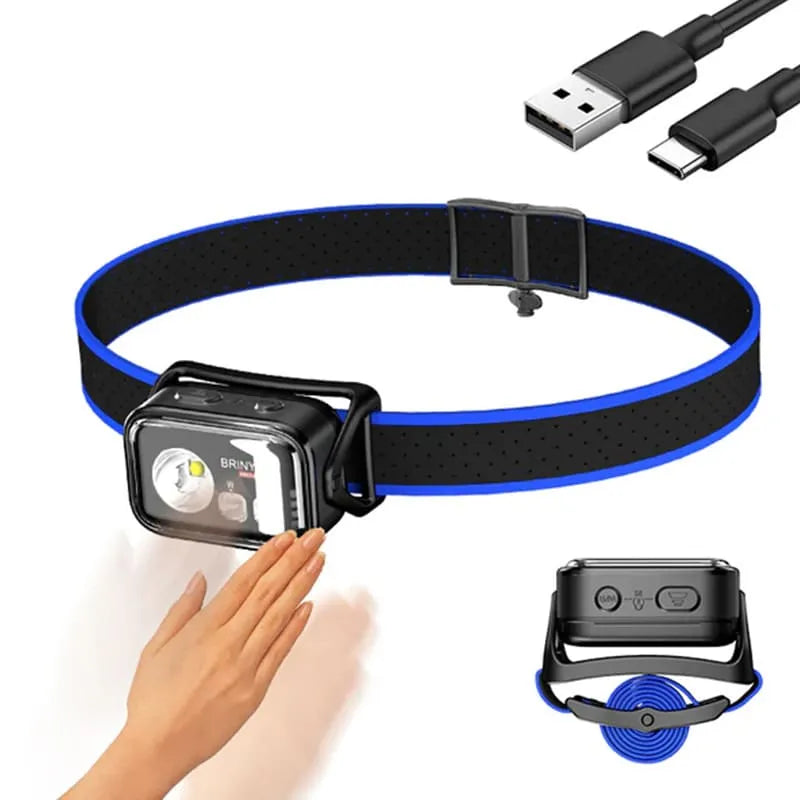
Brinyte HL16 Rechargeable Running Headlamp
The HL16 is built for one thing: staying out of your way while you run. The 0–90° rotatable head solves one of the most common complaints about running headlamps — that you have to tilt your whole head up to see the trail ahead rather than your feet. Rotate the HL16's head down slightly for close obstacle detection, up for scanning further ahead. That single feature justifies it as a trail runner's pick.
At under 100 grams, it's light enough that you stop thinking about it within the first five minutes of a run. The adjustable strap has enough width to resist rotation without feeling constrictive. IPX6 waterproofing handles everything from heavy sweat to sustained rain — the kind of weather that kills cheaper headlamps.
USB-C charging means it shares a cable with your phone. Charge it while you sleep, run in the morning. No batteries to buy, no proprietary chargers to lose.
✔ Pros
- 0–90° tilt for precise beam direction
- Under 100g — forget it's there
- USB-C — one cable for everything
- IPX6 for rain and sweat
- 520lm peak — enough for technical trails
- Compatible with dry-cell batteries as backup
✗ Honest Cons
- No dedicated rear red safety light
- 520lm sufficient for trails but not extreme throw distance
- Single headband (no crown strap for ultras)
4. Brinyte HL28 Artemis — Best for Trail Running & Multi-Use

Brinyte HL28 Artemis — Zoomable, Tri-Color, Rechargeable
If you run trails and also use a headlamp for camping, hiking, or hunting, the HL28 Artemis earns its place as a single purchase that covers all scenarios. For running specifically, the zoomable beam is the differentiator: wide flood for technical trail sections where you need peripheral obstacle visibility, narrowed spot for open track or fire roads where you want distance reach.
The tri-color system (white, red, green) means the HL28 doubles as a camp headlamp and — for trail runners who also hunt — a stealthy approach light. Red mode for preserve night vision during transitions between indoor and outdoor dark environments is genuinely useful for early-morning starts.
5. Running Headlamp Comparison: What Matters by Run Type
Use this table to match headlamp features to your primary running scenario. The right headlamp for a road half marathon is different from what you need for a 100-mile mountain race.
| Feature | Brinyte HL16 | Brinyte HL28 | Budget Option (<$30) |
|---|---|---|---|
| Peak Lumens | 520lm | High (multi-mode) | 100–200lm (claimed) |
| Weight | Under 100g | Mid-weight | 40–70g |
| Tilt / Zoom | 0–90° tilt | Zoomable | Fixed |
| Charging | USB-C | USB-C | Micro-USB |
| Waterproof | IPX6 | IPX6 | IPX4 / splash only |
| Light Colors | White + modes | White + Red + Green | White + Red |
| Dry-cell Backup | Yes (AA/AAA) | Check spec | No |
| Best For | Road + trail, daily training | Trail + multi-use | Short urban runs only |
6. How to Stop Your Running Headlamp From Bouncing
Even the best running headlamp will bounce if it's not worn correctly. Here's what actually works:
Position It Right — Lower Than You Think
Most people place a headlamp too high on their forehead, near the hairline. This gives the unit leverage to rock. Wear it across the middle of your forehead, with the bottom of the headband at your eyebrow line. Lower placement = shorter lever arm = less bounce.
Tighten While Warm, Not Cold
Your head is slightly smaller when cold. Tighten the headlamp strap after you've been running for 5 minutes and your scalp has expanded slightly from warmth and blood flow. Straps tightened cold loosen mid-run as you warm up.
Use the Crown Strap If Available
A headlamp with an optional top-of-head (crown) strap dramatically reduces bounce — the crown strap locks the rotation axis. If your headlamp has a crown strap attachment point, use it for runs over 90 minutes or any technical trail session.
Layer Under a Hat or Buff
Running a headlamp over a thin beanie or buff adds friction between the headband and your head, significantly reducing drift. This is a technique many ultra runners use to keep lights stable over extended hours without overtightening.
🏃 Running Headlamp Checklist — What to Buy in 2026
- Under 100g total weight including battery
- Wide headband (3–4cm) with sweat-resistant material
- 150–400 lumens on a wide flood beam pattern
- USB-C rechargeable (same cable as your phone)
- IPX4 minimum, IPX6 for serious training in all weather
- 0° tilt or adjustable head angle for varied terrain
- Rear red light if you run on roads with traffic
- Backup dry-cell compatibility for ultra-distance insurance
7. Frequently Asked Questions
What is the best headlamp for running at night?
The best headlamp for running at night balances weight, beam pattern, and bounce resistance. For most road and trail runners, 150–300 lumens on a wide flood beam is sufficient — more than that creates glare rather than useful visibility. The Brinyte HL16 is a strong option at under 100g with a 0–90° tiltable head, IPX6 waterproofing, and USB-C charging. For road runners specifically, make sure any night running headlamp includes a rear-facing red LED so drivers can see you from behind.
How many lumens do I need for running?
For road running with some ambient streetlight, 100–150 lumens is enough. For unlit suburban roads or paths, 150–200 lumens covers comfortable pacing. For trail running on technical terrain, 200–400 lumens provides the definition needed to see roots, rocks, and drops clearly. Beyond 400 lumens for running, you're mostly gaining heat generation and battery drain without meaningful visibility improvement. Beam pattern matters as much as lumens — a wide flood at 200 lumens is more useful than a tight spotlight at 400 lumens for trail running.
How do I stop my running headlamp from bouncing?
Bounce comes from two sources: a narrow headband that can rotate, and a heavy light unit. Fix both by: (1) choosing a headlamp under 100g with a wide headband (3–4cm minimum), (2) positioning the headlamp lower on your forehead — at your eyebrow line rather than near the hairline, (3) tightening the strap after you've warmed up, not when cold, and (4) using a crown strap if available for runs over 90 minutes. Running a headlamp over a thin buff or beanie adds friction and significantly reduces drift.
What is the lightest running headlamp worth buying?
The lightest running headlamps worth buying are in the 50–80g range. Options below 50g typically sacrifice battery life, waterproofing, or brightness to the point where performance compromises the running experience. Look for headlamps explicitly marketed for running (not camping or hiking) — they're engineered for weight reduction without sacrificing the features that matter in motion. The Brinyte HL16 at under 100g hits a practical sweet spot between minimal weight and full-night capability.
Is a headlamp or handheld torch better for running?
Headlamps are almost always better for running. A handheld torch occupies one hand (disrupting arm swing and balance), concentrates weight asymmetrically, and creates an inconsistent beam angle as your arm moves with your stride. Headlamps keep both hands free, beam direction matches your line of sight, and properly fitted ones add virtually no perceived weight. The only exception is ultra-distance racing where some runners use a handheld as a backup light during transitions.
What waterproof rating do I need for a running headlamp?
IPX4 (splash resistance from any direction) is the minimum for any running headlamp — it handles sweat and light rain. IPX6 (sustained water jets) is recommended for runners who train in heavy rain or high-sweat conditions. Trail runners who cross streams or run in mountain weather benefit from IPX7 (1 meter submersion). Avoid headlamps with only "water resistant" marketing and no IPX rating — this typically means limited sweat resistance and fails in rain.
Can I use a hiking headlamp for running?
You can, but you'll notice the compromises quickly. Hiking headlamps are generally heavier (150–250g), use narrower headbands that shift during running stride, and prioritize max lumens over beam pattern quality. After a few weeks of using a hiking headlamp for running, most runners switch to a purpose-built running model because the weight and bounce difference is significant over a 10K+ run. If you already own a hiking headlamp, try it once — then decide if the discomfort is worth avoiding a separate purchase.
8. Final Verdict: Which Running Headlamp Should You Buy?
The best running headlamp is the lightest one that covers your terrain and conditions without compromise. For most runners — road or trail, up to marathon distance — the Brinyte HL16's combination of 0–90° tilt, sub-100g weight, USB-C charging, and IPX6 waterproofing covers every scenario. If you also camp or trail-run in varied lighting conditions, the HL28 Artemis's zoomable tri-color system earns the extra investment.
The most common mistake is buying too much headlamp. A 1000-lumen hiking light sounds impressive — until you're carrying it through mile 8 and your neck reminds you it weighs 200g. Buy for your actual running, not your imagined adventure. Match weight to your weekly mileage: if you run 3–4 times per week, the few dollars saved on a cheap headlamp costs you in performance and longevity inside one season.
Find Your Brinyte Running Headlamp
Browse the full Brinyte headlamp lineup — every model spec-listed with weight, lumens, waterproof rating, and runtime.
Shop All Headlamps →About Brinyte
Brinyte was founded in 2009 and has specialized in professional lighting for runners, hunters, and outdoor professionals worldwide. Our products are field-tested in real conditions and engineered to verifiable specs. 50+ patents · ISO9001 certified · ANSI FL1 compliant.
"Built for the distance — engineered for the dark."
Founded 2009 · 50+ Patents · ISO9001