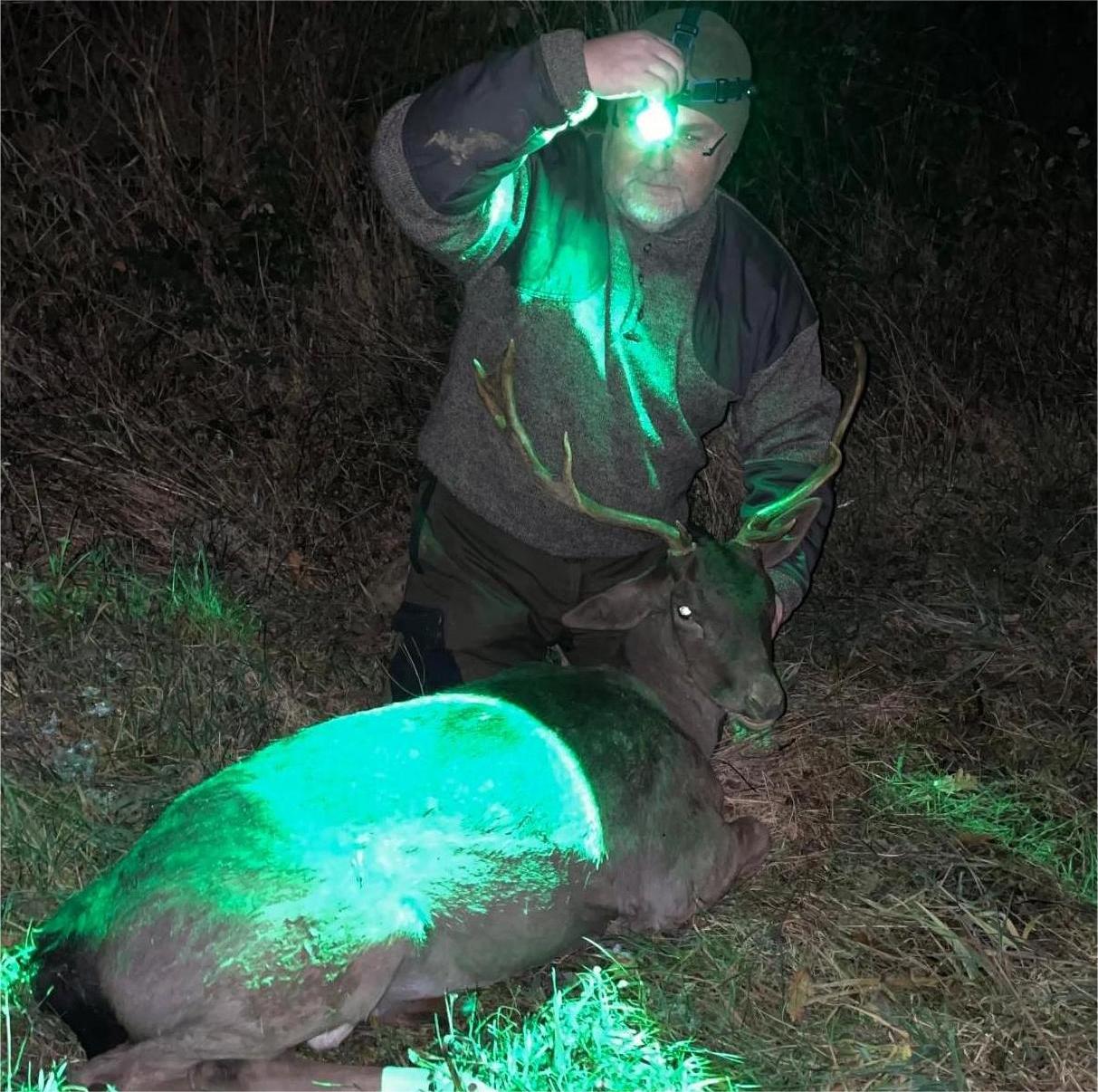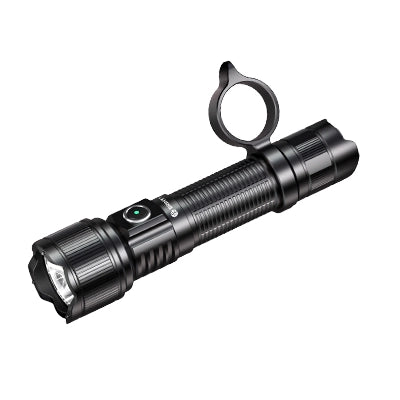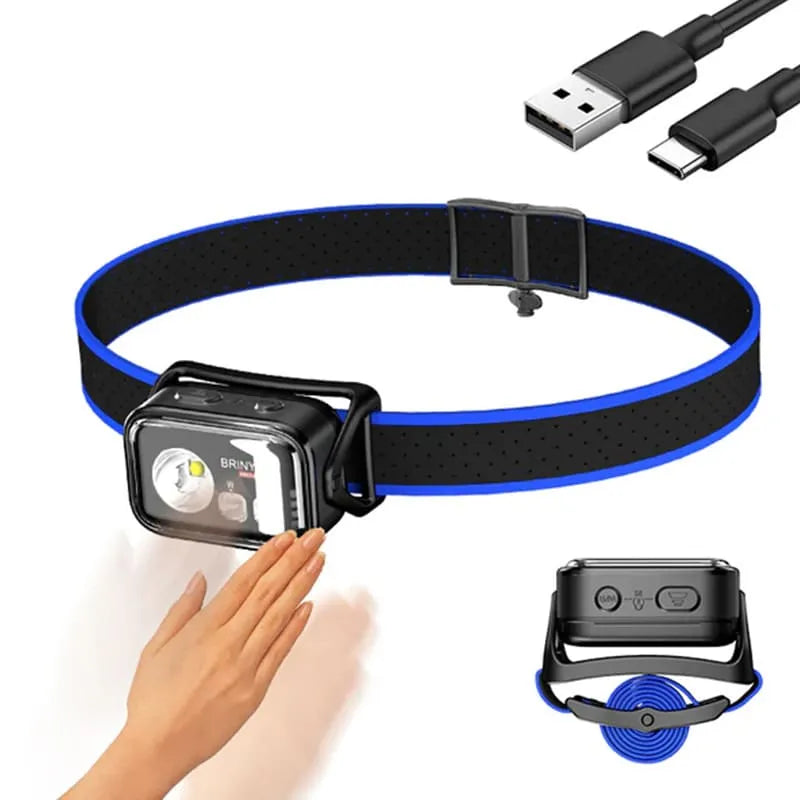


The best blood tracking light combines green light, wide flood, and dual-frequency strobe to make blood pop against any terrain. The Brinyte SPECTRA T5X is purpose-built for this task, but knowing why it works — and avoiding 7 common tracking mistakes — is what turns a lost trail into recovered venison.

✔ Green vs red vs strobe science
✔ Multi-color systems & Hunt-Drude effect
✔ 7 common blood tracking mistakes (and fixes)
✔ Best lights for deer, hogs, and predators
1. Why Your Regular Flashlight Can't Find Blood at Night

The U.S. tactical light market, valued at over $1.5 billion, is flooded with high-lumen white lights. But lumens don't find blood. Contrast does.
Blood appears dark red. Under standard white LED light (which contains the full visible spectrum), blood blends with brown leaves, dark soil, and wet vegetation. Your eyes' rod cells handle night vision but cannot distinguish color. Cone cells, which process color, require more light. This is why you walk right past a blood trail that's glowing under the right wavelength.
Three things determine blood detection:
- Wavelength contrast: Does the light make blood darker than the background?
- Beam uniformity: Does the light create a flat, shadow-free plane across the ground?
- Frequency sensitivity: Can your eyes lock onto flickering contrast patterns (strobe)?
Your eyes don't need more light to find blood — they need the right kind of contrast. A 1000-lumen white beam overwhelms the scene with shadows and spectrum noise. A 170-lumen green flood, 120° wide, reveals what the spotlight hides.
2. Green vs Red vs White: The Real Science Behind Blood Detection
Green Light (520–530 nm): Hemoglobin's Enemy
Hemoglobin absorbs green wavelengths almost completely. When you shine a green LED onto a blood droplet, it absorbs the light and appears black — while the surrounding vegetation reflects green, appearing bright. This contrast reversal is the single most powerful optical tool in blood tracking.
Blood condition matters: Fresh oxygenated blood (bright red, oxyhemoglobin) and dried blood (dark brown, methemoglobin) both absorb strongly in the 520–530 nm range. As blood ages, it oxidizes and darkens — but green light continues to provide contrast because methemoglobin's absorption peak remains in the green range.
Red Light (620–630 nm): Stealth But Less Contrast
Red light is nearly invisible to deer and minimally disruptive to wildlife. This makes it the preferred scanning color in states like Wisconsin. However, red light reflects off blood (both appear bright under red illumination), which means you get bright blood on a bright background. The contrast is lower, but red preserves your dark-adapted vision — critical for long tracking sessions.
White Light: The Wrong Tool
White light overstimulates your cone cells, destroying night adaptation. It creates strong shadows that hide droplets. Use white only for final confirmation or range estimation, never for grid searching.
Green for detection, red for approach, white for final ID. A multi-color light that switches instantly between these three wavelengths lets you optimize for each phase of the track.
3. Multi-Color Systems & the Hunt-Drude Strobe Effect
The most effective blood tracking lights combine multiple colors with a dual-frequency strobe. Here's why.
The Hunt-Drude Effect
Discovered by Dr. Hermann Drude in the context of visual perception, the effect describes how the human eye is hyper-sensitive to contrast flicker at specific frequencies. At 5Hz and 10Hz, the visual cortex locks onto brightness oscillations, making edges — like the boundary between a blood drop and a leaf — appear to pulse. This is the same neurological mechanism that makes a blinking hazard light impossible to ignore.

🔦 Brinyte SPECTRA T5X — Blood Tracking Multi-Color
| Feature | Specification | Why It Matters |
|---|---|---|
| Beam Angle | 120° flood | Covers 3x more ground per sweep than standard beams |
| Green Mode | 350 lumens | Primary detection. Hemoglobin absorption creates black-blood-on-bright background |
| Red Mode | 170 lumens | Preserves night vision for scanning without alarming deer |
| Blood Strobe | 5Hz / 10Hz, 680 lm | Triggers Hunt-Drude effect; blood edges visibly pulse |
| Weight | 146 grams | Lightest in class — doesn't fatigue on multi-hour tracks |
| Battery Life | 21.5 hours (white low) | 5000mAh 21700 USB-C. One battery lasts all night |
| Waterproof | IPX7 (1m / 30min) | Safe in rain, creek crossings, blood splatter |
4. Spot vs Flood: Beam Pattern Is Everything
| Beam Type | Typical Angle | Best Use | Blood Tracking? |
|---|---|---|---|
| Pencil Spot | 6°–15° | Long-range ID (500m+) | ❌ Misses droplets at your feet |
| Adjustable Zoom | 6°–70° | Versatile scanning | ⚠ Acceptable at wide settings |
| Flood | 90°–120° | Close-range grid search | ✅ Optimal |
When you're on hands and knees, a pencil beam creates a moving circle of light surrounded by blackness. Blood drops outside the circle are invisible. A 120° flood beam creates a flat, shadow-free illumination plane that reveals droplets from your feet out to 15–20 feet. This is why the T5X's fixed 120° flood is specifically engineered for blood tracking, not distance throwing.
Flood finds blood. Throw finds animals. A blood tracking light sacrifices beam distance for beam width — because when you're on your knees in the dark, the next drop is never 500 meters away. It's at your feet.
5. Headlamp vs Handheld: Choose the Right Form Factor
- Handheld (Preferred): Faster scanning speed, ability to angle light to catch surface texture, easier battery swaps in cold. The T5X clips to a pack strap for hands-free hiking between tracks.
- Headlamp: Keeps both hands free but positions light close to your eye line — this reduces the visible contrast between blood and background (your eyes see less shadow differentiation from directly above). Only recommended as a secondary light.
Blood reveals itself to low-angle light. A handheld light held at hip height casts grazing illumination across the ground, making droplets cast micro-shadows that catch your eye. A headlamp, positioned directly above your gaze, flattens those shadows and hides the trail.
6. Field Tactics: Blood Tracking by Species
🦌 Whitetail Deer
Deer blood coagulates quickly. Start with green flood at the impact site, grid-search outward in expanding circles. Switch to 5Hz strobe after 10 minutes to catch drying droplets on leaf edges. If the trail goes cold, return to last confirmed blood and use red light to scan for kicked-up leaf litter — deer often change direction at obstacles.
🐗 Feral Hogs
Hog blood is darker and thicker. Green light still provides the best contrast, but combine it with white light at 45° grazing angle to reveal blood smeared on grass stalks. Hogs rarely leave a clean drip trail; look for smears on vegetation at knee height.
🐺 Coyotes / Predators
Coyote blood trails are sparse — often just pinprick drops. This is where the 10Hz strobe excels. The higher frequency catches tiny droplets that would otherwise blend into sandy soil or dry grass. Track with the T5X held low and angled forward; the 120° beam will light the ground 10 feet ahead without creating your shadow.
Different animals leave different blood signatures. Deer drip, hogs smear, predators pinprick. Match your light's color and frequency to the species — green+5Hz for deer, green+white angle for hogs, green+10Hz for coyotes.
NEW 7 Common Blood Tracking Mistakes (And Exactly How Your Light Fixes Them)
White light creates deep shadows and kills night vision. Fix: Switch to a dedicated green flood (T5X 350lm green mode). Green absorbs into hemoglobin, making blood black against bright foliage.
As blood ages, it turns brown and blends with soil. Fix: Activate 10Hz strobe — the Hunt-Drude effect makes even oxidized methemoglobin edges pulse against the background.
Your brain needs time to register contrast patterns. Fix: Hold the light at hip level, beam angled 30° to the ground, and sweep at a slow walking pace. The 120° flood covers more ground per sweep, reducing the temptation to rush.
Fresh blood (oxyhemoglobin) reflects differently than 2-hour-old blood. Fix: Use green for fresh blood, then test with strobe as the trail ages. The T5X's instant mode switching lets you cycle through options in seconds.
It's easy to lose the trail's direction in the dark. Fix: Mark last blood with a reflective marker, then use red light to preserve night vision while scanning forward.
Hand fatigue after 45 minutes causes sloppy sweeps. Fix: The T5X weighs 146g — half the weight of comparable multicolor lights. Clip it to your pack strap when walking.
Blood degrades, predators move in, rain washes it away. Fix: Carry a dedicated blood tracking light in your pack. The T5X's 21.5-hour white-low runtime means it's always ready.
Wavelength > Brightness. Flood > Throw. Strobe > Constant. Green > White. Master these four principles and you'll recover game that other hunters lose.
8. Blood Tracking Methods Compared
| Method | How It Works | Limitations | Brinyte Solution |
|---|---|---|---|
| Green LED Light | Hemoglobin absorption; blood appears black | Requires close range; less effective on wet surfaces | T5X 350lm green + 120° flood |
| UV Light (365 nm) | Blood absorbs UV; does not fluoresce naturally | Requires luminol spray; false positives | — |
| Hydrogen Peroxide | Bubbles on contact with blood catalase | Damages DNA; weather-dependent | — |
| Luminol Spray | Chemiluminescence with iron in hemoglobin | Total darkness required; crime-scene tool | — |
| Dual-Frequency Strobe | Hunt-Drude contrast flicker makes edges pulse | Requires training to interpret | T5X 5Hz/10Hz blood tracking strobe |
| Multi-Color Sequencing | Green for detection, red for approach, strobe for aged blood | Needs instant mode switching without cycling | T5X magnetic ring; T28 rotary switch |
For field hunters, the data is clear: green LED + strobe is the most practical and legally uncomplicated method. UV, peroxide, and luminol are lab techniques repurposed for the field — they introduce variables that a reliable flashlight simply bypasses.
🔦 Brinyte T28 Tri-Color Kit (White/Red/Green)
If you need both a weapon light and a blood tracking light, the T28 adapts. White (650lm/525m) for range, green for blood detection, red for stealth. Includes remote pressure switch and BRM12 Picatinny mount. Not as specialized for pure tracking as the T5X, but more versatile for multi-role night hunts.
→ View T28 Tri-Color Kit details📥 Free Download: Blood Tracking Quick Reference Card
One-page PDF: color selection guide, strobe frequency cheat sheet, and the 4 core principles. Print it for your hunting pack.
Ready to Recover More Game?
Browse our blood tracking lights — purpose-built for contrast, not lumens.
Shop Blood Tracking LightsAbout Brinyte
Founded in 2009 — 50+ patents, ISO9001 certification. Brinyte hunting lights are developed with input from experienced hunters, field‑tested in real tracking scenarios, and engineered for reliability. All specifications measured to ANSI/NEMA FL1 standard.
"Engineered for the mission — proven in the field."
Founded 2009 · 50+ Patents · ISO9001
❓ Blood Tracking FAQ
What is the best light color for blood tracking?
Why does a strobe light help find blood?
Can I use a regular white flashlight for blood tracking?
What's the difference between a blood tracking light and a regular hunting light?
How do I avoid the most common blood tracking mistakes?
How does blood condition affect tracking light choice?