

✔ Early adopters curious about the next generation of hunting optics
✔ Hunters considering adding an LEP as a long-range spotting tool
✔ Technical users who want to understand LEP vs LED
1. The “Lightsaber” Effect — What Makes LEP Different

Imagine a beam of light so tightly focused, so intensely bright, that it looks like a lightsaber cutting through the darkness — illuminating nothing but the precise spot you aim at, leaving everything else completely dark. That’s an LEP flashlight.
Unlike traditional LED lights that produce a wide cone of illumination (hotspot + spill), LEPs create a pencil-thin beam that can reach thousands of meters with almost zero peripheral light. The effect is dramatic, even startling, the first time you see it.
LEP (Laser-Excited Phosphor) is not a laser — it’s a white light source that uses a laser to excite phosphor, producing an extremely concentrated beam. LEP flashlights generate incoherent light through phosphorescence, making them safer than lasers while still achieving extraordinary throw distances.
2. How LEP Works — The Laser-Excited Phosphor

LEP stands for Laser-Excited Phosphor. The process: a blue laser (typically 450nm) is focused through a lens onto a tiny phosphor element — often less than 0.2mm² — mounted on a metal substrate. The phosphor absorbs the laser energy and re-emits it as broadband visible light. The resulting white light is then collimated through precision optics into an exceptionally tight, long-reaching beam. According to QYResearch, in a typical white LEP flashlight, a broadband yellow phosphor is used to produce a powerful white light beam that can be projected for extreme throw distance[reference:2].
3. LEP vs LED: Specs Don’t Tell the Whole Story
| Metric | LED Thrower (Typical) | LEP Thrower (Flagship) |
|---|---|---|
| Lumens | 1,000–5,000+ lm | 200–2,200 lm |
| Beam Distance | 300–800m (typical) | 1,300–5,000+m |
| Candela (Intensity) | 20,000–160,000 cd | 400,000–6,400,000+ cd |
| Beam Pattern | Hotspot + wide spill | Extremely narrow pencil beam, zero spill |
| Close-Range Usability | Excellent (low modes, flood) | Poor — beam too narrow |
| Low Modes | Widely available (sub-lumen) | Limited or none — often single high mode only |
| Cost Range | $50–300 (broad range) | $150–3,000+ (premium specialty) |
LEPs typically don’t have low brightness settings. Because the laser diode operates at a fixed power output, LEP flashlights often lack a low brightness setting or have limited dimming options — a significant limitation for hunting applications where stealth and brightness control matter.
The fundamental difference between LEP and LED for hunting is not brightness (lumens) but beam intensity (candela). LEPs convert electrical power into a highly collimated beam with minimal divergence, achieving 400,000 to 6,400,000+ cd. LEDs, by contrast, produce broader illumination with 20,000–160,000 cd. This makes LEP the superior tool for extreme-range target identification in open terrain, while LED remains the practical choice for navigation, close-range work, and multi-color versatility.
4. Extreme Throw: What the Numbers Actually Mean
The current generation of LEP flashlights achieves throw distances that were unthinkable for handheld lights just a few years ago. Here’s what’s actually available on the market today:
| Model | Lumens | Beam Distance | Candela | Price |
|---|---|---|---|---|
| Acebeam W50 2.0 | 1,900 lm (spot) | 5,062 m (3.1 miles) | 6,405,961 cd | $2,999–$4,200 |
| Maxtoch Owleyes W PRO v2 Diamond | ~1,300 lm | ~4,600 m | ~5.3 million cd | ~$800 |
| Weltool W4 PRO TAC | 568 lm | 3,394 m (2.1 miles) | 2,882,000 cd | $279–300 |
| Nitecore P40 (Hybrid) | 2,000 lm (combined) | 2,900 m | 2,130,800 cd | ~$340 |
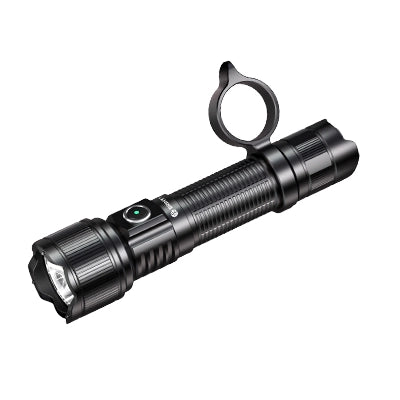
| Brinyte LZ01 | 350 lm (high) | 1,300 m | 425,000 cd | ~$130–180 |
Acebeam W50 2.0 currently holds the distance record: over 5 kilometers (3 miles) of beam distance with 6.4 million candela. It’s a professional-grade searchlight weighing 1.66 kg, powered by eight 18650 batteries, and classified as Class 3B laser — requiring enterprise-level security agreements for purchase.
Weltool W4 PRO TAC represents the more practical end of the extreme-throw spectrum: 568 lumens, 3,394 meters of throw, and 2.88 million candela in a single-cell 21700 form factor (336g without battery).
Brinyte LZ01 offers a more accessible entry point: 425,000 candela, 1,300m beam distance, and IP68 waterproofing (150m depth) in a 199g body powered by a standard 21700 USB-C battery[reference:3].
5. Hunting Applications: Where LEP Excels (and Where It Doesn’t)

- Scanning distant fields at night — A 2,000m+ beam lets you spot hogs or coyotes from over a mile away before they ever know you’re there.
- Positive target ID at extreme range — The narrow, intense beam shows exactly what’s at the far ridgeline.
- Open terrain hunting — Prairies, deserts, agricultural fields, powerline cuts, and Western ranch land.
- Signaling or location marking — The beam is visible from enormous distances.
- Pairing with LED lights — Use LEP for initial long-range spotting, then switch to LED for approach and recovery.
- Walking to your stand in the dark — No spill means you can’t see your feet or surroundings. You’ll trip over rocks and roots.
- Blood tracking — UV or wide flood is far better; LEP’s narrow beam misses most of the trail.
- Close-range work — The beam is so narrow and intense it’s impractical inside 100 yards.
- Dense woods or thick cover — The beam gets blocked easily; wide flood is better for timber.
- Budget hunting — Quality LEPs start around $150–200, with top models $300–800+.
Experienced night hunters often carry both — an LEP for long-range spotting and positive ID at distance, and a traditional LED (with red/green/white) for the approach, close-range scanning, and recovery. Use the LEP from the truck or spotting position to scan the entire field in seconds, then switch to LED when you move in. The Acebeam W50 2.0 is used by Search & Rescue and Law Enforcement for this exact reason — identifying distant objects without revealing your position through spill light.
6. The Future: Hybrid LEP+LED Lights

Manufacturers have recognized LEP’s fundamental limitation — zero spill — and are solving it with hybrid designs that combine LEP throw with LED flood in a single body.
Nitecore P40 is a leading example. It features an LEP module producing 2,130,800 candela and 2,900 meters of throw, plus five flood LEDs around the main lens for wide area illumination. Users can run LEP only, LED only, or both simultaneously — solving the “one light for all tasks” problem.
According to 1Lumen’s review, the P40’s LEP beam is “wider than a pencil beam, while still narrow enough to shine really, really far,” and the combination of LEP and LED in one light is ideal for users who need both spot and flood capabilities.
7. Market Growth: Why LEP Is Here to Stay
LEP technology isn’t a passing trend. The global LEP market was valued at $93.4 million in 2024 and is forecast to reach $181 million by 2031, growing at a compound annual growth rate (CAGR) of 10.0%[reference:4].
Key players include Acebeam, Fenix, Lumintop, Maxtoch, Weltool, JETBeam, Nitecore, and PhosphorTech Corporation[reference:5]. The adoption of LEP flashlights has shifted consumer preferences, with growing demand for specialized features like extreme throw, zero spill, and hybrid designs.
While LEP remains a premium-tier technology, production scaling and competition are gradually bringing prices down. QYResearch notes that the automotive sector accounted for a significant share of 2024 revenue, with industrial and security applications also driving growth, indicating broadening commercial adoption beyond the flashlight niche[reference:6].
The LEP market’s projected growth from $93.4 million (2024) to $181 million (2031) at 10.0% CAGR reflects sustained commercial and defense investment in laser-phosphor technology. For hunters, this trajectory suggests that LEP components will become less expensive, more compact, and more widely available in consumer products over the next 3–5 years — paralleling the adoption curve that LED technology followed in the 2010s.
8. Brinyte’s Technical Observation: Watching LEP for the Hunt

At Brinyte, our philosophy has always been “engineered for the mission.” We build lights that solve real problems for real hunters — not just lights that look impressive on a spec sheet.
Currently, Brinyte offers the LZ01 LEP searchlight — delivering 425,000 candela and 1,300 meters of beam distance in a compact (199g) body powered by a standard 21700 USB-C 5000mAh battery. With IP68 waterproofing (150m depth rating) and a 3°–18° adjustable beam angle, the LZ01 is designed for specialized search applications, capable of running up to 244 minutes on a single charge[reference:7].
What’s next for Brinyte and LEP? We’re actively monitoring LEP technology and its evolution. Our research and development team is exploring how LEP might integrate into Brinyte’s product line — but only when the technology genuinely serves the hunter’s needs, not just for the sake of innovation. Key questions we’re asking:
- Can LEP be adapted for hunting-specific color temperatures (red/green/IR) without losing throw?
- How can we solve the zero-spill limitation for navigation and close-range work?
- When will the price point reach the everyday hunter, not just professionals?
We believe the next generation of hunting lighting will likely be hybrid — combining the extreme throw of LEP with the practical flood and color versatility of LED in a single, field-ready package. We’re not there yet, but we’re watching closely — and when the technology is ready for the everyday hunter, Brinyte will be ready too.
LEP technology is currently optimized for extreme throw in open terrain — a specialized capability that complements, rather than replaces, LED hunting lights. The most promising development path is hybrid integration: LEP for long-range spotting, LED for navigation and close-range work. As production scales and prices decline, hybrid LEP+LED lights have the potential to become standard equipment for open-country night hunters.
Ready to Extend Your Night Vision?
Explore Brinyte’s LZ01 LEP searchlight and full hunting light lineup — built for the field, tested by hunters.
🔎 Shop Hunting Lights →❓ Frequently Asked Questions
What is the longest throwing LEP hunting flashlight?
The Acebeam W50 2.0 claims up to 5,062 meters (over 3 miles) of beam distance with 6,405,961 candela, making it the longest-throwing production LEP searchlight. The Maxtoch Owleyes W PRO v2 Diamond follows with 4,600+ meters. However, both are professional-grade tools with significant weight (1.66kg for the W50) and price tags ($2,999+).
Is LEP better than LED for hunting?
LEP is better for extreme long-range spotting in open terrain — scanning fields, powerline cuts, and ridgelines from over a mile away. LED is better for general hunting tasks: walking to your stand, close-range scanning, blood tracking, and everyday use. Many experienced hunters carry both: an LEP for initial scanning, then an LED for the approach and recovery.
Why do LEP flashlights have almost no spill?
LEP generates light from a tiny phosphor element (~0.2mm²) excited by a blue laser. The point-source white light can be collimated through precision optics into an extremely narrow beam. Unlike LEDs, which emit from a larger chip (1–5mm²) and naturally produce wide spill, LEP creates a near-perfect pencil beam with virtually zero peripheral illumination.
What is a hybrid LEP flashlight?
Hybrid LEP flashlights combine an LEP module for extreme long-range throw with auxiliary LEDs for wide flood illumination in a single body. The Nitecore P40 is a leading example, featuring a 2,900m LEP beam plus five flood LEDs. You can use LEP only, LED only, or both simultaneously — solving the zero-spill limitation for all-around hunting use.
Does Brinyte make LEP flashlights?
Yes. Brinyte offers the LZ01 LEP searchlight, delivering 425,000 candela and 1,300m beam distance, powered by a 21700 5000mAh battery with USB-C charging and IP68 waterproofing (150m depth). Brinyte continues to monitor LEP technology for future hunting-specific applications, particularly in hybrid configurations.
Are LEP flashlights dangerous?
LEP flashlights are generally considered safer than traditional laser devices because they emit incoherent light through phosphorescence. However, high-output LEPs like the Acebeam W50 2.0 are Class 3B laser products intended for professional users only. They should never be aimed at people or animals’ eyes. Always follow the manufacturer’s safety guidelines.
What’s the future of LEP in hunting?
The near-term future is hybrid: combining LEP throw with LED flood in a single light, as seen in the Nitecore P40. Longer term, expect more compact form factors, improved color versatility (red/green/IR), lower prices, and better battery efficiency. Brinyte is actively monitoring these developments for future product integration.
About Brinyte
Brinyte was founded in 2009. Since then, we have specialized in hunting and tactical lighting. Our products are developed with input from experienced hunters, field-tested in real conditions, and engineered for reliability. Brinyte holds 50+ patents and ISO9001 certification. This LEP guide is based on verified product specifications, independent reviews from 1Lumen and BudgetLightForum, and market research from QYResearch.
👉 About Brinyte | Hunting Lights | About the Author | All Hunting Guides
“Engineered for the mission — proven in the field.”
Founded 2009 · 50+ Patents · ISO9001