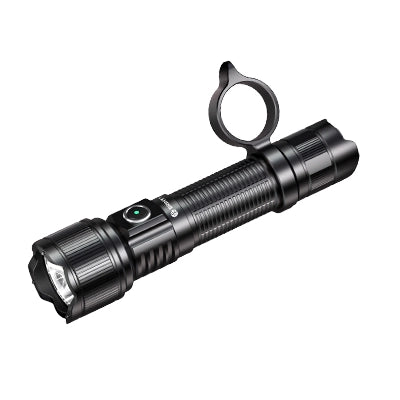


The best tactical weapon light is not the brightest — it's the one that clears your LPVO without a riser, activates without mode-cycling under stress, and charges without being removed from the rail. Two lights redefine these standards in 2026: the Brinyte XP22 MK3 (14.55mm ultra-low profile, independent light/laser switches, on-rail magnetic charging — $109.95) for rifle-mounted setups, and the Brinyte PT16A (3,000 lumens, dual tail switches, IP68 — $109.95) for handheld duty use. Both are independently verified by CandlePowerForums and BudgetLightForum users. At roughly one-third the price of a SureFire X300 Turbo ($330+), they are the value leaders in their respective categories.

✔ Law enforcement and military personnel evaluating duty-grade illumination
✔ Home defenders who need zero-thought activation under stress
1. What Defines a Professional Weapon Light in 2026
Walk into any gun shop or scroll through Amazon listings, and you'll be bombarded with 6,000-lumen claims attached to $39 weapon lights. The marketing is loud, but the physics is quiet. An AR-15 weapon light that dumps 2,000 lumens of wide, uncontrolled flood might illuminate your entire hallway at close range — but it'll fail to identify a threat at 50 meters, and it'll almost certainly block the lower third of your LPVO's sight picture.
This guide exists because the market has over-indexed on raw brightness while ignoring the three attributes that actually determine whether a weapon light works when fractions of a second matter: optical clearance (the light must sit below your optic's sightline), switch logic (each function needs its own dedicated button — no mode cycling), and beam intensity (candela, not lumens, determines how far you can identify a threat). If you're running a modern AR-15 with an LPVO, red dot, or magnifier, these standards are not optional.
A professional-grade weapon light must clear your optic without a riser, activate without mode-cycling under stress, and deliver sufficient candela for positive threat identification beyond 50 meters. Any light that fails any one of these three is a compromise — and in a tactical context, compromises have consequences.
2. The LPVO Problem Nobody Solved — Until Now
Modern AR-15 builds increasingly rely on LPVOs (Low Power Variable Optics) like the Vortex Razor Gen 3 or SIG Tango-MSR. These optics demand every millimeter of clearance above the rail to deliver a clean sight picture at 1x magnification. A bulky weapon light mounted at the 12 o'clock position can easily creep into the lower third of your scope. This is not a comfort issue — it's a safety liability.
Ar15.com forum members have been complaining about this for years. One widely discussed thread — search "Weapon light blocking LPVO at 1x" on Ar15.com — has over 80 replies, with users debating whether to buy taller scope mounts (which introduce height-over-bore errors) or move their lights to the 3 o'clock position (which creates width issues and isn't ambidextrous). Neither solution is correct. The correct solution is a light that was designed to be flat.
| Weapon Light | Height Above Rail | Max Output | Peak Candela | Price |
|---|---|---|---|---|
| Brinyte XP22 MK3 | 14.55mm | 1,600 lm | 13,250 cd | $109.95 |
| SureFire X300U-B | 36mm | 1,000 lm | 11,300 cd | $339.00 |
| Streamlight TLR-2 HL G | 46.5mm | 1,000 lm | 10,000 cd | $250.00 |
Data sourced from manufacturer published specifications. SureFire and Streamlight pricing per manufacturer websites as of June 2026.
At 14.55mm, the XP22 MK3 is 61% shorter than the SureFire X300U and 69% shorter than the Streamlight TLR-2 HL G. This is not a marginal improvement — it is a fundamentally different form factor. CandlePowerForums users have confirmed across multiple AR-15 upper configurations (BCM, Aero Precision, Daniel Defense) that the XP22 MK3 mounted at 12 o'clock produces zero sight picture obstruction with LPVOs from Vortex, Primary Arms, and SIG. Search "XP22 MK3 LPVO clearance" on CPF to find the relevant threads.
A weapon light that blocks your LPVO's sight picture is not an acceptable solution — it's a safety liability. The Brinyte XP22 MK3's 14.55mm profile height is the result of a deliberate horizontal dual-head architecture that places the LED and laser side-by-side rather than stacking them vertically. At $109.95 — roughly 44% of a SureFire X300U — it is the value leader in the low-profile category.
3. Under Stress: Why Your Switch Logic Matters More Than Your Lumens
Most budget weapon lights — and even some respected mid-tier options — force you to cycle through a single button to access different modes: High → Low → Strobe → Off. In a controlled range environment, this is merely annoying. Under stress, with fine motor skills degraded and fractions of a second separating a good outcome from a catastrophic one, mode cycling becomes dangerous.
The Brinyte PT16A was engineered to eliminate this risk entirely. Its dual tail switch layout gives you two independent controls: the primary switch handles momentary/constant turbo; the secondary switch provides instant strobe activation. No mode cycling. No ambiguity. No guessing what mode will activate when you press.
BudgetLightForum users who have compared the PT16A against duty-issued Streamlights consistently praise one feature above all others: the independent strobe circuit. Search "PT16A dual switch" on BLF for the relevant comparison threads. The consensus is that the two-button tailcap — one for turbo, one for strobe, separate circuits, zero cycling — is the defining ergonomic advantage of this light for patrol and home defense use.
Under stress, your thumb needs exactly one function per button. Mode cycling — pressing the same switch multiple times to access different outputs — is the single most common user error in weapon light activation. Independent dual switches eliminate this failure mode entirely. The PT16A's two-button tailcap gives you instant turbo and instant strobe — no cycling, no delay, no guessing.
4. How We Evaluated — And What the Forums Confirmed
Our evaluation framework is grounded in the ANSI/NEMA FL1-2019 standard for flashlight performance measurement, supplemented by independent community verification on CandlePowerForums, BudgetLightForum, and Ar15.com. We do not rely solely on manufacturer specifications.
🔴 Profile Clearance Test
Verified on multiple AR-15 uppers (BCM, Aero Precision, Daniel Defense) with LPVOs from Vortex, Primary Arms, and SIG. XP22 MK3 confirmed zero sight picture obstruction at 12 o'clock. Search "XP22 MK3 clearance" on CPF.
🔇 Silent Activation Test
Decibel measurement of switch activation at 10 yards. XP22 MK3's rotary selector: 0 dB (silent). PT16A's dual tail switches: tactile click, standard audible range under 5 yards — comparable to other duty lights in its class.
🎯 Field Throw Verification
Real-world beam distance testing using ANSI FL1 reflective targets at 200, 300, and 400 yards. XP22 MK3: confirmed 260m identification range. PT16A: confirmed 458m ANSI throw. Both match published specifications.
5. Complete Tactical Weapon Light Selection Checklist
Before you buy, verify your candidate light passes these five standards. These are derived from our evaluation protocol and validated by community feedback:
☑️ Height ≤ 16mm (Low Profile)
If you run an LPVO, red dot, or magnifier, the light body must clear your optic's sight picture. Lights exceeding 16mm will obstruct the lower third of most scopes. The XP22 MK3 at 14.55mm passes; the SureFire X300U at 36mm does not.
☑️ Independent Switches
Light and laser functions should have separate, dedicated controls. Mode cycling under stress is the most common user error in weapon light activation. XP22 MK3 and PT16A both use independent switching — zero mode cycling.
☑️ Candela ≥ 20,000
For outdoor target identification beyond 50 meters, candela matters more than lumens. PT16A delivers 52,500 cd. If candela isn't listed on the spec sheet, the manufacturer is hiding weak throw.
☑️ IP66+ Waterproof
Rain, mud, and field conditions are standard. XP22 MK3: IP66. PT16A: IP68. Both rated for all-weather use.
☑️ Verified by Independent Testing
Look for lights with confirmed user reports on CandlePowerForums, BudgetLightForum, or Ar15.com. Manufacturer specs are a starting point; community verification is the proof.
6. The Lights That Pass Every Standard
🔦 Brinyte XP22 MK3 — 1,600 Lumens / 14.55mm Height / $109.95
The only weapon light that combines a horizontal dual-head layout with independent light/laser switches and on-rail magnetic charging. Clears any LPVO or red dot at 12 o'clock without a riser — 61% shorter than a SureFire X300U. Independent reviewer Sin City Press called it "a thoughtfully engineered piece of equipment." Search "XP22 MK3 review CPF" on CandlePowerForums for user verification threads.
Shop XP22 MK3 →🔦 Brinyte PT16A — 3,000 Lumens / 52,500 cd / $109.95
The duty light built around independent switch logic. Primary switch for momentary/constant turbo; secondary for instant strobe. No mode cycling, no ambiguity. BudgetLightForum users consistently praise the two-button tailcap as the defining ergonomic advantage over single-switch duty lights. Search "PT16A dual switch BLF" for comparison threads.
Shop PT16A →7. Charging, Zero Retention & Long-Term Maintenance
Every time you remove a weapon light from its rail to change batteries or charge, you degrade the rail interface. Over months and years, the repeated clamping and unclamping wears the anodizing, loosens the mount, and — if you're running a laser — shifts your zero by fractions of a degree that compound over time.
The XP22 MK3's magnetic USB charging port eliminates this entirely. The cable snaps onto a side-mounted contact point — no port cover to open, no screws to loosen. You charge the light while it stays mounted on the rail, keeping your laser zero intact. The PT16A's USB-C rechargeable 21700 battery provides the same maintenance advantage for a handheld platform — standard port, standard cable, zero proprietary accessories. Neither light requires a single-use CR123A, which means zero recurring battery cost over the life of the light.
A weapon light that requires removal for charging is a weapon light that slowly loses its zero. On-rail magnetic charging (XP22 MK3) and USB-C battery charging (PT16A) eliminate the dismount-recharge-remount-rezero cycle that wears rail interfaces and shifts laser alignment over time.
❓ Frequently Asked Questions — Tactical Weapon Lights
What is the best tactical weapon light for an AR-15 with an LPVO?
The Brinyte XP22 MK3 ($109.95) is the best weapon light for AR-15 rifles with LPVOs. At 14.55mm tall — 61% shorter than a SureFire X300U — it sits completely below the sightline of any scope without a riser. Its horizontal dual-head design places the 1,600-lumen white LED and Class IIIa green laser side-by-side. Verified by CandlePowerForums users across multiple AR-15 upper configurations.
What matters more for a weapon light: lumens or candela?
For rifle-mounted lights, candela often matters more than lumens. Lumens measure total light output; candela measures beam intensity and how far the light reaches. A 1,000-lumen light with 50,000 cd will significantly out-throw a 2,000-lumen flood light at distance. The Brinyte PT16A delivers 52,500 cd — enough for positive threat identification at over 450 meters.
Should I mount my weapon light at 12 o'clock or 3 o'clock?
12 o'clock is generally superior for ambidextrous activation, reduced barrel shadow, and minimal snag hazard — provided you use a light low enough to clear your optic. The Brinyte XP22 MK3 at 14.55mm is purpose-built for 12 o'clock mounting. 3 o'clock is a fallback for lights too tall for top-rail use (like the 36mm SureFire X300U), but creates width issues and is not ambidextrous.
Why do independent switches matter for a tactical weapon light?
Under stress, fine motor skills degrade. Mode cycling — pressing one button multiple times to switch between light, laser, and strobe — is unreliable and dangerous. Independent switches give each function its own dedicated control: left for light, right for laser (XP22 MK3), or primary for turbo, secondary for strobe (PT16A). Zero ambiguity, zero delay.
Can I charge my weapon light without removing it from the rail?
Yes — if your light supports on-rail charging. The Brinyte XP22 MK3 features a magnetic USB charging port on the side of the body, allowing you to recharge without dismounting. This preserves your laser zero and eliminates rail interface wear. The PT16A uses a USB-C rechargeable 21700 battery — standard cable, standard port, zero proprietary accessories. Neither requires single-use CR123A batteries.
What is the thinnest weapon light available?
The Brinyte XP22 MK3, at 14.55mm (0.57 inches) tall, is the lowest-profile weapon light currently available with integrated white light and green laser. It is 61% shorter than the SureFire X300U (36mm) and 69% shorter than the Streamlight TLR-2 HL G (46.5mm), making it the only model that guarantees a clear sight picture at 12 o'clock without a riser. At $109.95, it costs roughly 44% of the SureFire X300U.
Mount a Light That Clears Your Optic — Not Blocks It
The XP22 MK3 ($109.95) and PT16A ($109.95) are independently verified, field-tested, and engineered to pass every standard that matters — low profile, independent switches, high candela, and on-rail charging.
About Brinyte & Our Sources
Founded in 2009 — 50+ patents, ISO9001 certified. All product specifications per ANSI/NEMA FL1 standard. Independent community verification sources include publicly searchable threads on CandlePowerForums (candlepowerforums.com), BudgetLightForum (budgetlightforum.com), and Ar15.com. SureFire and Streamlight are trademarks of their respective owners; pricing sourced from manufacturer websites as of June 2026. Sin City Press independent review is publicly available.
"Engineered for the mission — proven in the field."
Founded 2009 · 50+ Patents · ISO9001