

✔ Civilians considering a strobe flashlight for self-defense
✔ Tactical flashlight enthusiasts who want to understand the science
✔ Anyone asking: "Does tactical strobe actually work, or is it a gimmick?"

1. What Is a Strobe Flashlight & Why Do Flashlights Have Strobe?
A strobe flashlight is a tactical light that emits rapid, high‑intensity pulses of light — typically 8–20 flashes per second — rather than a constant beam. Unlike a regular flashlight that stays on until you turn it off, a strobing flashlight cycles between bright and dark at a rate specifically chosen to overwhelm the human visual system.
Most modern tactical flashlights have a strobe mode as a standard feature — but not all strobes are created equal. The key difference between a useful strobe and a useless one is instant activation. A strobe buried behind a mode‑cycle sequence (click‑click‑click to find it) is worthless under stress. A strobe activated by a dedicated, independent switch — like the dual tail‑switch on the Brinyte PT16A — is accessible instantly, without thought, in the moment you need it.
2. The Science Behind the Strobe: The Bucha Effect & Visual Disruption
To understand why do flashlights have strobe and whether tactical strobe do they actually work, we need to look at the physiology of human vision — specifically a phenomenon called the Bucha Effect.
In the 1950s, Dr. Bucha investigated helicopter crashes and discovered that pilots were losing their sense of balance and spatial orientation when flying through rotor‑generated flickering light — typically in the 10–20 Hz range. This frequency matches the strobe rate of most tactical flashlights today. When light pulses at this rate, the brain struggles to process visual information coherently. The rapid alternation between intense illumination and total darkness over‑loads the visual cortex, causing temporary disruption of depth perception, peripheral vision, and balance — a sensation often described as feeling "drunk" or "stuck in molasses."
Modern neuroscience confirms the mechanism: the pulsing light saturates photoreceptor cells (rods and cones) and the associated neural pathways, making it difficult for the brain to construct a stable, coherent image of the world. This disorientation is immediate and automatic — it cannot be "fought off" by willpower. That said, the effect is temporary, typically lasting only as long as the light is directly in the subject's eyes, plus a few seconds of recovery time.
Strobe‑induced disorientation isn't a myth — it's a documented physiological response first identified in aviation research and now applied in law enforcement and self‑defense tools. The key takeaway: strobe works by overwhelming the brain's visual processing, not by causing pain or physical harm. It creates a window of opportunity, not a permanent solution.
3. Tactical Strobe: Do They Actually Work in Real Life?
The most honest answer comes from law enforcement trainers and military operators who have used strobe on the job. Their consensus: strobe can provide a critical tactical advantage, but it is not a substitute for distance, cover, or backup.
NEXTORCH tactical instructor Zhou Yang, who trains Chinese police units, states: "The strobe's disorienting effect and fear‑inducing nature can significantly impair a suspect's ability to react — giving officers a crucial window to close distance or apply control techniques." This reflects how police use the tactical flashlight strobe mode: not as a magic wand, but as a force multiplier in a larger tactical sequence.
However, there are also candid assessments from experienced operators. A former Special Forces soldier writing for Guns and Ammo tested strobe in force‑on‑force scenarios and reported: "I've never seen a man drop from strobe alone. In fact, when we used it on each other, the guy being strobed often fought harder — because he knew something was coming." This underscores a critical point: strobe can signal your intent to an attacker. If you strobe and stand still, you've given away your position and announced your presence.
The practical consensus from these mixed perspectives:
- Strobe works best when you move immediately after activating it. The disorientation covers your movement.
- Strobe is more effective in complete darkness — where the contrast between the flashes and the darkness is maximum.
- Strobe works better against untrained or intoxicated subjects than against highly trained, focused individuals.
- Strobe is a tool, not a weapon. It creates seconds of advantage — not minutes.
4. How Police & Security Use Strobe Flashlights
In law enforcement, the strobe flashlight on the person is a standard element of a patrol officer's use‑of‑force continuum — sitting between verbal commands and physical control. Police typically deploy strobe in three scenarios:
- Building searches: Strobing into a dark room before entry can disorient anyone inside, while simultaneously preserving the officer's night‑adapted vision (because the flashes are brief).
- Contact and cover: While one officer issues commands, another uses strobe to keep the subject off‑balance and unable to track the officers' movements.
- Vehicle stops at night: A strobe aimed into a vehicle can prevent the driver from seeing how many officers are present, where they are positioned, and what they are doing — increasing officer safety.
Key to these applications is strobe discipline: police do not turn strobe on and leave it on. They activate it in short bursts while moving, using the disruption to reposition or close distance. A strobe left on continuously becomes a predictable beacon.
5. How to Use a Strobe Flashlight for Self-Defense (Step‑by‑Step)
For civilians carrying a flashlight with strobe for personal protection, using strobe correctly is more important than having the brightest light. Here is a simple, practiced sequence:
- Identify the threat. Use momentary‑on white light to confirm the presence, location, and posture of the potential attacker. Do not strobe yet — you need to gather information.
- Activate strobe as you begin to move. The moment you decide to escape or create distance, hit the strobe. Do not stand still while strobing — lateral movement (side‑to‑side) is hardest for a disoriented person to track.
- Use the strobe to cover your exit. Back away or move to a safer position while the attacker is visually disrupted. Keep the strobe directed at their face.
- Transition to constant‑on white light only when you need to reassess. Strobe consumes more battery and can degrade your own situational awareness over time. Use it in short bursts.
- Never rely on strobe alone. Strobe is a layer of defense. It should be combined with verbal commands, physical barriers, and — where legal — other defensive tools.
6. Pros & Cons of Tactical Strobe Flashlights
| Pros | Cons |
|---|---|
| Creates disorientation in seconds — the Bucha Effect is real and immediate. | Not a "stun gun" — a determined attacker may push through the effect. |
| Provides a non‑lethal option on the use‑of‑force continuum, giving you options between words and physical force. | Can signal your presence and intent — if you strobe and stand still, you've told the attacker exactly where you are. |
| Works day or night — effective in low‑light conditions where contrast is high. | Depletes battery faster than constant‑on at the same brightness level. |
| Can be used with other tactics — combined with movement, verbal commands, or physical tools. | Must be instantly accessible — a strobe buried behind mode‑cycling is worthless. Requires a dedicated, one‑press activation. |
| Legal to carry almost everywhere — unlike many defensive tools, flashlights are not restricted. | Can temporarily affect your own vision if reflected off walls or windows in confined spaces. |
7. How to Choose a Quality Tactical Strobe Flashlight
Not every strobe flashlight is built for real defensive use. When selecting a tactical strobe light, these are the non‑negotiable criteria:
- Instant strobe activation — via a dedicated switch. This is the single most important feature. If you have to cycle through modes to reach strobe, the light is not suitable for self‑defense. Look for dual tail‑switch designs (like the Brinyte PT16A) where one switch controls constant‑on, and the other switch immediately activates strobe from any state.
- High candela (20,000+ cd). Strobe works by intensity, not just frequency. A higher candela means a tighter, more intense beam that delivers more light energy into the subject's eyes at any given distance.
- 1,000+ lumens. Sufficient brightness to ensure the strobe is disorienting even in ambient urban lighting.
- Strobe frequency in the 10–20 Hz range. This is the sweet spot identified by research — fast enough to disrupt vision, slow enough to create distinct flashes.
- IP68 or IPX8 waterproofing. Defensive encounters don't wait for good weather.
- Pocket‑ or belt‑carryable size. If it's too big to carry every day, it won't be there when you need it.
8. Best Brinyte Tactical Strobe Flashlights
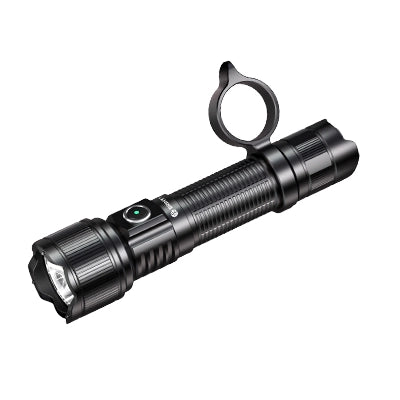
🔦 Brinyte PT16A — Instant Strobe, No Mode Cycling
The PT16A is Brinyte's flagship strobe‑enabled duty light, and its independent strobe switch is what separates it from consumer‑grade lights. The primary tail switch controls momentary/constant‑on. The secondary switch activates strobe instantly — from off, from on, from any mode. There is no cycling. No delay. This is the feature that law enforcement officers and security professionals consistently identify as the most important differentiator between a tactical tool and a toy.
With 3,000 lumens and 52,500 candela, the PT16A delivers strobe intensity that overwhelms at close to medium range. The 300‑hour low mode also makes it a practical everyday carry light — strobe is there when you need it, but the light serves all your administrative tasks without constant recharging.
Shop PT16A →🔫 Brinyte XP22 MK3 — Strobe on a Low‑Profile Weapon Light
For those who carry a pistol or patrol rifle, the XP22 MK3 brings strobe capability to a weapon‑mounted platform. Its ultra‑slim 14.55mm profile clears most optics and co‑witness setups, and the independent left/right switches separate light (with strobe mode) from laser activation — ensuring you never cycle through modes when fractions of a second matter.
Shop XP22 MK3 →❓ Frequently Asked Questions
Do tactical flashlights have a strobe mode?
Yes, almost all modern tactical flashlights have a strobe mode. However, the quality of implementation varies dramatically. A useful strobe must be instantly accessible — ideally via a dedicated switch — not buried behind a mode‑cycling sequence. The Brinyte PT16A's independent strobe tail switch is an example of proper implementation: one press, instant strobe, from any state.
Tactical strobe: do they actually work?
Yes, tactical strobe does work — but it is not a "stun gun" and it won't incapacitate a determined attacker. The strobe's rapid pulsing (10–20 Hz) induces the Bucha Effect, causing temporary disorientation, loss of depth perception, and impaired balance. Police and security personnel use strobe to create brief windows of advantage. For civilians, the key is to strobe and move — use the disorientation to escape or create distance, not to stand still and hope the attacker gives up.
Why do flashlights have a strobe function?
Flashlights have a strobe function primarily for self‑defense and tactical signaling. The rapid pulsing at specific frequencies (10–20 Hz) disrupts human visual processing via the Bucha Effect, causing temporary disorientation. Strobe can also be used for emergency signaling (SOS) and to disorient wildlife. The feature originated from aviation research and was adopted by law enforcement as a non‑lethal tool on the use‑of‑force continuum.
Can a strobe flashlight be used on a person?
Yes, strobe flashlights can be used on a person for self‑defense or law enforcement purposes. The intense, pulsing beam directed at an individual's face causes temporary visual disruption and disorientation. However, this should only be done in legitimate defensive situations. Extended direct exposure at very close range can cause eye discomfort and temporary after‑images. Police officers are trained to use strobe in controlled bursts while moving, not as a continuous beam.
What is the best strobe flashlight for self-defense?
The best strobe flashlight for self‑defense is one with an independent, instant‑access strobe switch — not a light that requires cycling through modes to find strobe. The Brinyte PT16A meets this criterion with its dual tail‑switch design: one switch for constant light, one for instant strobe. It also delivers 3,000 lumens and 52,500 candela of intensity, sufficient for disorienting strobe at defensive distances, and is belt‑carryable for daily use.
Ready to Add Instant Strobe to Your EDC?
Don't settle for a strobe that takes three clicks to activate. Brinyte's dual‑switch strobe lights give you instant, one‑press access — the way strobe was meant to work.
Shop Brinyte Tactical Strobe Lights →About Brinyte
Founded in 2009, Brinyte designs and manufactures tactical flashlights with input from law enforcement professionals and military trainers. 50+ patents, ISO9001 certified. Our PT16A has been deployed by Cyprus Police and tested by independent reviewers at 1Lumen, BudgetLightForum, and CandlePowerForums. Every light is engineered to be mission‑ready — not just to look good on a spec sheet.
"Engineered for the mission — proven in the field."
Founded 2009 · 50+ Patents · ISO9001