

Your "best EDC flashlight of 2026" just blinded you to the threat you needed to see. Stop counting lumens. Start demanding candela. The best EDC flashlight 2026 is the one that lets you identify a man's hands at 60 meters — not the one that lights up the pavement at your feet.

✔ The CCW holder who knows the difference between seeing pavement and seeing threats
✔ Anyone who's ever put a "top-rated" EDC light back in the drawer because it didn't throw far enough
1. Midnight. Parking Garage. Blind.
Midnight. Empty parking garage. You're walking back to your car. At the far end, past the flickering fluorescent, there's a shape moving. Not walking toward you — yet — but present. Watching. You reach into your pocket and pull out the light that every "best EDC flashlight 2026" list told you to buy. The one with four LEDs, a green laser, UV mode, and eight thousand lumens on turbo. You press the button.
The concrete around your feet erupts in stadium-bright light. Congratulations — you just illuminated yourself for every threat within a hundred meters. The shape at the far end? Still a shape. Still watching. Still closing. You are brilliantly illuminated to yourself and utterly blind to your surroundings.
You paid $129 to blind yourself. That's not an EDC light. That's a panic button dressed up as preparedness.
The entire 2026 EDC industry has sold you a lie. The lie is that more features and more lumens make a better everyday carry. They don't. They make a light that's excellent at finding your car keys and useless at telling you whether the man at the far end of the parking garage is holding a phone or a knife. The best EDC flashlight 2026 isn't the one with the longest spec sheet. It's the one that answers the only question the dark ever asks: what is that, and how much time do I have?
Flood illuminates your feet. Candela illuminates the threat. The entire 2026 EDC industry is optimized for the first. The Brinyte PT16 — with 92,500 candela reaching 608 meters into the dark — is purpose-built for the second. That's not a spec. That's the difference between seeing the threat and becoming the target.
2. Four Seconds. Count Them Right Now. That's What Your "Best EDC" Light Gives You.
A 200-pound man at full sprint covers 30 meters in four to five seconds. A motivated threat walking with intent — not running, just closing — covers the same distance in twelve to fifteen seconds. Now look at your current EDC flashlight. What's its effective identification range? For the vast majority of 2026's flood-first lights, the answer is 15 to 20 meters.
Do you see the problem? By the time your light clearly illuminates a threat, the threat is already inside your decision loop. You have four or five seconds to process, decide, and act. That's not security. That's a coin toss in the dark.
The Brinyte PT16's 92,500 candela pushes effective hands-visible identification beyond 60 meters. At that distance, the same walking threat gives you 30 to 40 seconds of decision time. That's not a coin toss. That's tactical control of unknown space.
Q: Is carrying a heavier light worth the candela advantage?
A: Only if you value seeing threats before they reach you. A 92,500cd light gives you 60 meters of visual control — and 50+ seconds to think. A flood-first EDC gives you 15 meters and a fistful of lumens that can't answer the only question that matters: what is that?
| Scene | Flood-First EDC (15-20m range) | Candela-First PT16 (60m+ range) |
|---|---|---|
| Parking garage, far movement | Illuminate yourself. See nothing. | Identify hands, posture, intent. |
| Suburban power outage | Walk to every corner to check. | Stand at the door. Sweep the fence line. |
| Late-night gas station | Sees the pump. Misses the dumpster. | Sweeps the full perimeter before you open the door. |
| Roadside breakdown | Sees your engine. Attracts attention. | Scans the treeline and both shoulders while you stay near the vehicle. |
Every meter of effective beam distance buys you approximately 0.5 seconds of decision time against a walking threat. A flood-first EDC buys you 7-10 seconds. The PT16 buys you 30-40. In the dark, time is the only currency that matters — and most EDC lights are bankrupt.
3. The Light You Forget You're Carrying — Until You Can't Afford to Drop It
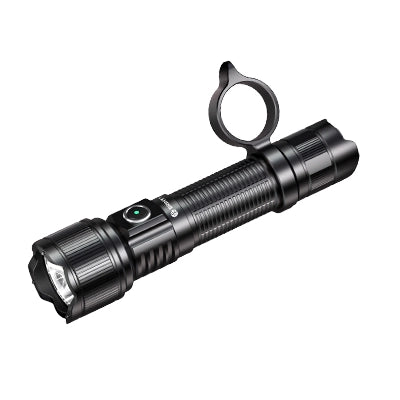
At 159mm and 174 grams with battery, the PT16 is heavier than most 2026 EDC lights. The first time you slip it into your jeans pocket, you're aware of it. By day three, you've stopped noticing it entirely.
This sounds contradictory. It's not. Pocket presence is not determined by static dimensions. It's determined by whether the object fights your body or disappears into it.
The PT16's cylinder stays put. Flat lights rotate sideways in your pocket, presenting their broad face against your thigh every time you sit, crouch, or climb stairs. That constant readjustment — the subtle, unconscious shifting you do to get comfortable — is what creates the sensation of "carrying something." The PT16 doesn't do that. It sits vertically along your leg seam, stays there when you bend to tie your shoes, and doesn't poke your hip when you sit because its length distributes pressure along the thigh rather than concentrating it at a single point.
And when you draw? That 174 grams becomes the reason your hand finds the light exactly where it expects it. Thumb to tail switch. Index and middle finger around the body. The weight indexes the light in your palm before your fingers close. In the rain, with cold hands, wearing gloves, at 2 a.m. with adrenaline in your bloodstream — the PT16 goes where your hand expects it to be. Lights half its weight have a habit of slipping in the draw.
A good EDC light disappears into your pocket. A great one reappears in your hand before you remember reaching for it. The PT16 earns its place not by shrinking, but by staying exactly where you put it — and delivering exactly what you expect when you reach for it in the dark.
4. 92,500 Candela Isn't a Number. It's an Engineering Decision Made Without Apology.
Most 2026 EDC lights are designed to look good on a spec sheet. The PT16 was designed to look good at 60 meters.
Brinyte's engineers chose the Luminus SFT40 LED for one reason: its die size, when paired with a deep, precision-machined smooth reflector, produces an exceptionally tight beam. They made an aggressive tradeoff — sacrificing the wide, soft spill that makes a light pleasant indoors, and directing nearly all optical energy into a concentrated hot spot. The result is 92,500 candela. Per square centimeter, that's three to five times the beam intensity of the typical 2026 flood-first EDC light.
This is not a spec for bragging rights. It's a deliberate decision to make a light that answers questions, not one that illuminates pavement. When you sweep the PT16 across a dark treeline, you don't see a wash of light. You see individual branches. Individual shadows. Individual shapes resolving into identifiable forms at distances where other lights show only a gray wall.
The independent strobe circuit is the same kind of decision. Most 2026 EDC lights bury strobe behind a triple-click, a mode cycle, or — worse — a companion app. The PT16 gives it a dedicated tail switch on a separate circuit that bypasses the main driver entirely. Press it — from off, from low, from high, from any state — and the strobe activates in under 0.3 seconds. No cycling. No thinking. Just a disorienting, 2000-lumen, 15Hz pulse that buys you the most valuable thing in any confrontation: a moment of advantage.
5. One Battery. One Charger. Zero Thinking.
The PT16 runs on a single 21700 lithium-ion cell with USB-C direct charging. That's not unusual in 2026. What's unusual is that Brinyte made the same battery platform the spine of nearly its entire tactical and hunting lineup.
The PT16A, ZT40, T28, T18, and T40 all use the same 21700 cells. You're not carrying different spares for different lights. You're carrying one spare that works in everything. One charging cable in your truck. One routine. If your PT16 is in your pocket and your ZT40 is in your hunting pack, the batteries swap between them in five seconds. If your PT16A is your vehicle light and your PT16 is your pocket light, you can pull the cell from one into the other without a second thought.
This is the kind of logistical coherence that law enforcement agencies understand instantly — and that consumer EDC reviews almost never mention because they treat every light as an isolated purchase. A flashlight is not an isolated purchase. It's the first piece of a system. And a system that shares batteries is a system that works when you need it.
6. Why Your Favorite Reviewer Never Mentioned This Light
The PT16 family doesn't appear on the major EDC roundups. It doesn't have a YouTube thumbnail with a shocked face and seven red arrows. And that tells you more about the roundups than it tells you about the light.
The PT16A — the PT16's 3000-lumen sibling — has been procured in operational quantities by the Cyprus Police. It has been carried by United States Coast Guard rescue swimmers during real-world maritime search operations. The Brinyte ZT40 is formally listed on the U.S. General Services Administration's GSA Advantage procurement platform — a qualification that requires verified performance data, supply chain accountability, and durability documentation that no "best of 2026" YouTube roundup ever asks for.
Law enforcement agencies don't evaluate flashlights by emoji count in a thumbnail. They evaluate them by whether the light survives a duty belt for two years. Whether the IP rating holds up after a foot chase in the rain. Whether the strobe activates instantly with gloved hands under stress. Whether the battery platform reduces logistical overhead across an entire unit. The PT16 was designed for exactly these criteria — not for a five-star rating from someone who tested it in their living room.
This is not a light that wins consumer awards. This is a light that's already on the street, in the holster, and in the water — trusted by people who don't write reviews because they're too busy using the gear.
The best endorsement is not a star rating. It's a procurement contract from an organization that bets lives on equipment. The PT16 family carries institutional trust earned over years of operational use. That trust is harder to earn than any award — and it's the reason this light exists in the first place.
7. Complete the System: Three Lights, One Ecosystem
If the PT16 is your daily carry, the rest of the Brinyte ecosystem fills the roles that your EDC light doesn't need to: vehicle backup, outdoor versatility, and absolute maximum endurance.
🔦 Brinyte PT16 — 2,000 lm / 92,500 cd
The light that defines the best EDC flashlight 2026 category by the metric that actually matters: identifying threats before they close the distance. Not the light that won a roundup. The light that makes you reconsider what "everyday carry" means.
Shop PT16🔦 Brinyte PT16A — 3,000 lm / 52,500 cd
The PT16's bigger brother. Glove box. Nightstand. Go-bag. Anywhere you need battery compatibility with your daily carry and enough runtime to last the entire outage.
Shop PT16A🔦 Brinyte ZT40 — 1,650 lm / Zoomable
When the work week ends and the weekend demands a light that shapeshifts. 6° spot for distance, 70° flood for camp. Same battery. Same charger. No new system to learn.
Shop ZT40Stop Counting Lumens. Start Demanding Candela.
The best EDC flashlight 2026 is not a list. It's a decision. Choose time. Choose threat identification at 60 meters. Choose the light that tells you what's in the dark before it reaches you.
Explore Brinyte Tactical LightsAbout Brinyte
Founded in 2009 — 50+ patents, ISO9001 certification. Brinyte builds lights for the professionals who train with them, the officers who patrol with them, and the prepared civilians who understand that the dark doesn't care about your brand loyalty. All products tested to ANSI/NEMA FL1 standards. No companion app. No firmware updates. Just a button, a beam, and the confidence that it will work when you press it.
"Engineered for the mission — proven in the field."
Founded 2009 · 50+ Patents · ISO9001
❓ EDC FAQ
What is the best EDC flashlight 2026?
The best EDC flashlight 2026 depends entirely on your priority. If your priority is close-up task lighting — finding keys, walking the dog — a flood-first light from mainstream brands works fine. If your priority is identifying threats before they reach you — seeing hands, weapons, and intentions at 60 meters instead of 15 — then the candela-first Brinyte PT16 (92,500 cd) is purpose-built for that mission and unmatched in its class.
Why is candela more important than lumens for EDC safety?
Lumens measure total light output — how much light leaves the lens. Candela measures beam intensity — how far that light travels before it becomes useless. For EDC safety, candela determines effective threat identification distance. A 2000-lumen flood light may only give you clear identification at 20 meters. A 92,500 cd light extends that to 60+ meters, buying you seconds that can change the outcome of a confrontation.
How far can the Brinyte PT16 identify a threat?
The PT16 is rated at 608 meters beam distance per ANSI/NEMA FL1 standards (equivalent to moonlight at that distance). For practical threat identification — being able to see hands, objects, posture, and intention — the PT16 provides clear resolution at 60+ meters. This is roughly three to four times the effective range of a typical 2026 flood-first EDC light.
Isn't the Brinyte PT16 too big for everyday carry?
At 159mm x 25.4mm and 174g, the PT16 is heavier than many 2026 EDC lights. But pocket presence is determined by how an object interacts with your body in motion — not by its static dimensions. The PT16's cylindrical shape stays put in your pocket instead of rotating sideways. Users consistently report that after a few days, they stop noticing it entirely — until they need it, and then its weight indexes the light perfectly in their hand for a fast, reliable draw.
What battery does the PT16 use?
The PT16 uses a single 21700 lithium-ion rechargeable battery with USB-C direct charging. The same battery platform is shared across the Brinyte tactical and hunting lineup — PT16A, ZT40, T28, T18, T40 — allowing battery interchangeability across your entire gear system. No proprietary packs. No obsolete cells. Just one standard, one charger, every light you own.
What's the difference between the PT16 and PT16A?
The PT16 is a 2000-lumen, 92,500 cd light optimized for maximum beam distance in an EDC form factor. The PT16A is a 3000-lumen, 52,500 cd light that prioritizes higher total output for area illumination and longer low-mode runtime (300 hours). Both share the same 21700 battery, USB-C charging, IP68 waterproofing, dual-switch interface, and independent strobe circuit. If your priority is range, go PT16. If your priority is endurance with higher output, go PT16A. Either way, your batteries swap.