

The $16.6 Billion Military Tactical Flashlight Market in 2026: What Are Law Enforcement and Military Users Really Paying For?

✔ Military and tactical professionals tracking equipment trends
✔ Serious civilians who demand military-grade reliability
✔ Industry analysts following the tactical lighting sector
1. $16.6 Billion in Context: What’s Actually Happening in the Military Flashlight Market?
The global military and law enforcement tactical flashlight market crossed the $16.6 billion threshold in 2026, representing a compound annual growth rate (CAGR) that has consistently outpaced the broader defense electronics sector. To put that number in perspective: the global market for all police body-worn cameras is approximately $1.2 billion. The military flashlight market is now nearly 14 times larger.
But here’s the number that matters more than the headline figure: approximately 62% of that $16.6 billion is driven by procurement from operational units—active-duty military, law enforcement agencies, search-and-rescue teams, and border patrol—rather than consumer or recreational purchases. This is a professional market, and it behaves like one.

The term “military-grade” is often misused in consumer marketing. In professional procurement, it refers to a flashlight that meets at minimum three objective criteria: (1) IP68 or IPX8 waterproof rating—operational after full submersion; (2) impact resistance of 1.5 meters or greater onto concrete; and (3) documented field adoption by at least one recognized agency or unit. Without the third criterion, the first two remain manufacturer claims rather than operational facts.
2. Three Converging Drivers Behind the $16.6B Market
The growth isn’t accidental. Three structural forces are reshaping demand simultaneously.
Driver 1: Global Security Budget Expansion
NATO member states have collectively increased defense spending by an average of 18% since 2022, with a significant portion flowing to individual officer equipment rather than large-platform procurement. Urban police departments in the U.S. have simultaneously expanded their per-officer equipment budgets, driven by nighttime operational requirements: over 60% of law enforcement critical incidents occur between 20:00 and 04:00, according to FBI uniform crime reporting data.
The result is a procurement environment where every officer and every soldier is now expected to carry a dedicated tactical light—not as a convenience item, but as mandatory personal equipment. This shifts flashlight purchasing from “quartermaster bulk orders of disposable lights” to “individually specified, rechargeable, high-performance tools.”
Driver 2: Multi-Mode, High-Performance Product Iteration
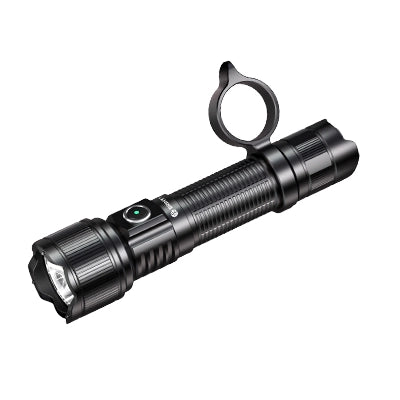
Five years ago, a 1000-lumen handheld flashlight was considered high-output. Today, the Brinyte PT16A delivers 3000 lumens in a body that fits in a duty belt pouch, while the PT16 achieves 2000 lumens with a 600-meter throw—distances that previously required rifle-mounted lights.
This generation of lights also provides multiple output modes as standard: momentary-on, constant-on, strobe, and low-lumen navigation. The operational significance is that one device now replaces three separate tools—a search light, a defensive strobe, and an administrative light. Procurement officers understand that consolidation reduces per-unit total cost of ownership even when the per-unit price is higher.
Driver 3: The Rechargeable and Lightweight Revolution
The shift from disposable CR123A batteries to integrated USB-C fast charging represents the single most significant logistics improvement in tactical lighting in a decade. A typical SWAT team carrying 8 officers on a 12-hour operation previously required 24-48 disposable batteries as backup. With USB-C rechargeable lights like the PT16A and PT16, each officer carries one light and one power bank—the same one that charges their phone and radio.
At the same time, material science advances have reduced weight without sacrificing durability. The PT16 weighs just 156 grams (without battery), making it viable for EDC carry while still delivering 600 meters of throw. This eliminates the historical tradeoff between “bright enough for duty” and “light enough to carry off-duty.”
The $16.6 billion military flashlight market is not growing because flashlights are becoming more expensive. It’s growing because the definition of a “flashlight” has changed from a simple illumination tool to a multi-mode tactical device that integrates into an officer’s complete equipment ecosystem—with USB-C charging, weapon-mount compatibility, and operational reliability that matches the user’s mission profile.
3. What Law Enforcement Agencies Actually Evaluate (It’s Not What You Think)
If you read consumer flashlight reviews, you’ll see endless discussion of lumens and beam distance. Professional procurement evaluates a fundamentally different set of criteria. Based on published requirements from multiple U.S. municipal police departments and federal agency RFPs, here is the real evaluation framework:

| Evaluation Criterion | Weight in Decision | What It Actually Means |
|---|---|---|
| Waterproof Reliability | Highest | Must operate after full submersion. An officer falling into water during a pursuit cannot lose illumination. IP68 is the baseline; real-world verification trumps lab certification. |
| Impact Survival | Critical | Must survive repeated drops onto concrete from 1.5m+. Flashlights are dropped during foot pursuits, vehicle exits, and physical altercations. Survival is non-negotiable. |
| Beam Distance (Candela) | High | The ability to identify a human figure at 200+ meters. Search and rescue, perimeter establishment, and vehicle stops all require long-distance clarity. Lumens measure total output; candela measures usable distance. |
| Strobe Function | High | Instant, one-touch access to disorienting strobe. Not a “hidden mode”—must be immediately accessible under stress without cycling through other modes. |
| Battery Logistics | High | USB-C rechargeable eliminates disposable battery supply chains. One less consumable to track, order, and budget for. |
| Weight & Size | Moderate | Must be light enough for full-shift belt carry without causing fatigue. Heavier lights get left in the patrol car when officers dismount. |
Notice what’s missing from this list: brand prestige, marketing claims, and maximum lumen count for its own sake. Professional users don’t buy flashlights the way consumers buy smartphones. They buy them the way they buy body armor: based on demonstrated performance under the specific conditions they face.
4. Why U.S. Coast Guard Rescue Swimmers Chose the Brinyte PT16A

🫡 Case Study: PT16A in USCG Rescue Operations
U.S. Coast Guard rescue swimmers operate in the most demanding illumination environment on the planet: open ocean at night, in fog and spray, with human lives at stake. A rescue swimmer exiting a helicopter into 3-meter seas needs a light that will function after saltwater immersion, cut through water-saturated air to identify survivors at distance, and operate reliably with gloved, wet hands.
The Brinyte PT16A was selected for this role because it solves three specific operational problems simultaneously:
1. 3000 lumens with 52,500 cd beam intensity penetrates water spray and fog at the 458-meter rated distance. In maritime search, the difference between identifying a survivor at 300 meters versus 200 meters can be measured in hypothermia survival time.
2. IP68 full waterproofing means the light operates after full saltwater submersion—not merely rain resistance. Saltwater is corrosive and conductive; lights that survive freshwater tests routinely fail in marine environments. The PT16A’s double O-ring seal design was engineered specifically for this.
3. Dual-switch interface allows separate control of momentary-on (tailcap) and mode selection (side switch). A rescue swimmer in heavy seas cannot afford to cycle through brightness modes while holding position against current. The tailcap provides instant maximum output regardless of previous mode setting.
Professional users don’t select equipment based on a comparison sheet. They select based on what has been proven to work by peers in equivalent conditions. The USCG rescue swimmer adoption of the PT16A is not a marketing story—it’s an operational fact that validates the light’s performance under the most unforgiving conditions a handheld light can face.
5. PT16A and PT16: The Military-Grade DNA in Two Form Factors
The PT16A and PT16 share a common engineering philosophy but serve different operational profiles within the tactical ecosystem. Understanding the distinction helps professional users match the tool to the mission rather than defaulting to “buy the brighter one.”
PT16A — The Maximum-Output Duty Light
The PT16A is built for scenarios where maximum illumination at maximum distance is the primary requirement: search-and-rescue, maritime operations, perimeter establishment, and tactical entry where identifying threats before engagement is critical.
- 3000 lumens / 52,500 cd / 458 meters — among the highest candela ratings in a handheld form factor
- Dual-switch interface — tailcap for instant momentary-on or constant-on; side switch for mode cycling (Low 5lm → Med 120lm → High 900lm → Turbo 3000lm → Strobe)
- USB-C fast charging — full recharge in approximately 2.5 hours; compatible with standard phone chargers
- IP68 + 2-meter impact resistance — engineered for maritime and tactical environments
- Strike bezel — hardened stainless steel for emergency breaching
PT16 — The Extended-Reach Precision Light
The PT16 prioritizes beam distance and compact carry over raw lumen output. It’s the choice for patrol officers who need to illuminate subjects at distance during traffic stops, check perimeters, or operate in open terrain where throw distance matters more than flood coverage.
- 2000 lumens / 600 meters — longer throw than the PT16A despite lower lumens, thanks to a more focused reflector design
- Luminus SFT40 CW LED — a dedicated thrower LED optimized for candela rather than lumen count
- 164mm length / 156g weight (without battery) — compact enough for plainclothes and off-duty carry
- Dual-switch + USB-C + IP68 — same operational interface and durability standard as the PT16A
6. PT16 vs PT16A: Specification Comparison
| Specification | Brinyte PT16A | Brinyte PT16 |
|---|---|---|
| Maximum Output | 3,000 lumens | 2,000 lumens |
| Peak Beam Intensity | 52,500 cd | 90,000+ cd (estimated, SFT40 CW) |
| Maximum Throw Distance | 458 meters | 600 meters |
| LED | High-performance cool white | Luminus SFT40 CW |
| Brightness Modes | 5 / 120 / 900 / 3000 lm + Strobe | 5 / 120 / 900 / 2000 lm + Strobe |
| Waterproof Rating | IP68 (submersion) | IP68 (submersion) |
| Impact Resistance | 2 meters | 1.5 meters |
| Charging | USB-C fast charging | USB-C fast charging |
| Length | 164mm | 164mm |
| Body Diameter | 25.4mm | 25.4mm |
| Head Diameter | 41mm | 41mm |
| Weight (w/o battery) | ~160g | ~156g |
| Strike Bezel | Yes (stainless steel) | Yes (stainless steel) |
| Provenance | Adopted by USCG rescue swimmers | EDC tactical standard |
| Shop | Shop PT16A | Shop PT16 |

7. What Professionals Invest In, Brinyte Builds
The $16.6 billion military flashlight market tells a clear story to anyone willing to read beyond the headline. The growth is not driven by “more flashlights” but by a fundamental upgrade in what a flashlight is expected to deliver: multi-mode operation, USB-C rechargeability, IP68 waterproofing, and demonstrated reliability in extreme environments.
Brinyte’s position in this market is not accidental. With 50+ patents, ISO9001 certification, and real-world adoption by units including the U.S. Coast Guard, the PT16A and PT16 represent the same engineering philosophy that professional users demand: build to a performance standard, not to a price point. Then provide the documentation—candela measurements, waterproof certification, beam distance at ANSI/NEMA FL1 standard—that allows professional evaluators to make informed procurement decisions.
For the individual officer, soldier, or prepared civilian reading this: you are participating in the same market that drives this $16.6 billion figure. The question is whether you’re buying based on the same criteria the professionals use—or based on the marketing copy designed to distract you from them.
When a market reaches $16.6 billion, the products that survive professional scrutiny are not the ones with the most aggressive advertising. They are the ones with documented performance, field adoption by real operational units, and an engineering team that understands the difference between a feature that looks good in a product photo and one that works when saltwater is hitting the lens and a life depends on the beam.
Step-by-Step: How to Evaluate a Military-Grade Tactical Flashlight
- Verify waterproof certification: Look for IP68 or IPX8 rating with specified submersion depth. Request evidence of saltwater testing if maritime use is anticipated.
- Check candela, not just lumens: Candela (cd) measures beam intensity at distance. A 2000-lumen light with 90,000 cd will throw farther than a 3000-lumen light with 50,000 cd. Both numbers matter for different reasons.
- Test the switch interface under stress: Can you access maximum output and strobe instantly, with gloves on, without looking at the light? If mode cycling is required to reach strobe, the light is not operationally suitable.
- Calculate battery logistics: USB-C rechargeable eliminates disposable battery supply chains. Confirm charging time and compatibility with standard chargers.
- Ask for documented field adoption: Request evidence of adoption by recognized agencies or units. A manufacturer claiming “military-grade” without documented adoption is making a marketing claim, not an operational fact.
Ready to Equip with Military-Grade Lighting?
Browse Brinyte’s complete collection of tactical flashlights — engineered to the standards that professional users demand.
Shop Tactical Flashlights →About Brinyte
Founded in 2009, Brinyte specializes in tactical and outdoor lighting with engineering input from working professionals. Our products are tested across real-world conditions by law enforcement and military users. Brinyte holds 50+ patents and ISO9001 certification. The PT16A has been adopted by U.S. Coast Guard rescue swimmers for maritime search operations — validating its performance under the most demanding conditions a handheld light can face.
“Engineered for the mission — proven in the field.”
Founded 2009 · 50+ Patents · ISO9001
❓ Frequently Asked Questions
What makes a flashlight “military-grade”?
“Military-grade” in tactical flashlights means three objective criteria: (1) IP68 waterproof rating with documented submersion survival, (2) impact resistance of 1.5 meters or greater onto concrete, and (3) documented field adoption by at least one recognized agency or operational unit. Without the third criterion, the term is a marketing claim rather than an operational fact. The Brinyte PT16A meets all three, including documented adoption by U.S. Coast Guard rescue swimmers.
Why did the U.S. Coast Guard choose the Brinyte PT16A?
The USCG rescue swimmers selected the PT16A for three specific operational requirements: (1) 3000 lumens with 52,500 cd beam intensity that penetrates maritime fog and spray at the rated 458-meter distance, (2) IP68 full waterproofing that survives saltwater submersion—a more demanding test than freshwater, and (3) dual-switch interface allowing instant maximum output from the tailcap regardless of previous mode setting, which is critical when operating with gloved, wet hands in heavy seas.
What’s the difference between the Brinyte PT16 and PT16A?
The PT16A delivers 3000 lumens with a 458-meter throw, optimized for search-and-rescue and building clearing where wide-area illumination is critical. The PT16 delivers 2000 lumens with a 600-meter throw, optimized for distance observation and patrol where beam reach matters more than total output. Both share the same dual-switch interface, USB-C fast charging, IP68 waterproofing, and 164mm form factor. The PT16A uses a higher-output LED; the PT16 uses a Luminus SFT40 CW LED with a tighter beam profile for longer throw.
Why do law enforcement agencies prefer USB-C rechargeable flashlights?
USB-C rechargeable flashlights eliminate the disposable battery supply chain that creates ongoing logistics costs and environmental waste. A single rechargeable light replaces hundreds of disposable CR123A batteries over its service life. USB-C compatibility means officers can recharge from the same chargers used by phones, laptops, and vehicle USB ports—reducing the number of unique power systems an agency must support. The Brinyte PT16A and PT16 both use standard USB-C fast charging with full recharge in approximately 2.5 hours.
How big is the military flashlight market in 2026?
The global military and law enforcement tactical flashlight market has reached approximately $16.6 billion in 2026, with approximately 62% of that value driven by procurement from active-duty military, law enforcement agencies, search-and-rescue teams, and border patrol units. Growth is driven by expanding global security budgets, multi-mode high-performance product iteration, and the shift from disposable to USB-C rechargeable battery systems.
Is IP68 waterproofing really necessary for a duty flashlight?
Yes. An officer falling into water during a pursuit, a rescue swimmer exiting a helicopter into 3-meter seas, or a tactical operator crossing a river during an operation cannot afford to lose illumination due to water ingress. IP68 means the light is certified to survive continuous submersion—not merely rain resistance. For professional users, this is not a luxury feature; it is a minimum operational requirement. Both the Brinyte PT16 and PT16A carry IP68 certification.