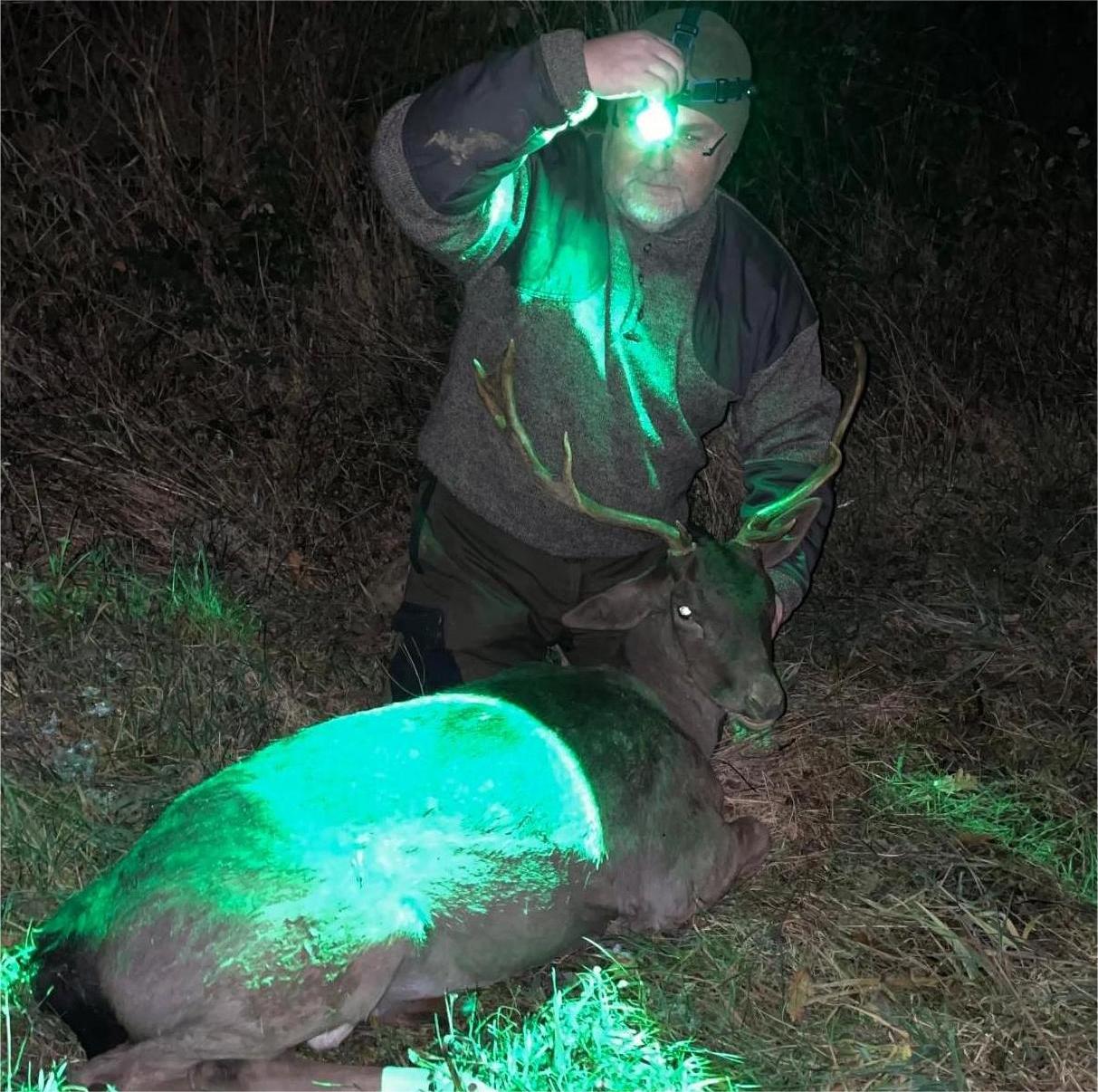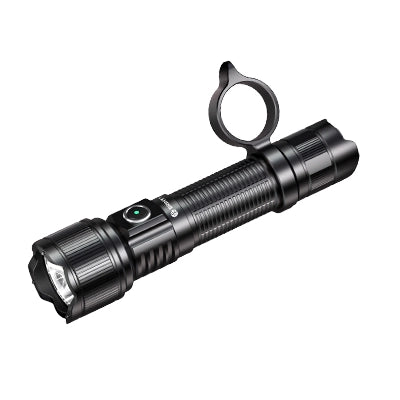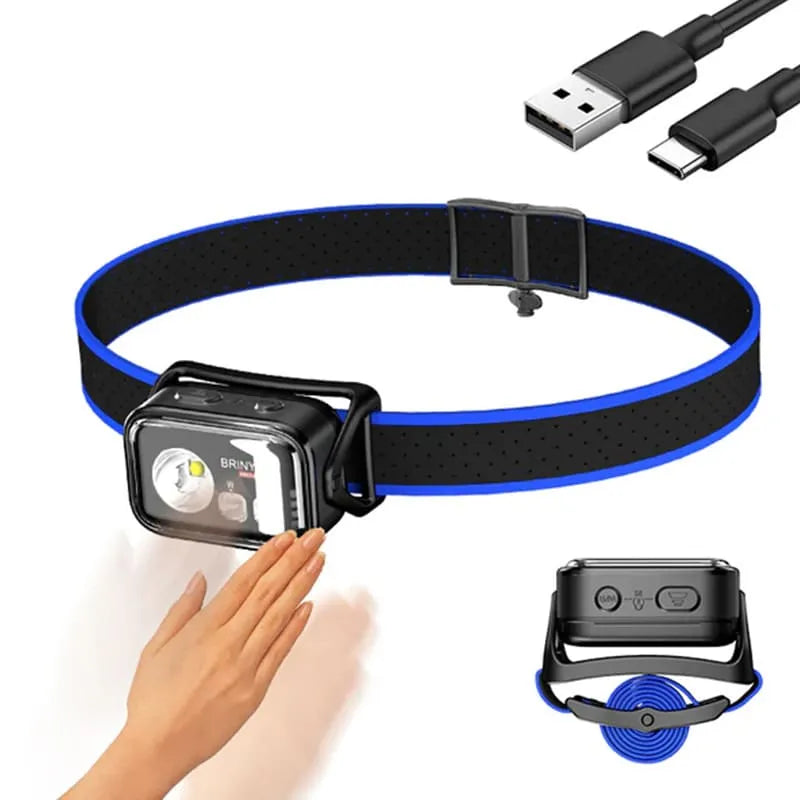


⚡ TL;DR — LEP Explained in 30 Seconds
LEP (Laser-Excited Phosphor) is the newest frontier in flashlight technology — it uses a blue laser to excite phosphor, creating a super-concentrated beam that can reach kilometers with almost zero spill. Traditional LEDs create wide, useful flood; LEPs create a "lightsaber" pencil beam for extreme long-range spotting.
✅ Incredible throw: 1,000–5,000+ meters — 5–10x farther than most LEDs
✅ Low lumen, high candela: 500–900 lumens but 500k–2M+ candela
✅ Zero lumen degradation: Consistent brightness until battery dies
✅ Zero spill: Only the target is illuminated — ideal for stealth
⚠️ Limitations: Costly ($150–$500+), no low modes, narrow beam impractical for close work
👉 Bottom line: LEP is a specialty tool, not an LED replacement. For scanning distant fields, ridgelines, or long-range target ID, nothing beats LEP. For walking to your stand, blood tracking, or general use — stick with LED. The smart hunter carries both.
✔ Long-range shooters needing extreme throw for target ID
✔ Anyone confused by lumens vs candela for tactical applications
✔ Early adopters wanting to understand the future of hunting illumination
1. What Is LEP? Understanding the Technology
LEP stands for Laser-Excited Phosphor — a fundamentally different way of generating white light. While LEDs emit light directly from a semiconductor chip across a relatively large area (1–5mm²), LEP uses a focused blue laser beam (approximately 450nm wavelength) that strikes a tiny phosphor element — typically smaller than 0.2mm² — converting the laser energy into broadband white light with extremely high luminance (brightness per area).
This point-source white light can then be focused through precision optics into an incredibly narrow, laser-like beam — what reviewers often call a "lightsaber" or "pencil beam". Unlike LEDs, which naturally produce wide spill, LEP creates almost zero peripheral illumination — only the target is lit.
LEP (Laser-Excited Phosphor) generates white light through a fundamentally different mechanism than LED: a 450nm blue laser excites a sub-0.2mm² phosphor element, producing a point-source white beam that can be collimated into an ultra-narrow pencil beam with virtually zero peripheral spill. This point-source luminance advantage is what enables LEP flashlights to achieve 500,000 to 6,000,000+ candela from just 500–900 lumens — performance that would require 10,000+ LED lumens to match.
2. LEP vs LED: Head-to-Head Spec Comparison

| Metric | LED Flashlight (Typical Thrower) | LEP Flashlight |
|---|---|---|
| Lumen Output | 1,000–5,000+ lm | 200–900 lm (modest) |
| Candela (Intensity) | 10,000–100,000 cd | 100,000–2,000,000+ cd |
| Throw Distance | 100–500m (typical) | 1,000–5,000+ m |
| Beam Pattern | Defined hotspot + wide spill | Extremely narrow "pencil beam" — zero spill |
| Spill Light | Significant peripheral illumination | None — only target lit |
| Lumen Degradation | Gradual decline over runtime | Zero degradation — consistent until shutoff |
| Low Modes | Available (sub-lumen to turbo) | Limited or none — often single high mode only |
| Thermal Management | Mature, widely implemented | Advanced — high-intensity modes generate heat quickly |
| Cost | $30–200 (broad range) | $150–500+ (premium specialty tier) |
3. LEP Performance: Real Numbers from the Field
| Model | Lumens | Throw Distance | Candela | Battery | Price |
|---|---|---|---|---|---|
| Nitecore P40 | 2,000 | 2,900m | 2,130,800 cd | 1 × 21700 | ~$340 |
| Maxtoch Owleyes W PRO v2 | 1,200 | 4,000m | 4,000,000 cd | 2 × 21700 | ~$430 |
| Weltool W4 PRO TAC | 568 | 3,394m | 2,882,000 cd | 1 × 21700 | $279–300 |
| Acebeam W10 Pro | 750 | 1,420m | 504,000 cd | 1 × 21700 | $299.99 |
| Acebeam W50 2.0 | 1,900 / 2,200 | 5,062m | 6,405,961 cd | 8 × 18650 | $2,999–$4,200 |
4. Hunting Applications: When LEP Excels (and When It Doesn't)
✅ LEP EXCELS WHEN:
- Scanning distant fields at night — A 1,000m+ beam lets you spot hogs or coyotes from a mile away
- Positive target ID at extreme range — The narrow, intense beam shows exactly what's out there
- Signaling or location marking — The beam is visible from enormous distances
- Night wildlife observation — Zero spill means you don't alert animals you're not targeting
- Spotting game in open terrain — Deserts, prairies, agricultural fields, powerline cuts
- Paired with night vision gear — Some LEPs offer IR versions for covert observation
⚠️ LEP STRUGGLES WHEN:
- Walking to your stand in the dark — No spill means you can't see your feet or surroundings
- Blood tracking — UV or wide flood is far better; LEP's narrow beam misses the trail
- Close-range work — The beam is so narrow and intense it's impractical inside 50 yards
- Budget hunting — Quality LEPs start around $150–200, with top models $300–500+
- All-in-one solutions — LEP cannot replace your everyday LED hunting light; they complement, not replace
- Dense woods or thick cover — The beam gets blocked easily; wide flood is better for timber
5. The Spill Factor: Why Zero Spill Is Both Advantage and Limitation
Perhaps the most distinctive characteristic of LEP is its near-zero spill. Unlike LEDs, which create a wide cone of peripheral illumination around the hotspot, LEP produces a razor-thin beam that illuminates only what you aim at.
This has major implications for hunters: Advantage: You can scan a field without lighting up the entire landscape — reducing the chance of spooking game that's outside your target area. Your presence remains hidden while you identify targets at extreme range. Disadvantage: You cannot use an LEP as your primary walking or navigation light. With zero spill, you won't see roots, rocks, or obstacles at your feet. You cannot track a blood trail — the narrow beam will miss most of the trail entirely. You cannot scan for movement across a wide area; you have to methodically "paint" the landscape point by point.
6. Lumen vs. Candela: What Actually Matters for Long-Range Hunting
Many hunters obsess over lumens — but for long-range illumination, candela is the number that matters. Lumens measure total light output in all directions; candela measures intensity in a specific direction — how far the light actually throws. LEP lights typically have modest lumen ratings (200–900 lm) but astronomical candela (500k–2M+ cd), producing throw distances that LED lights would need 10,000+ lumens to match. For scanning a distant ridgeline or positively identifying a coyote at 800 yards, candela is the spec that matters. For walking to your stand or navigating thick timber, lumens (and beam flood) matter more. This is why LEP is a specialist tool for long-range applications, not a general-purpose replacement for LED.
For long-range hunting applications beyond 300 yards, candela — not lumens — is the critical specification. Lumens measure total light output (flood); candela measures beam intensity (throw). An LEP light producing 500 lumens at 500,000 candela will positively identify a target at 1,400+ meters; an LED light producing 3,000 lumens at 50,000 candela may only reach 450 meters. The candela-to-lumen ratio is the key metric for assessing a flashlight's long-range hunting capability: LEP achieves 400–3,000 cd/lm; LED achieves 5–50 cd/lm.
7. Market Trends: The Rapid Evolution of LEP Technology
The LEP flashlight market is experiencing robust growth, driven by advancements in laser technology and increasing demand for high-performance lighting solutions. The global LEP market was valued at $93.4 million in 2024 and is projected to reach $181 million by 2031 — nearly doubling in seven years. Key trends include ultra-long-range models exceeding 4,000 meters, enhanced battery efficiency with USB-C charging, and integration of waterproofing (IP68) and zoom capabilities. Leading brands like Acebeam, Weltool, Lumintop, and Maxtoch are driving innovation. Major manufacturers are also introducing dual-head hybrid designs — combining an LEP spotlight with a ring of LED floodlights in a single flashlight — solving the "zero spill" limitation. As production scales, prices are gradually becoming more accessible, though LEP remains a premium-tier technology.
8. Brinyte's Position: The Practical Hunting Light Philosophy
At Brinyte, our philosophy has always been "engineered for the mission" — building lighting tools that solve real problems for real hunters. Since 2009, we've focused on what works in the field, not just what looks impressive on a spec sheet. Our T28 series pioneered integrated tri-color hunting lights (red/green/white) with patented rotary switching. Our XP22 MK3 delivers ultra-low profile weapon lights for rifles and carbines. Our ZT40 offers zoomable versatility for mixed terrain.
What about LEP? We're actively monitoring LEP technology and its evolution. Our research and development team is exploring how LEP might integrate into Brinyte's product line — but only when the technology genuinely serves the hunter's needs, not just for the sake of innovation. We believe the next generation of hunting lighting will likely be hybrid — combining the extreme throw of LEP with the practical flood and color versatility of LED in a single, field-ready package. We're not there yet, but we're watching closely.
LEP is the future — but not the present for every hunter
LEP technology is genuinely revolutionary for long-range illumination — nothing else throws light like an LEP. For hunters who regularly scan open fields, powerline cuts, or desert terrain at night, an LEP is a game-changing tool that can spot game from distances you didn't think possible. But LEP is not a replacement for your existing LED hunting lights. It's a specialized addition to your kit — the long-range spotter that complements your red/green/white LED for the approach, scanning, and recovery. For most hunters, the smart move is to keep your reliable LED hunting light and add an LEP as a secondary spotter. As prices continue to drop and hybrid designs mature, LEP will become more accessible. Brinyte is watching this space closely — and when the technology is ready for the everyday hunter, we'll be ready too.
📥 Free PDF: LEP vs LED Hunting Light Comparison Guide
One-page printable comparison of specs, applications, pros/cons, and buying considerations for LEP vs LED hunting lights.
❓ Frequently Asked Questions
What is LEP technology in flashlights?
LEP (Laser-Excited Phosphor) uses a blue laser focused onto a tiny phosphor element to generate an extremely concentrated point-source white light beam. Unlike LEDs, which emit light from a larger semiconductor chip, LEP creates a near-laser beam with almost zero peripheral spill and dramatically higher candela (beam intensity). This enables LEP flashlights to achieve throw distances of 1,000–5,000+ meters.
Is LEP better than LED for hunting?
LEP is better for extreme long-range spotting — scanning distant fields, ridgelines, and identifying targets at 1,000+ meters. LED is better for general hunting tasks: walking to your stand, close-range scanning, blood tracking, and everyday use. The best approach for serious night hunters is to carry both — an LEP as a long-range spotter and an LED for navigation and approach.
How far can an LEP flashlight throw?
Consumer LEP flashlights currently range from 1,000 to 5,000+ meters of throw. The Nitecore P40 reaches 2,900m, the Weltool W4 PRO TAC reaches 3,394m, the Maxtoch Owleyes W PRO v2 reaches 4,000m, and the Acebeam W50 2.0 holds the production record at 5,062m (over 3 miles) with 6,405,961 cd.
Why do LEP flashlights have zero spill?
LEP generates light from a point source (sub-0.2mm² phosphor element), which can be collimated through precision optics into a near-perfect parallel beam. LEDs emit from a much larger chip (1–5mm²), which naturally produces wide peripheral spill. The LEP's point-source advantage enables the zero-spill pencil beam.
What matters more for long-range hunting — lumens or candela?
For long-range hunting beyond 300 yards, candela is the specification that matters. Candela measures beam intensity and determines how far the light throws. LEP flashlights achieve dramatically higher candela-to-lumen ratios (400–3,000 cd/lm) compared to LED (5–50 cd/lm), making them superior for extreme-distance target identification despite their modest lumen output.
Does Brinyte make LEP flashlights?
Yes. Brinyte has released the LZ01 LEP searchlight, delivering 425,000 candela and 1,300m beam distance in a compact 199g form factor with IP68 waterproofing. While Brinyte continues to develop its LEP technology, our current hunting light lineup (T28, ZT40) remains LED-based with multi-color and zoomable features optimized for practical hunting applications.
About Brinyte
Brinyte was founded in 2009. Since then, we have designed hunting and tactical lighting with direct input from working hunters, law enforcement, and outdoor professionals. Our team tests every product across real-world conditions — from Texas hog hunts to Wisconsin winter coyote stands. Brinyte holds 50+ patents and ISO9001 certification. This LEP guide is based on verified product specifications, independent reviews, market research, and field experience.
👉 About Brinyte | Hunting Light Collection | About the Author
"Engineered for the mission — proven in the field."
Founded 2009 · 50+ Patents · ISO9001