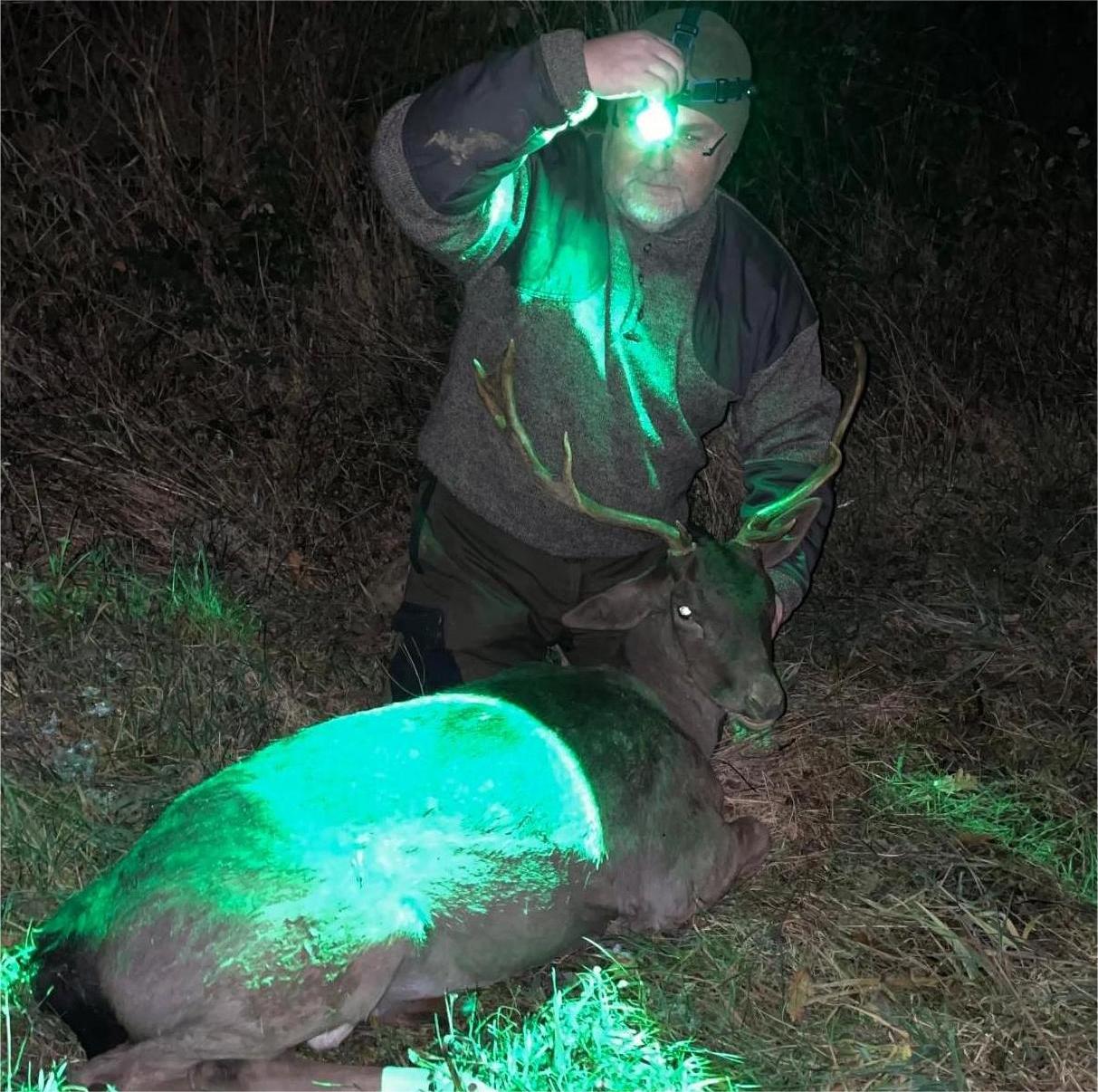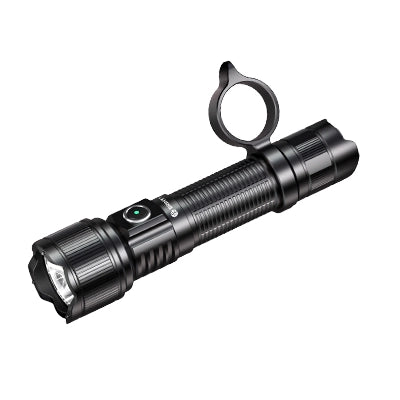


I got to the property around 9 p.m. It was a stretch of public land about an hour outside Austin — one of those Texas Wildlife Management Areas that opens for hog hunting in the fall. If you've ever hunted public land in Texas, you know the drill: you show up early, you find a spot that looks promising, and you hope the guys who were there last week didn't scare everything off.
November in the Hill Country is a crapshoot. One night it's 40 degrees and clear, the next it's 70 and humid. That night we got lucky — clear sky, no moon, just cold enough that the hogs would be moving early. I had a 16-inch AR, a good shooting stick, a thermos of coffee, and a T28 Artemis I'd been wanting to put through its paces.
I'm not going to tell you this is some kind of scientific test. It wasn't. It was just one guy, one night, one piece of public land, and a sounder of hogs that didn't know I was there.
If you hunt multiple predators and you're tired of carrying three separate lights or swapping modules in the dark, the T28 is worth a serious look.
I took one to Texas in November 2025 and spent a night with a sounder of hogs at 200 yards. The rotary color switch, stepless dimmer, and zoomable beam worked like they were supposed to. The 21700 battery lasted the whole night with plenty left over. It's not the lightest thing on the market, and the Fresnel lens has some optical quirks at tight focus, but for a hunter who needs red, green, and white in one package, it's one of the best options under $120.
1. The Setup: Mounting the T28 and Getting Situated
I mounted the T28 using the included Picatinny clamp. It took about 90 seconds — slide it onto the rail, align the teeth, torque the screw with the hex key they provide. Solid as a rock. No wobble. I don't run a pressure switch on this particular rifle, so I was using the tail switch exclusively.
The light weighs 222g without the battery. With the battery and mount, you feel it on the front of a carbine, but it's not unmanageable. I've run heavier lights. The 54mm head is larger than a typical single-color hunting light, so it changes the balance point slightly — you notice it when you first shoulder the rifle, but you stop noticing it after about 20 minutes of walking and scanning. It's the kind of thing that bothers you for the first five minutes and then you just adjust.
The property was a mix of wheat stubble and creek-bottom brush — the kind of terrain hogs love because they can feed in the open and bolt into thick cover if they get nervous. I set up on the downwind side of a field that looked like it had been rooted up recently, about 200 yards from the tree line.
The light felt solid. The anodizing was consistent, the threads were smooth, and the rotary switch had a clean detent action. It didn't feel like a cheap light. I've handled plenty of budget lights that have gritty threads and loose tolerances — this wasn't one of them.
2. The Sounder: 11:15 p.m., 200 Yards Out
I'd been sitting for about an hour when I heard them — the unmistakable sound of hogs rooting through dry grass along the creek line. I clicked the T28 on. Green, still on flood, dimmed down to what I'd guess was about 15% power. The hogs kept feeding.
I started moving in, slow and low. At about 120 yards, I twisted the head to tighten the beam from flood to spot. The transition was smooth — no clicking, no sudden change in brightness. The hogs kept feeding.
At 80 yards, I rotated the color selector ring to switch from green to red. That's where I noticed something I actually liked: the detent wasn't a click — it was a solid, deliberate engagement, like shifting a well-built manual transmission into gear. You feel it lock into place, but it doesn't make a sound that would carry across a field. One of those little engineering details that tells you someone actually thought about how this thing would be used in the dark.
The beam shifted instantly. No flicker, no delay, no need to cycle through modes. Just green one second, red the next.
At 50 yards, I dialed the brightness down to what I'd guess was about 5% — just enough to see the outline of the boar. The hogs had no idea I was there.
I didn't take a shot that night — didn't have the right tags for that particular WMA — but I learned everything I needed to know about the light.
3. Specs at a Glance
Here's what the T28 actually delivers, based on the official specs and what I saw in the field:
| Mode | Output | Beam Distance | Runtime (approx.) |
|---|---|---|---|
| White (Flood) | 1,000 lm | — | ~2.5 hrs |
| White (Spot) | 560 lm | 700+ m / 125,000 cd | ~2.5 hrs |
| Green (Spot) | 120 lm | 350+ m / 28,750 cd | ~5.5 hrs |
| Red (Spot) | 80 lm | 280+ m / 19,500 cd | ~5 hrs |
The white spot numbers are impressive — 700+ meters of throw at 125,000 candela. In real terms, that means you can identify a target at 300-400 yards on a clear night. Green and red have less throw, but that's fine — you're not using them for long-range ID anyway.
What these numbers don't tell you: how the light feels in your hand, how the switch responds, how the beam looks on dirt and grass instead of a white wall. That's what the rest of this is for.
4. What Worked in the Field

The Rotary Color Switch
This is the headline feature. Rotate the ring on the head of the light, and you switch between white, red, and green LEDs instantly. No unscrewing the head, no swapping modules, no fumbling with filters in the dark.
In the field, this meant I could scan with green at 200 yards, switch to red at 80 yards, and switch back to green for tracking — all without taking my eyes off the sounder. The detents are positive enough to feel through gloves, and the rotation is smooth but not loose.
The Stepless Dimmer
The tail switch provides smooth brightness control from 2% to 100%. No preset steps, no sudden jumps. You start at minimum and dial up slowly — the hogs never spook because they never see a sudden change in light.
This is the feature I didn't expect to care about. After using it, I wouldn't buy a hunting light without it. The ability to dial in exactly the right amount of light for the distance is genuinely useful.
The Zoom
The T28 zooms from 6° spot to 70° flood. I used flood for walking and scanning, spot for identifying targets at distance. The transition is smooth, and the beam stays reasonably clean across the zoom range.
At 70° flood, the T28 lights up a massive area — I could see 50 yards in every direction without sweeping the rifle. At 6° spot, I could pick out individual hogs at 200+ yards.
The Battery Life
Four hours of mixed use, and the battery still had plenty of charge. The 21700 5000mAh cell is a big upgrade from the 18650s in older hunting lights. More capacity, longer runtime, and you can swap in a standard 21700 if you need to — you're not locked into a proprietary battery.
If you're tired of carrying three lights or swapping modules in the dark, the T28 solves those problems. The color switch, dimmer, and zoom all work together to make one light that actually does what you need in the field.
5. What Didn't — And What You Should Know

No light is perfect. Here's what I noticed about the T28 that you should know before buying.
The Fresnel Lens Quirks
At tight focus (6° spot), the beam has some visible ring artifacts — concentric circles that look like tree rings. This is a characteristic of the Fresnel lens design. The Fresnel lens is what keeps the head weight down to 222g instead of something heavier.
Does it matter in the field? No. At 200+ yards on dirt and grass, you won't notice it. If you shine it on a white wall at 10 yards, you'll see the rings. This is a tradeoff for having a zoomable light that doesn't weigh a ton.
Independent reviewers at 1Lumen noted the T28 "produces a nice, uniform beam without any obvious donut holes" and that the light is "a great size and fits well in the hand" (archived Jun 2025). They also called the smooth anodization "a great quality feeling."
Weight and Balance
At 222g with a 54mm head, the T28 is heavier and bulkier than a typical single-color light. On a lightweight AR, you'll feel the difference in balance. I got used to it after about 20 minutes, but it's worth noting. If you're building an ultralight rifle, this might not be the right light for you.
IP66, Not IP68
The T28 is IP66 rated. That means it's dust-tight and protected against powerful water jets. It'll survive heavy rain, mud, and hose-down cleaning. It is not designed for submersion. Don't drop it in a creek.
Amazon users have also weighed in. One verified buyer noted that "the ability to turn the power up and down is really nice" and that "red/green/white is just a turn of the head, super easy and the colors are true and bright" (archived Jun 2025). Another mentioned that "when hunting having the white in between the red and green is a big miss. You will always hit the white" — a valid criticism of the rotary switch layout.
The Dimmer Has No Markings
The tail rotary switch has no markings. In total darkness, you can't tell whether you're at 10% or 50% brightness without looking at the beam. You learn to feel the rotation after a while, but it's a minor inconvenience.
6. The Verdict: Who Should Buy the T28
Buy the T28 if:
- You hunt multiple predators (coyotes, hogs, deer) and need different colors for different scenarios
- You're tired of carrying three separate lights or swapping modules in the dark
- You value silent operation — the dimmer and rotary switch make zero noise
- You want USB-C charging and a 21700 battery for all-night runtime
- You want a zoomable beam for both scanning wide fields and locking onto distant targets
- Your budget is around $90–110 and you want the most versatile hunting light in that range
Skip the T28 if:
- You only hunt one species with one color — a dedicated single-color light will be lighter and cheaper
- You're obsessive about beam quality at all distances — the Fresnel lens artifacts at tight focus will bother you
- You need submersion waterproofing — the T28 is IP66, not IP68
- You're building an ultralight rifle and can't afford the 222g weight and 54mm head size
📚 Keep Reading — More Night Hunting Content
If This Review Helped, Here's the Full Setup
The T28 Artemis — tri-color, zoomable, USB-C rechargeable. Comes with battery, cable, and lanyard. If you're mounting it on a rifle, grab the BRM12 mount and RM28 remote switch separately.
See T28 Artemis on Brinyte →7. Frequently Asked Questions
Does the T28 shift zero when changing colors?
No. The T28 uses a fixed tri-LED design with all three emitters aligned on the same optical axis. When you rotate the color switch, the beam stays centered — no zero shift.
How far can the Brinyte T28 shine?
White spot mode delivers 700+ meters of throw with 125,000 candela — enough to identify targets across 500-yard pastures. Green spot reaches 350+ meters, red spot 280+ meters.
Can the T28 survive .308 recoil?
Yes. The T28 is rated for 1m impact resistance and has been tested by hunters on .308, 6.5 Creedmoor, and 12-gauge platforms. The 21700 battery stays centered under recoil.
How long does the battery last?
White flood: ~2.5 hours. Green: ~5.5 hours. Red: ~5 hours. On a typical night hunt with mixed use, the T28 will easily last a full 8-hour sit. The included 21700 5000mAh battery charges via USB-C in about 3 hours. You can also swap in a standard 21700 if you need to.
Is the T28 waterproof?
IP66 — dust-tight and protected against powerful water jets. It handles heavy rain, mud, and hose-down cleaning. Do not submerge it. If you need submersion waterproofing, look for an IP68 light.
What's the difference between the T28 and the T28-IR?
The standard T28 has white, red, and green LEDs for visible-light hunting. The T28-IR replaces red and green with 850nm and 940nm infrared for use with night vision devices.
About Brinyte
Brinyte Field Testing Team — We're hunters and gear testers who spend our nights in Texas brush, Georgia river bottoms, and Alabama creek beds. Every product in this review has been tested in real field conditions — not just on a bench. Brinyte was founded in 2009 and holds 50+ patents and ISO9001 certification.
"Engineered for the mission — proven in the field."
Founded 2009 · 50+ Patents · ISO9001