

Introduction
In tactical, home-defense, and low-light environments, one mistake stands above all others:
- Failing to identify the target before acting.
Whether you’re a defender, a security professional, or simply moving through your home during a nighttime disturbance, proper low-light search & identification (ID) skills can determine whether a situation ends safely—or goes very wrong.
This guide breaks down real, field-tested methods used by professionals, adapted for everyday users, and illustrated with Brinyte tactical lights like PT28, PT16A, and XP22 PRO.
Why Low-Light Identification Matters
Most high-stress mistakes happen because the user either:
- turns the light on at the wrong moment
- uses the wrong brightness
- exposes their position unnecessarily
- searches incorrectly and loses situational awareness
A tactical flashlight isn’t just a light source—
- A target identification tool
- A navigation tool
- A de-escalation tool
- And sometimes, a lifesaving tool
Mastering low-light ID means controlling what you see, when you see it, and how you reveal yourself.

The Core Principles of Safe Low-Light Search
Use Light in Short, Controlled Bursts (Flash–Move–Flash)
Professionals rarely leave their light on continuously.
Instead, they:
- Flash the light briefly
- Gather information
- Move to a new angle
- Flash again
Benefits:
- Avoids exposing your exact position
- Reduces the chance of blinding yourself off walls
- Preserves night vision
- Provides cleaner room-by-room information
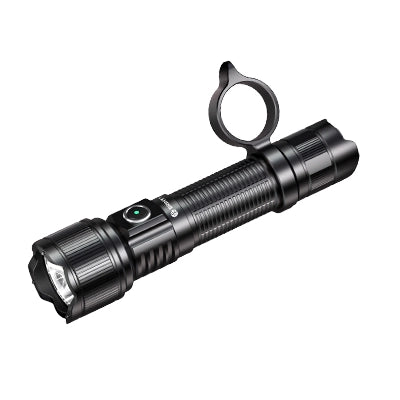
Brinyte PT28 is ideal here with its instant momentary activation and balanced beam.
Avoid “Target Fixation”—Scan, Don’t Tunnel
Poor lighting technique causes users to stare directly at the center hotspot—and miss important peripheral details.
Use:
- the spill beam to check movement
- the edge of the hotspot to reduce glare
- a higher viewpoint when possible to avoid back-reflection
A tactical beam like Brinyte PT16A provides strong throw for long-range ID without overwhelming close spaces.
Bounce Light Off Walls Instead of Shining Directly
To avoid overexposing a hallway or blinding yourself:
- Point the light toward a wall
- Use diffuse reflection to illuminate the area
- Maintain concealment while gathering information
This technique is especially effective in homes or narrow spaces.
Keep the Flashlight Away from Your Centerline
Holding your light in front of your chest = exposing your most vital area.
Safer options include:
- Harries grip (light hand braced under firearm arm)
- Neck index (light beside the head, for quick directional shifts)
- Modified FBI technique (light held high and away from the body)
These reduce the likelihood of a threat targeting your torso if they shoot toward the light source.
Tactical Search Patterns: How Professionals Actually Move
Threshold Evaluation
Instead of entering a dark room immediately:
- Stay at the “threshold”
- Use angled light bursts to clear corners
- Identify movement before committing
This prevents walking blindly into an unknown environment.
Slicing the Pie
Move around corners gradually:
- Lean slightly
- Illuminate only the next slice of the angle
- Advance and repeat
This is the safest way to clear hallways, outdoor structures, or thick vegetation.
Long-Range Identification
For outdoor users:
- Use a long-throw beam at medium/high mode
- Confirm the shape, movement, and behavior of the object
- Avoid turbo unless necessary
Brinyte PT16A 3000-lumen thrower excels at long-distance scanning without blowing out details.
Common Mistakes That Lead to Dangerous Misidentification
❌ Using turbo mode at close range
→ Causes white-out, glare, and “loss of detail”
❌ Keeping the light on continuously
→ Reveals your movement pattern and position
❌ Shining the light directly into reflective surfaces
→ Self-blinding hazard
❌ Using a poor grip or low-quality switches
→ Delayed activation under stress
❌ Not training with your chosen flashlight
→ Tactical tools are only as good as your instincts with them
Recommended Brinyte Tactical Lights for Low-Light Search
Brinyte PT28 — Best for Home Defense & Security
- Balanced flood + throw
- Instant strobe
- Excellent for flash–move–flash technique
Brinyte PT16A — Best for Long-Range Identification
- 3000-lumen output
- Tight hotspot for distance ID
- Great for outdoor environments
Brinyte XP22 PRO — Best for Weapon-Mounted Control
- Dual tactical switches
- Instant momentary + strobe
- Ultra-fast target acquisition

Frequently Asked Questions
1. Should I keep my flashlight on continuously while searching?
No. Short bursts (flash–move–flash) improve safety and reduce exposure.
2. What brightness level is best for indoor identification?
300–800 lumens. Higher levels can cause glare in tight spaces.
3. When should I use turbo mode?
Only for outdoor or long-range identification—not indoors.
4. Should I point my flashlight directly at a potential threat?
Not initially. Use spill beam first, then increase intensity as needed.
5. What grip works best for low-light search?
Harries or neck-index grips provide control and fast angle changes.
6. Is a strobe feature useful for identification?
Strobe is best for disorientation—not for clean identification.
7. What beam type is better for search tasks?
A balanced beam (like PT28) gives the most usable indoor/outdoor versatility.
8. Why avoid holding the flashlight centered in front of your body?
It can draw a threat’s attention to your vital zone.
Conclusion: Control Your Light, Control the Situation
Low-light search isn’t about having the brightest flashlight—it’s about using light intelligently.
By mastering:
- light discipline
- controlled bursts
- correct grip
- proper beam angles
- situational awareness
…you dramatically reduce risk and increase clarity.
Whether you rely on Brinyte PT28, PT16A, or XP22 PRO, Brinyte tactical flashlights are engineered for real-world identification—not just specs on a box.