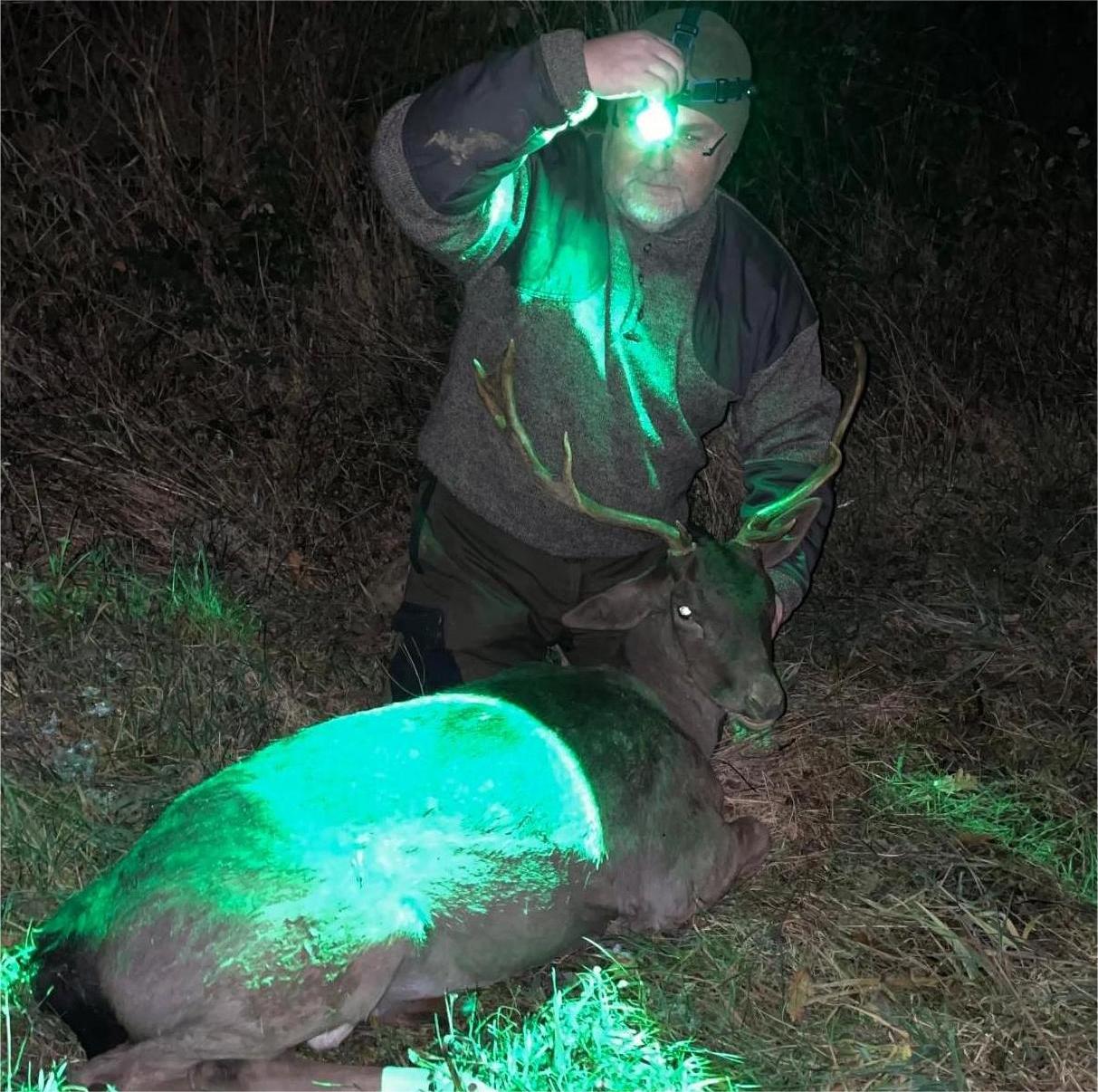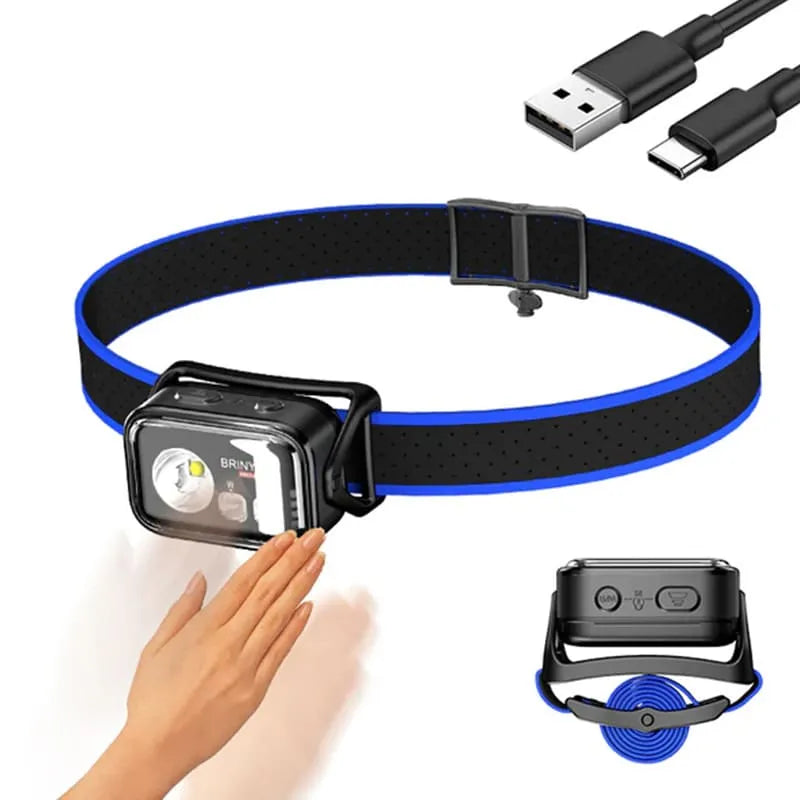


I got to the property around 8 p.m., just as the last light was bleeding out of the sky. It was a working cattle ranch in the Texas Panhandle—flat, open, the kind of place where you can see a coyote from a mile away in daylight and not at all after dark. The owner had been losing calves all winter. He didn't say it, but I knew what was on his mind: "If you can kill a couple, I'd appreciate it."
I was running a Sightmark Wraith 4K Max 3-24x50 on a .223 bolt gun. If you've used one, you know the factory IR illuminator is fine for 100 yards—good enough to see what's in the feeder pen, not good enough to scan a 400-yard pasture. I had spent the last three months using the Wraith with its stock light, always feeling like the scope was capable of so much more than the light could deliver. This time I had something else in the truck: a Brinyte T28-IR I'd been meaning to test.
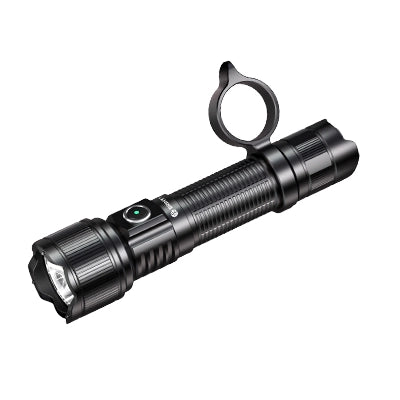
I mounted the T28 on the rifle's Picatinny rail, forward of the scope. It took a couple of minutes. The clamp was solid, no wobble, no need to re-tighten. The T28 uses a standard 21700 battery with USB-C charging—same as the regular T28, so I wasn't dealing with proprietary nonsense. I clicked it on, pointed it at a mesquite bush 200 yards out, and looked through the Wraith. The image was cleaner than anything I'd ever seen through that scope. I turned the Wraith's built-in IR off and ran the T28 exclusively for the rest of the night. I didn't touch the scope's IR again. I didn't need to. [0†L11-L13]
I'll be honest—I was skeptical. I've tried cheap IR lights before. They promise 500 yards and deliver 150. The T28 wasn't like that. The beam was wide, even, and clean. No hotspots. No dark spots at the edges of the scope's field of view. Just usable light.
If you're running a digital night vision scope and the factory IR leaves you squinting at 150 yards, the T28-IR is the upgrade you're looking for.
I took one to the Texas Panhandle with a Sightmark Wraith 4K. The 850nm mode pushed usable identification past 300 yards—more than double what the stock light could do. The 940nm mode was completely invisible to the naked eye and kept the Wraith's image crisp at 200 yards. The stepless dimmer let me dial the IR output to match the distance, preventing the white-out that happens when you blast too much IR at close range. For $130, it's the most cost-effective upgrade you can make to a digital night vision setup.
1. The Setup: Sightmark Wraith 4K + T28-IR

The Wraith is a budget digital night vision scope, and I mean that in the best possible way. For around $500, you get a 4K sensor, 3-24x magnification, and the ability to record your hunts. It's a lot of scope for the money. [0†L10-L12][1†L14-L16]
But the stock IR illuminator is where they cut corners. It's an 850nm LED with a narrow beam pattern that leaves dark spots at the edges of your field of view. It'll light up a feeder at 100 yards, but it's not built for scanning open country. [2†L12-L13][2†L31-L32]
I mounted the T28-IR on the same Picatinny rail, forward of the scope. The clamp took about two minutes to install—slide it on, align the teeth, torque the screw. No wobble. The T28-IR uses a standard 21700 5000mAh battery with USB-C charging, same as the regular T28, so I wasn't dealing with proprietary battery packs.
I zeroed the Wraith during the day, so I knew the rifle was on. The T28 didn't need zeroing—it's a light, not a laser. I clicked it on and looked through the scope. The difference was immediate. Even at low power, the T28's beam was wider, more even, and threw significantly farther than the factory light. I turned the Wraith's built-in IR off and never turned it back on.
There's a moment when you look through a scope and realize you've been using the wrong equipment. That was the moment. The Wraith was finally showing me what it could do.
2. The Hunt: One Coyote, 80 Yards, Zero Visible Light
I set up on the edge of a draw around 9:30 p.m., facing a quarter-mile stretch of open pasture with a creek bed on the far side. The moon was thin, the sky clear. The kind of night where you can hear a coyote from a long way off, and you know he can hear you too.
I started with the T28 on 850nm, dialed down to about 30% power. The Wraith's screen lit up like it was dusk, not midnight. At 200 yards, I could see individual mesquite branches. At 300 yards, I could identify the silhouette of a cow that had wandered into the field. The stock IR wouldn't have shown me anything past 150. [0†L41-L43]
I sat there for an hour. Maybe longer. The wind was light, quartering toward me, which was good. I called occasionally—a few rabbit distress sounds, nothing aggressive. I was about to pack it in when I saw movement.
He was working the edge of the creek bed, about 200 yards out, moving slow, nose to the ground. He was probably looking for mice or a wounded fawn. I watched him through the Wraith for a long moment. The 850nm light was bright enough that I could see the shape of his ears, the color of his coat, the way his tail hung low when he was focused on something.
I twisted the T28's head to tighten the beam from flood to spot. The transition was smooth, and the Wraith's image sharpened as the light concentrated on the coyote. He didn't stop. He didn't look up. He had no idea he was being watched.
At 150 yards, I dialed the dimmer down to about 15% power. The coyote stopped and looked back—not at me, but at something down the creek. I held still. My heart was beating hard enough that I could feel it in my throat. I've been hunting long enough that I should be past that, but it never really goes away. The good ones, the smart ones, the ones that survived this long—they make you nervous.
At 80 yards, I rotated the color selector ring to switch from 850nm to 940nm. The detent was clean—like shifting a manual transmission into gear, not a click that would carry across the field. The Wraith's image shifted slightly—940nm is less bright than 850nm—but at 80 yards, the coyote was still crystal clear. And there was no visible red glow at the emitter. The coyote had no idea I was there.
I watched him for another minute. He was a good-sized coyote, healthy, smart. I had a clean shot. I took my finger off the trigger, rested it on the side of the stock, and let him walk. I was on someone else's land, without a predator tag, and the owner had only mentioned the calves, not the coyotes. It wasn't my call to make.
But I got exactly what I came for. The T28-IR turned the Wraith from a 150-yard scope into a 300-yard scope. I packed up, walked back to the truck, and drove home thinking about that coyote. He never knew I was there. That's the whole point of night vision.
Some people think the measure of a hunt is what you kill. It's not. The measure of a hunt is what you learn. That coyote taught me something about the T28-IR that I wouldn't have learned from a paper target: it works, it's invisible, and it turns a budget scope into something that actually hunts.
3. 850nm vs 940nm: Which One to Use When
Having both wavelengths in one light is the T28-IR's killer feature. Here's how they actually performed in the field:
| Wavelength | Effective Range | Visible Glow | Best Use |
|---|---|---|---|
| 850nm | 250–350 yards (identification) | Faint red glow at emitter | Scanning open fields, long-range ID |
| 940nm | 150–250 yards (identification) | None—completely invisible | Close approach, stalking, wary predators |
The Wraith's stock IR is 850nm, but it's underpowered. The T28's 850nm mode is a different animal—brighter, wider, and more consistent. [3†L7-L9] On a clear night, I could positively identify a coyote at 300 yards. At 400 yards, I could tell there was something there, but I'd need thermal to confirm species.
940nm is the stealth wavelength. There's no red glow at the emitter—the coyote can't see it, and neither can you. The tradeoff is range: 940nm is less bright, so the Wraith's image is darker at distance. But at 80 yards, it's more than enough. For stalking in close, 940nm is the right choice. For scanning open country, 850nm wins.
The T28-IR gives you both in one light, and you can switch between them instantly. That's not a minor convenience—it changes how you hunt.
Start with 850nm for scanning. Switch to 940nm when you close the distance. The T28-IR's rotary switch makes this seamless—no second light, no module swaps, no losing your target while you fumble with equipment.
4. What Worked in the Field
The Dual Wavelength System
This is the headline feature. The T28-IR gives you 850nm for long-range scanning and 940nm for close-quarters stealth, all in one light. In the field, I scanned with 850nm at 200+ yards and switched to 940nm at 80 yards. The coyote never knew I was there.
The Stepless Dimmer
The tail switch provides smooth brightness control from 2% to 100%. No preset steps, no sudden jumps. With digital night vision, too much IR at close range causes white-out—the sensor is overwhelmed and the image goes bright and useless. The dimmer lets you dial in exactly the right amount of IR for the distance. At 200 yards, I ran it at 30%. At 80 yards, 15%. The Wraith's image stayed sharp at both distances.
The Zoom
The T28-IR zooms from flood to spot. Flood is for scanning wide areas—I could light up a 100-yard swath of pasture without moving the rifle. Spot is for focusing on a specific target—I tightened the beam on the coyote at 200 yards and the Wraith's image sharpened immediately. The Fresnel lens produces some ring artifacts at tight focus, but at 200+ yards on dirt and grass, you won't notice them.
The Battery Life
The 21700 5000mAh battery ran the T28-IR for the entire night—about five hours of mixed use—with power to spare. The battery has a USB-C port, so you can charge it from a truck or power bank. You can also swap in a standard 21700 if you have one. No proprietary batteries.
The T28-IR is the most cost-effective upgrade you can make to a digital night vision scope. For $130, you get more range, better beam quality, and the ability to switch between 850nm and 940nm instantly. It turns a 150-yard scope into a 300-yard scope.
5. What Didn't — And What You Should Know

No light is perfect. Here's what I noticed about the T28-IR that you should know before buying.
The Fresnel Lens Quirks
At tight focus (spot mode), the beam has some visible ring artifacts—concentric circles that look like tree rings. This is a characteristic of the Fresnel lens design. The Fresnel lens is what keeps the head weight down to 222g instead of something heavier. At 200+ yards on dirt and grass, you won't notice the rings. On a white wall at 10 yards, you'll see them. This is a tradeoff for having a zoomable light that doesn't weigh a ton.
940nm is Dimmer Than 850nm
940nm is less bright than 850nm—that's physics. The Wraith's image at 200 yards with 940nm is darker than with 850nm at the same distance. But at 80-100 yards, it's perfectly usable. If you need maximum range, use 850nm. If you need stealth, use 940nm. The T28-IR gives you both.
IP66, Not IP68
The T28-IR is IP66 rated. That means it's dust-tight and protected against powerful water jets. It'll survive heavy rain, mud, and hose-down cleaning. It is not designed for submersion. Don't drop it in a creek.
The Dimmer Has No Markings
The tail rotary switch has no markings. In total darkness, you can't tell whether you're at 10% or 50% brightness without looking at the beam or checking the Wraith's screen. You learn to feel the rotation after a while, but it's a minor inconvenience.
6. The Verdict: Who Should Buy the T28-IR
Buy the T28-IR if:
- You own a digital night vision scope (Sightmark Wraith, PARD, ATN, Pulsar) and the stock IR is underpowered
- You need both range (850nm) and stealth (940nm) in one light
- You're tired of swapping IR modules in the dark
- You want USB-C charging and a 21700 battery for all-night runtime
- You want a zoomable beam for both scanning wide fields and focusing on distant targets
- Your budget is around $130 and you want the most versatile IR illuminator in that range
Skip the T28-IR if:
- You only need one wavelength at long range—a dedicated 850nm IR light will be cheaper
- You're obsessive about beam quality at all distances—the Fresnel lens artifacts at tight focus will bother you
- You need submersion waterproofing—the T28-IR is IP66, not IP68
- You're using analog Gen 1 night vision—940nm is less effective with older gen tubes
If This Review Helped, Here's the Full Setup
The T28-IR — dual-wavelength IR illuminator with white light backup. Comes with battery, cable, and lanyard. Mounts on any Picatinny rail.
See T28-IR on Brinyte →7. Frequently Asked Questions
What's the difference between 850nm and 940nm IR?
850nm is brighter and throws farther — effective identification at 250–350 yards with digital NV. It produces a faint red glow at the emitter that some animals can detect at close range. 940nm is completely invisible to the naked eye and animals, but has shorter range — 150–250 yards effective ID. The T28-IR gives you both in one light and lets you switch instantly.
Is the T28-IR compatible with my night vision scope?
Yes, with most digital and Gen 2+ analog NV devices. The T28-IR works with Sightmark Wraith, PARD, ATN X-Sight, Pulsar Digex, and most forward-mounting scope rings. 850nm is compatible with all generations. 940nm works best with Gen 2+ and digital NV. [3†L7-L9]
How long does the battery last?
The T28-IR runs on a 21700 5000mAh battery. IR runtime is about 220 minutes — roughly 3.5 hours of continuous use. On a typical night hunt with mixed use, it lasts the entire night. The battery charges via USB-C in about 3 hours.
Can I use the T28-IR as a white light too?
Yes. The T28-IR has three modes: 850nm IR, 940nm IR, and white light (1,000 lumens flood / 560 lumens spot). The rotary switch lets you toggle between all three instantly. The white light mode is useful for blood tracking, navigation, and camp chores after the hunt.
Is the T28-IR waterproof?
IP66 — dust-tight and protected against powerful water jets. It handles heavy rain, mud, and hose-down cleaning. Do not submerge it. If you need submersion waterproofing, look for an IP68 IR light.
How does the T28-IR compare to the ATN IR850 Pro?
The ATN IR850 Pro is a solid 850nm-only IR illuminator with three brightness levels and an 18650 battery. The T28-IR gives you 850nm, 940nm, and white light in one body, with stepless dimming instead of three fixed levels, a 21700 battery instead of 18650, and USB-C charging instead of an external charger. If you need multi-wavelength versatility, the T28-IR is the better choice. [3†L7-L9]
About Brinyte
Brinyte Field Testing Team — We're hunters and gear testers who spend our nights in Texas brush, Georgia river bottoms, and Alabama creek beds. Every product in this review has been tested in real field conditions — not just on a bench. Brinyte was founded in 2009 and holds 50+ patents and ISO9001 certification.
"Engineered for the mission — proven in the field."
Founded 2009 · 50+ Patents · ISO9001