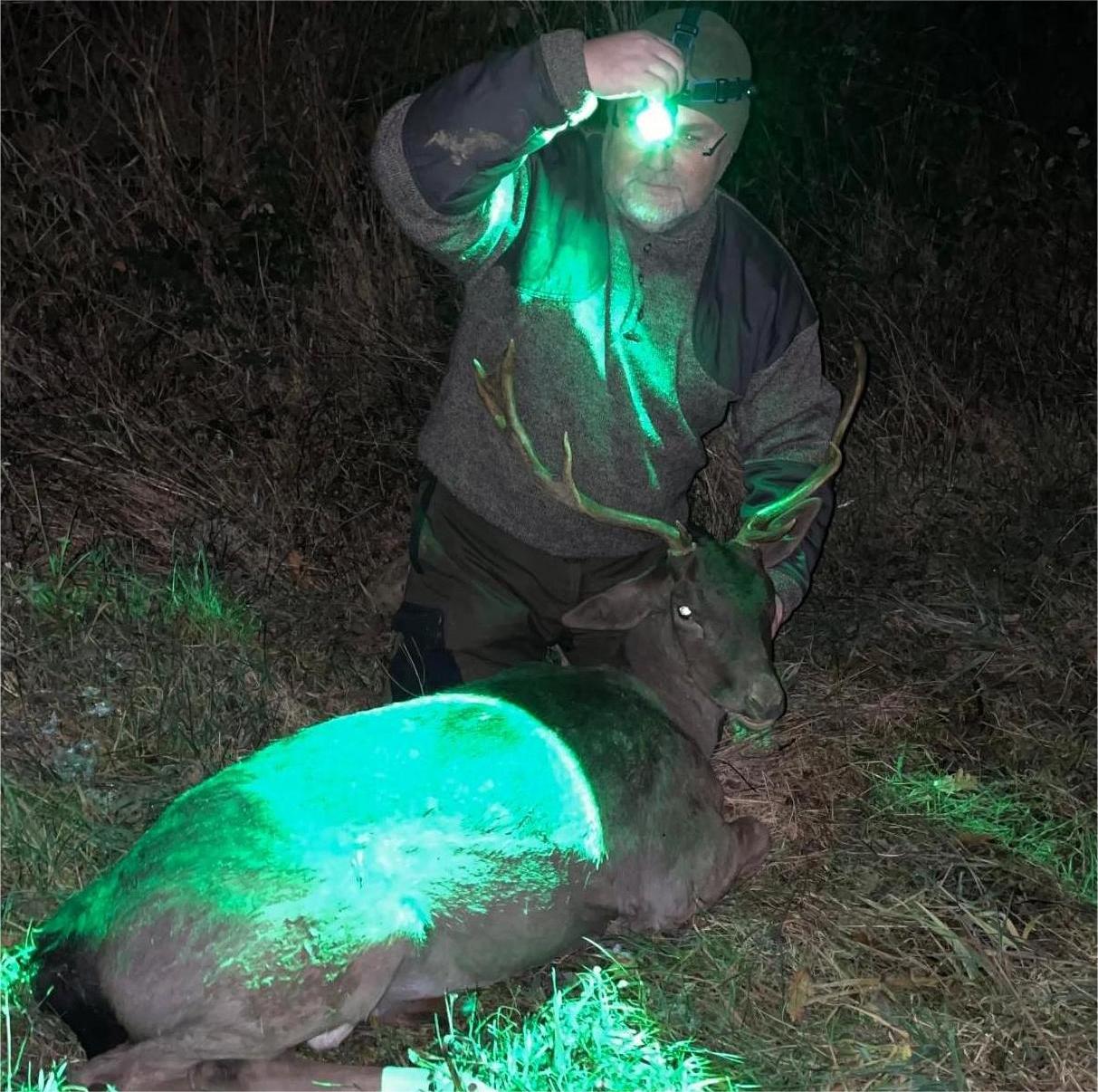


You're shooting at a reflection, not a fish. When your headlamp or handheld light hits the water at an angle, most of the beam bounces off the surface back into your eyes — you see a mirror image of the sky, not the fish below. Compounding this is refraction error: light bends when it enters water, so the fish isn't where it appears to be. The fix is a green bow-mounted light that runs parallel to your arrow — the light enters the water at the same angle as your shot, eliminating both problems. Scroll down for the 30-second kitchen sink test that proves it, and the gear that solves it.

✔ Anyone who's tried night bowfishing with just a headlamp and couldn't figure out why they kept missing
✔ Bank, wading, and kayak bowfishers who want to understand the physics before they buy gear
1. Why You Keep Missing Fish at Night — It's Not Your Aim
It's 10:30 PM on a Texas reservoir. The air is finally cooling off after a 98°F day. You're standing waist-deep in water that feels like bathwater. Ahead of you, in the shallow flats, you can hear carp rolling — big ones, splashing in water barely two feet deep. You spot one. You draw, aim carefully, release — and the arrow hits two feet to the left of where you were aiming. The fish vanishes. You know you aimed correctly. You know you didn't flinch. So why does this keep happening?
Here's the answer that took me years of missing fish to understand: you didn't miss the fish. You shot at a ghost. What you saw — what you aimed at — was not the carp. It was a reflection of the carp on the water's surface, displaced by the angle of your headlamp and bent by the physics of light passing from air into water. Your arrow went exactly where you aimed it. The problem is that where you aimed is not where the fish actually was.
This is the core challenge of night bowfishing, and the rest of this guide is about understanding the physics that causes it — and the one piece of gear that fixes it.
Every missed shot in night bowfishing is caused by one of two optical problems: surface reflection (you see the sky, not the fish) or refraction error (the fish isn't where it appears to be). Both are solved by changing the angle at which light enters the water — not by getting brighter, and not by aiming differently.
2. The Reflection Problem — Why Your Headlamp Is Lying to You

When light hits water at an angle — the way your headlamp does when you're standing waist-deep and looking down — about 70-90% of it reflects off the surface. This is basic optics: the greater the angle between the light source and the water surface, the more light bounces back. Your headlamp is mounted on your forehead. The water is at your feet. The angle is extreme. Most of what you see when you shine a headlamp at the water is a reflection of the sky, the trees, and the light itself — not what's under the surface.
But there's a second problem compounding this. Even the light that does penetrate the surface bends as it crosses from air into water — this is refraction. A fish that is physically 18 inches below the surface appears to be about 12 inches deep. More critically, its apparent horizontal position shifts. Your brain, trained by a lifetime of seeing objects in air, calculates the fish's position based on where the light appears to come from — and that calculation is wrong. You aim at the phantom. The arrow passes harmlessly to the side.
The Bowfishing Country forum has an entire thread dedicated to this phenomenon, titled "Why do I keep missing at night??" with over 60 replies from frustrated bowfishers. The consensus among experienced members: if you're using a headlamp or handheld light as your primary shooting light, you will miss more fish than you hit — regardless of how well you aim.
Surface reflection obscures the target. Refraction displaces it. A headlamp causes both problems simultaneously — the light hits the water at a steep angle, maximizing reflection, and the small portion that penetrates bends unpredictably based on water clarity and surface ripple. The solution is not a brighter headlamp. It's a light that enters the water at the same angle as your arrow.
3. Why Green Light — What Actually Penetrates Murky Water
Once you understand the angle problem, the next question is: what color light gives you the best chance of seeing the fish once the beam does penetrate the surface?
Green light (520-560nm) is the superior wavelength for bowfishing. The physics is straightforward: water absorbs red and infrared wavelengths within the first few inches. White light contains the full visible spectrum — much of its energy is wasted on wavelengths that never reach the fish. Green light sits in the sweet spot where water absorption is minimal and human eye sensitivity is maximal. In typical turbid freshwater — the kind you find in carp and gar habitats — a green light for bowfishing penetrates approximately 2-3× deeper than an equivalent white light.
Green light penetrates murky freshwater 2-3× deeper than white light because water's absorption spectrum is lowest in the green-yellow range. This is the same optical principle that explains why underwater photos look blue-green and why submarine communications use blue-green lasers. For a bowfisher standing in waist-deep water, switching from white to green is the difference between seeing the fish and seeing your own reflection.
4. The Complete No-Boat Setup — Coaxial Green Light + Hands-Free Headlamp
Now we put the physics into practice. You need two lights for a complete no-boat night bowfishing system: one that solves the reflection/refraction problem for shooting, and one that keeps your hands free for navigating to your spot in the dark.
The Shooting Light: Coaxial Green on Your Bow
The light that actually lets you hit fish must be mounted on your bow, not on your head. When the light is mounted directly on the bow, its beam runs parallel to your arrow shaft. The light enters the water at the same angle as your shot — eliminating the angular reflection that makes headlamps useless for shooting. What you see through a bow-mounted green light is the fish's actual position.
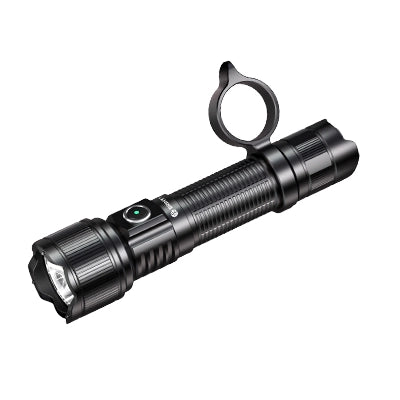
🎯 Brinyte ZT40 Green — IPX8 Submersible Bow Light
IPX8 means it survives a full dunk — drop it in the lake, pick it up, keep shooting. The adjustable zoom lets you flood a wide area to locate fish, then tighten into a spot beam for precise targeting. Smaller and lighter than the T28, the ZT40 is purpose-built for bow mounting without weighing down your setup. This is the coaxial green light that solves the reflection problem described in Section 2.
Shop ZT40 Green →The Navigation Light: Hands-Free Headlamp
Your bow light solves shooting. But you still need to walk to your spot — through mud, over roots, around snakes — without holding a flashlight in your teeth. A wading bowfisher's headlamp needs three things: waterproofing, long runtime, and a red mode that preserves night vision.
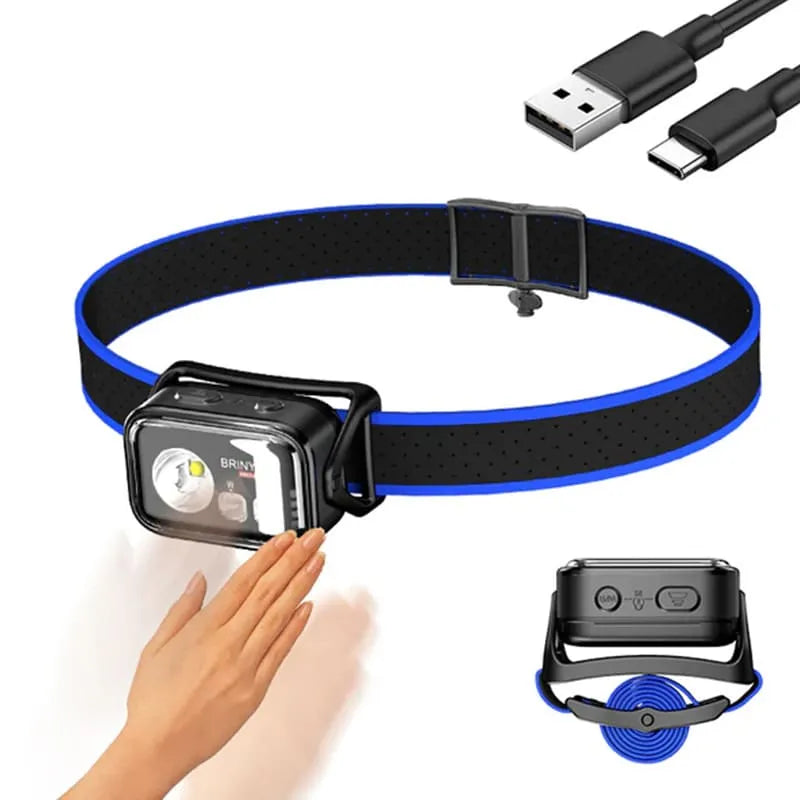
💡 Brinyte HL18 Noctua — 1600 Lumen Wading Headlamp
The 90° rotatable head is the defining feature for bowfishing — point it forward for walking the bank, rotate it down for checking your reel. Red mode preserves night vision during approach. At 120 hours on the lowest setting, it'll outlast your longest night on the water.
Shop HL18 Noctua →No-Boat Lighting: Three Approaches Compared
| Setup | Surface Reflection | Refraction Error | Hands-Free | Cost |
|---|---|---|---|---|
| Coaxial Bow Light + Headlamp | ✅ Eliminated | ✅ Minimized | ✅ Both | ~$180 |
| Headlamp Only | ❌ High — reflects off surface | ❌ Significant | ✅ Yes | $50-100 |
| Handheld Flashlight | ❌ Very high | ❌ Significant | ❌ No | $20-50 |
❓ Frequently Asked Questions — Night Bowfishing
Why do I keep missing fish at night bowfishing?
You're shooting at a reflection, not the fish. Your headlamp or handheld light hits the water at an angle, creating surface reflection that shows you a mirror image. Compounding this, refraction bends the light that does penetrate, displacing the fish's apparent position. The fix is a bow-mounted green light that runs parallel to your arrow — the light enters the water at the same angle as your shot, eliminating both problems.
What is the best light for night bowfishing?
A green bow-mounted light (like the Brinyte ZT40 Green) for shooting — green penetrates murky water 2-3× deeper than white and, when mounted coaxially on your bow, eliminates surface reflection. Pair it with a waterproof headlamp (like the Brinyte HL18 Noctua) for navigating to your spot hands-free.
Why is green light better than white for bowfishing?
Green light (520-560nm) penetrates water 2-3× deeper than white light because water's absorption spectrum is lowest in the green-yellow range. White light contains the full spectrum — most of its energy is absorbed within inches. Green sits in the optical sweet spot for seeing through murky freshwater.
Can I bowfish at night without a boat?
Yes — bank bowfishing and wading bowfishing are the most accessible ways to start. You need a portable, battery-powered lighting system: a green bow-mounted light for shooting and a waterproof headlamp for navigation. The Brinyte ZT40 Green (IPX8, bow-mountable) + HL18 Noctua (IP66, hands-free) system is purpose-built for this exact scenario.
What is the best headlamp for bowfishing?
The Brinyte HL18 Noctua — 90° rotatable head for forward walking and downward gear checks, IP66 waterproof, 1600 lumens Turbo for scanning the opposite bank, and 120-hour runtime on Moonlight mode. Red mode preserves night vision during approach.
What waterproof rating do I need for wading bowfishing lights?
IPX8 minimum for any light that will be submerged — meaning it can survive continuous immersion beyond 1 meter. The ZT40 Green is IPX8 rated and survives a full dunk. For headlamps, IP66 minimum — protected against powerful water jets and heavy rain.
📥 Free Download: Night Bowfishing Quick Reference Card (PDF)
One-page printable: surface reflection vs coaxial lighting diagram, green light comparison table, and complete bank/wading gear checklist.
Stop Shooting at Reflections
The ZT40 Green + HL18 Noctua system is purpose-built for the physics problem that causes every missed fish at night — surface reflection and refraction error, solved with coaxial green lighting.
About This Guide
Founded in 2009 — 50+ patents, ISO9001 certified. Underwater light physics based on publicly available optical absorption spectra for freshwater. Field reports verified through publicly searchable threads on Bowfishing Country (bowfishingcountry.com) and TexasBowhunter (texasbowhunter.com) bowfishing forums. Product specifications per ANSI/NEMA FL1 standard.
👉 About Brinyte | Hunting & Outdoor Lights | About the Author
"Engineered for the mission — proven in the field."
Founded 2009 · 50+ Patents · ISO9001