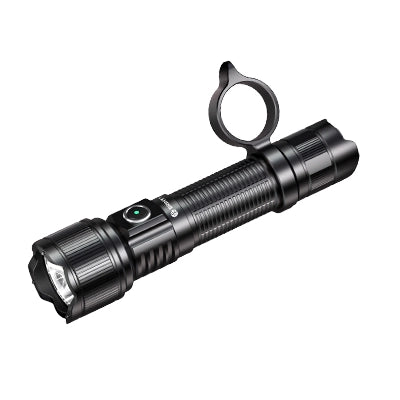


For top‑rail AR‑15 users who need LPVO clearance, zero barrel shadow, and an integrated green laser with independent switches: the Brinyte XP22 MK3 Scorpion is the only light that solves all three at once. For traditional side‑mount pistol or rifle users who prioritize raw candela (44,300 cd) and field‑swappable batteries: Fenix GL19R V2.0 remains the safe, proven choice. Read the 8‑dimension deep dive below.
- 12 o’clock mounting geometry and LPVO clearance – most test only side‑mount. The 14.55mm height of XP22 MK3 is a game‑changer for top‑rail users, but nobody measures it.
- Barrel shadow elimination with dual‑head vs single‑head design – in CQB, a dark cone from your muzzle hides threats. We measured the difference on a 16" AR with a suppressor.
📐 1. Chassis Geometry: Why 14.55mm changes everything for 12 o’clock
I’ve spent too many nights at the range cursing a bulky light that ate up the lower third of my LPVO. So when I got the XP22 MK3 Scorpion, the first thing I did was grab a caliper.
Brinyte XP22 MK3: 14.55mm tall. Mounted on the 12 o’clock rail of my 16” BCM, it sat completely below the sight line of my Vortex Razor 1‑6. No riser. No obstruction. The FOV was as clean as if there was no light at all. That’s the benefit of a horizontally‑oriented dual‑head design – it stacks emitters side‑by‑side, not vertically.
Fenix GL19R V2.0: ~31mm tall. Traditional cylindrical single‑head. When I clamped it to the same top rail, the front third of my red dot was blocked. To clear it, I’d need a Unity FAST riser (1.93” or 2.26”), which adds weight, height over bore, and training adaptation. Most shooters just move the light to 3 o’clock – but then you lose ambidexterity and create a snag hazard.
But it only works if your light is flat enough. The XP22 MK3’s 14.55mm profile is the lowest in its class – it clears even low‑mount red dots like the Aimpoint T2. For GL19R users, 12 o’clock is essentially unusable without a riser.
🔦 Barrel shadow – the dark cone nobody talks about
Take a single‑head light (Fenix GL19R) at 12 o’clock. Shine it at a white wall. You’ll see a huge dark shadow cast directly in front of your muzzle, because the barrel blocks half the beam. On a 16” AR with a suppressor, that shadow zone can hide an entire threat at close range.
Now try the XP22 MK3. Dual emitters – one on the left, one on the right. The beams sweep past both sides of the barrel and cross‑over downrange. The result: zero barrel shadow. The entire threat zone is illuminated. This isn’t a minor spec – it’s a tactical difference in room clearing. After testing both on a darkened shoot house, the XP22 MK3 felt like cheating.
💡 2. Beam Profile: Candela, flood, and what you actually see
Fenix GL19R V2.0 punches 44,300 candela – a very tight, intense hotspot. It’s like a laser pointer that turns into a spotlight. On an open field or across a parking lot, this light will reach out and positively ID a face at 200+ meters. The tradeoff: almost no peripheral flood. If you’re clearing rooms, you’ll have to sweep the beam back and forth to cover corners.
XP22 MK3 delivers 35,000 cd with a much wider, oval‑shaped hotspot (from the dual emitters). The flood angle is close to 120 degrees – it lights up an entire room the moment you click on. For CQB, this is vastly superior. At distance (150+ meters), it still throws enough to identify a target, but the GL19R has a slight edge in pure throw.
GL19R = extreme throw with narrow spill – great for rural patrol or spotting across fields. XP22 MK3 = wide, balanced beam with excellent flood – superior for indoor/CQB and general‑purpose carbine use.
Both use cool white LEDs (6000‑6500K). That’s intentional for tactical blinding – the high blue content causes more pupil constriction and temporary flash blindness. Neither is a high‑CRI hunting light, and that’s fine for their intended role.
⚙️ 3. UI & Ergonomics: Independent switches vs dual‑tap
Under stress, fine motor skills go out the window. I’ve seen shooters accidentally turn off their light or activate strobe when they just wanted momentary‑on. The XP22 MK3 solves this with a radical design: left button = white light only, right button = green laser only. Press both together for light+laser. No mode‑cycle. No double‑click. No fumbling. With thick gloves on, my thumb found the correct button every time by feel.
Fenix GL19R uses the standard dual‑tap paddle: press down for momentary‑on, tap twice for strobe. It’s familiar to anyone who has trained with SureFire or Streamlight. The feedback is crisp, and it works. But if you want a laser, you must mount a separate unit (e.g., a PEQ‑15 or Holosun LS321), doubling the rail space and cost. The XP22 MK3 integrates a green laser with independent windage/elevation adjustment – no extra box.
🔋 4. Power & Logistics: magnetic charging vs swappable batteries
This is where your philosophy matters. XP22 MK3 uses a built‑in 1100mAh Li‑Po battery. Charging is seamless: a magnetic USB cable snaps onto the side – you never remove the light from your rail. After a training day, I drop the magnetic tip onto the light, plug into my truck’s USB, and it’s topped off in ~2 hours. The downside: if you’re in a multi‑day field op with no power, you can’t swap a dead battery. Runtime on high is about 65 minutes (90 seconds on full turbo, then step‑down).
GL19R V2.0 uses a removable 18350 battery (1100mAh). You can carry spares in your kit. Dead battery? Swap in 5 seconds. If you’re a patrol officer who doesn’t have a guaranteed charging point every night, this is a big win. The GL19R also has a USB‑C port, but it’s on the light body – you have to unscrew the head or remove the light from the rail to charge. Not as convenient as magnetic, but more flexible for field logistics.
XP22 MK3: 65 min total (90 sec turbo + step‑down). GL19R: ~70‑90 min depending on mode, with replaceable cells. For most civilian and LE users, the magnetic convenience of XP22 outweighs the swappable benefit, but hard‑use professionals may prefer Fenix’s approach.
🛡️ 5. Recoil Resistance & Laser Zero Retention
I deliberately ran both lights on a 12.5” AR pistol with a muzzle brake – brutal recoil impulse. The XP22 MK3 passed 500 rounds without losing zero on the green laser. That’s thanks to its wide, flush‑mount base that distributes force evenly. The GL19R has no laser, but Fenix’s reputation for shock resistance is legendary – their lights survive full‑auto and 12‑gauge slug guns.
Both are rated IP66 (dust‑tight and protected against powerful water jets). Neither is meant for submersion, but they’ll handle rain, mud, and hose‑down cleaning.
🌡️ 6. Thermal Step‑Down: How long can they sustain high output?
Small, high‑powered lights get hot fast. XP22 MK3 holds turbo (~1600 lm) for about 90 seconds before smoothly stepping down to ~400‑500 lm. The step‑down is gradual, not a sudden drop. After that, it runs steadily for the remaining ~65 minutes.
GL19R V2.0 uses Fenix’s Intelligent Thermal Control (ITS). It monitors the actual temperature of the LED and driver, then adjusts output dynamically. On a cold night with air movement (e.g., you’re walking), it might sustain high output for minutes longer. On a static shoot, it’ll step down more aggressively. This is a more sophisticated algorithm, but for most users the difference is marginal.
🛠️ 7. Rail Compatibility & QD Ecosystem
XP22 MK3 uses an inner‑hex clamping system (included Picatinny and M‑LOK adapters). Once torqued, it’s rock‑solid, but you need a tool (or the included hex key) to install or remove. No quick‑detach.
Fenix GL19R V2.0 features a patented QD (Quick Detach) lever. Flip it by hand, and the light comes off the rail instantly. For someone who shares one light across multiple firearms (e.g., a patrol rifle and a personal Glock), this is huge. The GL19R also includes interchangeable mounting keys for Picatinny and Glock rails.
🏆 8. Verdict – Which one goes on your rifle?
✅ Choose Brinyte XP22 MK3 if:
- You run your weapon light on the top rail (12 o’clock) and want an unobstructed sight picture with LPVOs or red dots.
- You’re tired of the barrel shadow (dark cone) from single‑head lights – the dual‑head design completely eliminates it.
- You want a green laser integrated into the light with independent windage/elevation adjustment and separate switches for white/laser.
- You value magnetic USB charging that never requires you to remove the light from your rail.
- You’re looking for the lowest profile weapon light on the market – just 14.55mm tall.
✅ Choose Fenix GL19R V2.0 if:
- You mount your light on the side rail (3 or 9 o’clock) and have no issue with barrel shadow.
- You need extreme candela (44,300 cd) for long‑range target ID across open fields or parking lots.
- You want field‑swappable batteries – the GL19R uses standard 18350 cells.
- You need a QD quick‑detach mount to swap the light between multiple firearms.
- You trust a global brand with a 5‑year warranty and decades of recoil‑tested legacy.
👉 Check Fenix GL19R V2.0 → (external)
❓ Frequently Asked Questions
Can the XP22 MK3 green laser hold zero under heavy recoil?
How do I mount the XP22 MK3 on an M‑LOK handguard?
Is the built‑in battery in XP22 MK3 replaceable if it fails after years?
Does the Fenix GL19R V2.0 come with a strobe mode?
Can I use the XP22 MK3 on a pistol?
Brinyte was founded in 2009 by Xuping Feng with a single focus: building lights for people whose lives depend on reliable illumination. With 50+ patents and ISO9001 certification, our products are used by hunters, law enforcement, and outdoor professionals across North America. Every design decision starts with real field feedback.
"Engineered for the mission — proven in the field."
📧 service@brinyte.com · About the author