

Vehicle Safety Beyond Home: What Your Mobile Security Setup Is Missing

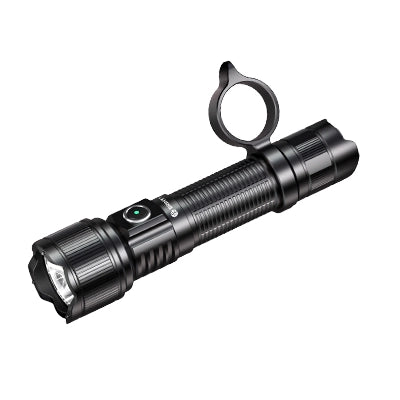
A bright, instantly accessible flashlight is the single most overlooked piece of vehicle safety equipment. The Brinyte PT16 or PT16A, stored in your glove box or center console, gives you three critical capabilities: the ability to illuminate potential threats before you walk into them, a strobe mode that can create a 2–5 second disorientation window for escape, and a hardened strike bezel capable of breaking tempered vehicle glass in an emergency. For legally armed citizens, the XP22 MK3 low-profile weapon light completes the system — but the flashlight alone will handle the vast majority of situations you are actually likely to encounter.
✔ Parents loading kids into car seats at night — distracted and vulnerable
✔ Road-trippers and RV owners stopping at unfamiliar gas stations
✔ Legally armed citizens seeking a vehicle-safe weapon light solution
✔ Anyone who has felt a flicker of unease walking to their car at night
1. The Spaces We Pass Through — And What They Cost Us
There is a category of places that almost everyone moves through every day, and almost nobody thinks about until it is too late. Security professionals call them transitional spaces — the zones between two defined environments. The parking lot between your office and your car. The gas station on a highway you have never driven before. The rest stop at 11 p.m. when your phone says you have another two hours to go. The driveway where you fumble with keys while your back is to the street.
These spaces share three qualities that make them uniquely dangerous: they are neither fully public nor fully private, they are places where people are predictably distracted, and they are locations where help — even if called — is minutes away. A 2023 Bureau of Justice Statistics special report on violent victimization noted that approximately 17% of nonfatal violent crimes occurred in parking lots, garages, or near commercial establishments — locations where victims were in transit between one place and another. This is not a reason for paranoia. It is a reason for preparation.

The good news is that transitional space safety is not about expensive modifications or lifestyle changes. It is about having the right tools in the right places, and the awareness to use them. The most important of those tools — the one that handles the widest range of scenarios — is also the simplest: a reliable, high-output flashlight that lives in your vehicle, not your pocket.
A transitional space is any location where a person moves between two environments — typically between a vehicle and a building, or between a vehicle and an open area. Parking lots, gas stations, driveways, and roadside stops are all transitional spaces. These locations are statistically overrepresented in crime data because individuals are distracted by the transition itself (unlocking a car, pumping gas, checking directions) and because the space is neither fully secured nor fully public.
The most dangerous places are not the ones you fear — they are the ones you pass through every day without thinking. A vehicle safety system that accounts for transitional spaces does not require expensive equipment or lifestyle changes. It requires a flashlight that lives in your glove box, a habit of scanning before you walk, and the understanding that awareness is the cheapest and most effective security tool you own.
2. Building Your Vehicle Safety System — The Core Principle
A vehicle safety system is not a collection of gadgets. It is a layered approach to the specific vulnerabilities of life on the road. The core principle is simple: you should be able to see a potential threat before you are close enough to be affected by it. This means the first layer — before any defensive tool, before any physical barrier — is illumination.
This is where most people have a gap. They carry a phone, which produces 40–80 lumens of unfocused light (manufacturer spec average across major smartphone brands, 2024–2025). They might have a keychain light that runs on a coin cell battery. Neither of these is sufficient to illuminate a parking lot from a safe distance, identify a person's hands, or signal for help from across a rest stop. They are convenience tools, not safety tools.
Q: Why can't I just use my phone flashlight?
A: A phone flashlight produces 40–80 lumens of unfocused light — barely enough to illuminate the ground three feet ahead. It also drains the very battery you need to call for help. A dedicated car flashlight is a safety tool. Your phone's flashlight is a convenience feature — and it fails the moment you need it most.
A dedicated vehicle flashlight — stored in the glove box, center console, or door pocket — solves this at the root. The Brinyte PT16 and PT16A both deliver 2000+ lumens (ANSI FL1) with a balanced beam that illuminates both the immediate area and the distance. They are IP68 waterproof, so humidity and temperature swings inside a vehicle do not affect them. They are USB-C rechargeable, so they can be topped up from the same charger that powers a phone during a road trip. And critically, they have a tail switch that activates with a half-press — no mode cycling, no fumbling with a touchscreen, no searching for an app icon in the dark.
The first layer of vehicle safety is not a weapon — it is illumination. If you can see a threat from 100 meters away, you can avoid it entirely. If you can illuminate the backseat of your car before you enter, you can confirm it is empty. If you can flood a dark parking lot with 2000 lumens, you can make yourself a harder target — not by fighting, but by being visibly aware and prepared. Light is information. Information is safety.
3. Your Glove Box Guardian — PT16 or PT16A
The Brinyte PT16 (2000 lumens, 600m throw) and PT16A (3000 lumens, 458m throw) are both built on the same compact 164mm × 25.4mm body — small enough to fit in any glove box, center console, or door pocket. They share the same dual-switch interface, IP68 waterproofing, USB-C fast charging, and a hardened stainless steel strike bezel. The difference is in beam optimization: the PT16 prioritizes throw distance for scanning large lots and open spaces, while the PT16A delivers higher lumen output for maximum visual disruption at closer ranges.
🔦 Brinyte PT16
2000 lumens (ANSI FL1), 600m throw (ANSI FL1), IP68. Longer beam reach for scanning large parking lots, roadside fields, and rest stops from a safe distance. Simple tail switch — half-press for momentary, full-click for constant-on. USB-C rechargeable — top up from your car charger on long drives.
Shop PT16🔦 Brinyte PT16A
3000 lumens (ANSI FL1), 458m throw (ANSI FL1), IP68. Higher output for maximum visual disruption. Stainless steel strike bezel — in an emergency, can break tempered vehicle side glass. Dual-switch interface for mode cycling without changing grip. SOS strobe for passive emergency signaling.
Shop PT16A
4. For Legally Armed Citizens — The XP22 MK3

For those who are legally permitted to carry a firearm in their vehicle, the Brinyte XP22 MK3 is the ideal low-profile weapon light companion. At just 14.55mm in height, it is one of the thinnest rail-mounted lights on the market — designed to clear holsters and vehicle storage compartments without snagging. It delivers 1300 lumens (ANSI FL1) with an integrated Class IIIa green laser, and charges via magnetic USB without removal from the rail.
The XP22 MK3's dual independent switches — one for the white LED, one for the green laser — allow the user to activate either or both simultaneously. In a vehicle defense scenario, the green laser provides a rapid aiming reference in the confined, low-light environment of a car interior, while the white LED illuminates the target for positive identification. Positive identification is not optional. It is a legal and ethical prerequisite.
The most effective vehicle defense tool is the one you can access while seated and buckled. For legally armed citizens, a low-profile weapon light like the XP22 MK3 ensures that if a lethal threat presents itself in or immediately around your vehicle, you have both illumination for positive identification and a laser for rapid aiming — without adding bulk that slows your draw or snags on your seatbelt. But the light alone — without the firearm — is the tool that handles 95% of real-world scenarios.
5. Tools Alone Are Not Enough — The Three Habits That Matter More
A flashlight in the glove box is an insurance policy. But like any insurance policy, it only works if you remember you have it — and know what to do with it. Three simple habits will do more for your vehicle safety than any piece of gear:
- Scan before you walk. Before you exit a building towards your car, pause at the door. Look across the parking lot. Is anyone loitering near your vehicle? Is the space next to your driver's door occupied by a van or large SUV that blocks visibility? If something feels wrong, wait. Walk out with a colleague. Or take a different route to your car.
- Light before you enter. When approaching your vehicle, use your flashlight to illuminate the backseat and the area around the driver's door before you unlock it. This takes three seconds. It confirms your car is empty and that no one is positioned near the door. Three seconds of prevention is worth more than any reactive measure.
- Lock immediately upon entry. The moment you sit down and close the door, lock it. Do not wait until you have started the engine. Do not check your phone first. The "golden moment" for a carjacking or vehicle-adjacent assault is the window between when the driver enters and when the doors lock. Close that window to zero seconds.
These three habits cost nothing. They require no special equipment. They are effective regardless of whether you carry a firearm, pepper spray, or nothing at all. The most powerful safety tool you own is the one between your ears.
Gear amplifies habits — it does not replace them. The best flashlight in the world is useless if it is buried in a backpack in the trunk when you need it. The best weapon light is irrelevant if you cannot access it while seated and buckled. Build the habits of scanning, illuminating, and locking into your routine — and the tools you carry will be there when the habits call for them.
Step-by-Step: Build Your Vehicle Safety System in One Afternoon
- Choose and position your vehicle flashlight: Select the Brinyte PT16 (2000lm, 600m throw) or PT16A (3000lm, 458m throw). Place it in a consistent, reachable location — glove box or center console. Verify you can reach it while seated and buckled without looking. Charge it fully before storing, and set a calendar reminder to top up the charge every three months.
- Develop three key habits through repetition: (1) Scan the parking lot before you exit a building towards your car. (2) Illuminate your vehicle's interior and the area around the driver's door before you unlock it. (3) Lock the doors immediately upon entry — before starting the engine, before checking your phone. These habits cost nothing and are the most effective layer in any vehicle safety system.
- Add a weapon light only if you are legally permitted to carry a firearm and have received professional training: If you choose to include a firearm in your vehicle safety plan, the Brinyte XP22 MK3 provides 1300 lumens and an integrated green laser for rapid target identification in confined spaces. Confirm that your storage and carry method complies with all applicable laws in your jurisdiction. Seek professional training for vehicle-specific defensive scenarios.
Build Your Vehicle Safety System Today
No app. No firmware. No subscription. Just light you can count on when you need it most.
Shop Flashlights →About Brinyte
Founded in 2009, Brinyte designs and manufactures lighting tools for professionals and civilians who understand that reliability is the only spec that matters. All core models use standard removable batteries with onboard USB-C charging — no cloud, no firmware, no subscriptions. 50+ patents. ISO9001 certification. No companion app required. Never.
"Engineered for the mission — proven in the field."
Founded 2009 · 50+ Patents · ISO9001
6. Frequently Asked Questions
What is the best flashlight to keep in my car?
The best car flashlight is one that is always there when you need it — stored in a consistent, reachable location like the glove box or center console. The Brinyte PT16 (2000 lumens, 600m throw, IP68) and PT16A (3000 lumens, 458m throw, IP68) are both ideal: USB-C rechargeable from your car charger, simple tail-switch operation, and built to withstand the temperature and humidity swings of vehicle storage.
Can a flashlight be used for self-defense in a vehicle?
Yes. A high-output flashlight (2000+ lumens) with a strobe function can create a 2–5 second window of disorientation, which is often enough to escape or de-escalate a situation. The PT16A's 3000-lumen strobe is particularly effective for this purpose. Additionally, the hardened strike bezel can be used to break vehicle glass in an emergency — but the light's primary defensive value is illumination: seeing a threat before you are close enough to be affected by it.
Is it legal to mount a weapon light on a truck or vehicle gun?
Laws vary significantly by jurisdiction. Some states permit firearms to be carried in vehicles with specific storage requirements; others restrict where and how a firearm may be transported. A weapon-mounted light is generally treated as an accessory to the firearm, not as a separate regulated item — but this is not legal advice. You must verify the laws in your state, county, and municipality before storing a firearm in your vehicle. Consult an attorney familiar with your local firearms laws.
What is a transitional space, and why does it matter for safety?
A transitional space is any location where people move between two environments — parking lots, gas stations, driveways, roadside stops. These spaces are statistically overrepresented in crime data because individuals are distracted by the transition itself (unlocking a car, pumping gas) and because the space is neither fully public nor fully private. The most effective safety measure is illumination: being able to see the space clearly before you enter it.
How do I break a car window with a flashlight in an emergency?
In a vehicle submersion or door-blocked-by-impact scenario, aim the strike bezel of a tactical flashlight (like the PT16A) at the edge of the tempered side window — not the center. Tempered glass is strongest at the center and fractures most easily at the edges, where internal stress is concentrated. Apply firm, focused pressure or a sharp strike to the edge. The window will shatter into small, relatively safe fragments.
How often should I check my car flashlight battery?
Check your vehicle flashlight every three months. Turn it on at high mode for 30 seconds. If brightness drops noticeably from the last check, recharge it. Lithium-ion batteries (like the 21700 cells in the PT16 and PT16A) self-discharge slowly — about 1–2% per month — so a quarterly check is sufficient for a light stored in a vehicle. Set a recurring calendar reminder so it becomes a habit, not an afterthought.