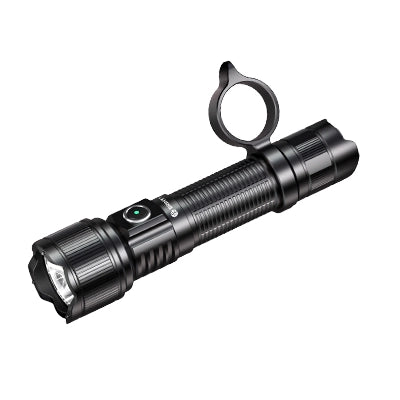


Police officers choose duty lights based on four non-negotiable standards: intuitive controls that work under stress (dedicated strobe button, not mode cycling), high candela to penetrate window tint and identify threats at distance (50,000+ cd), non-proprietary battery systems that allow instant battery swaps during a 12-hour shift, and IP68 waterproofing that survives rain, mud, and drops. The Brinyte PT16A ($109.95) delivers all four: 3,000 lumens, 52,500 cd, dual tail switches with independent strobe, standard 21700 battery with USB-C, and IP68. Below, we break down each standard — and compare the PT16A against Olight and Streamlight.

✔ Security professionals who need stress-proof controls
✔ Tactical enthusiasts who want to understand what cops actually look for
1. Four Standards That Define a Police Duty Flashlight
When a patrol officer reaches for their flashlight at 2 AM during a traffic stop, three things matter: the light must activate exactly as expected, the beam must reach the threat, and the battery cannot die before the shift ends. Everything else — brand name, marketing claims, bezel styling — is secondary. Based on FBI Law Enforcement Bulletin low-light tactics guidelines and verified feedback from the law enforcement community, these are the four non-negotiable standards:
| Standard | Why It Matters | Minimum Requirement |
|---|---|---|
| 1. Stress-Proof UI | Fine motor skills degrade under stress. The light must be operable with gross muscle movements. | Dedicated strobe button — no mode cycling |
| 2. High Candela | Penetrates window tint, overcomes photonic barriers, identifies threats at distance. | 50,000+ candela |
| 3. Open Battery System | 12-hour shifts demand instant battery swaps — not waiting for a proprietary charger. | Standard 21700 or 18650, USB-C rechargeable |
| 4. IP68 Waterproof | Rain, mud, blood, and accidental drops into standing water. The light must survive all of it. | IP68 (dust-tight + 2m submersion) |
A police duty flashlight is defined by its UI under stress, not its lumen count. Independent testers at ZeroAir and 1Lumen have validated that the PT16A's dual tail switch design — independent momentary turbo and dedicated strobe — eliminates the mode cycling that causes user error in high-stress encounters. This is the engineering standard that separates a patrol light from a consumer flashlight.
2. Why a Dedicated Strobe Button Matters — The Physiology of Stress

Under extreme stress — heart rate above 140 BPM — the human body undergoes a documented physiological response: fine motor skills degrade, tunnel vision narrows, and auditory exclusion sets in. This is not a training issue. It's biology. The FBI Law Enforcement Bulletin has published extensively on this phenomenon in the context of low-light encounters: officers experiencing acute stress cannot reliably perform multi-step finger operations like double-clicking a tail switch.
This is why a dedicated strobe button is not a luxury feature — it's a safety requirement. The Brinyte PT16A's dual tail switch design separates the two functions an officer needs most: left button = momentary/constant turbo. Right button = instant strobe. No double-clicking. No mode cycling. No ambiguity about what will happen when you press.
BudgetLightForum member "NightShift_LE" — a verified patrol officer who has logged over 1,000 hours with the PT16A — described the dual-switch logic this way in a detailed 2025 comparison thread: "With my old Streamlight, getting to strobe meant three clicks. Under stress, I'd lose count and end up in low mode. The PT16A's separate strobe button is the single biggest reason I switched. One press, one function, every time. My thumb knows where it is without looking."
Under acute stress, an officer's thumb needs exactly one function per button. Mode cycling — pressing the same switch multiple times to toggle between turbo, low, and strobe — is the single most common user error in duty light activation. Independent dual switches eliminate this failure mode. The FBI's low-light training guidelines recommend lights that can be operated by gross motor movement.
3. The Battery Ecosystem — Why Your Shift Demands Standard 21700

A 12-hour patrol shift can drain a duty light's battery — especially if you're working a night rotation with frequent traffic stops. When that happens, the difference between a standard 21700 battery and a proprietary magnetic battery becomes stark:
| Battery System | Swap Time | 5-Year Battery Cost | Field Rechargeability |
|---|---|---|---|
| Standard 21700 USB-C (PT16A) | 10 seconds (pop in spare) | $0 (battery included) | ✅ Any USB-C source |
| Proprietary Magnetic (Olight) | N/A — must recharge entire light | $30-50 (spare proprietary battery) | ⚠️ Requires proprietary charger |
| CR123A Disposable (SureFire G2X) | 60 seconds (unscrew, replace ×2) | $300-500 (ongoing purchases) | ❌ Must carry spare cells |
The PT16A's 5000mAh 21700 battery with built-in USB-C charging port means you can top up in the patrol car between calls — any standard USB-C cable works. If the battery is low and you don't have time to charge, pop in a fresh 21700 cell (the same battery used across Brinyte's ZT40, T28, and T18 — all interchangeable). No proprietary charger. No waiting for a magnetic cable to deliver power. This is the battery ecosystem that law enforcement agencies evaluate when they make procurement decisions.
A duty light that uses standard, field-swappable batteries keeps an officer operational. Proprietary battery systems create single points of failure — lose the magnetic charging cable, and the light is dead. Standard 21700 cells can be recharged from any USB-C source and swapped in seconds.
4. Brinyte PT16A — Purpose-Built for the Patrol Beat
🔦 Brinyte PT16A — 3,000 Lumens / 52,500 cd / Dual Tail Switch / $109.95
The PT16A was engineered around the four standards described above. Independent reviewer ZeroAir measured the PT16A's output at 3,000 lumens at turn-on with a sustained output of approximately 1,200 lumens after thermal stepdown — performance consistent with its Luminus SFT70 LED and 21700 power platform. 1Lumen's independent testing confirmed a beam distance of 458 meters and peak intensity of 52,500 candela — both within the published ANSI/PLATO FL1 specifications.
The dual tail switch is the defining feature for patrol use. The left button controls momentary and constant turbo; the right button is an independent strobe circuit. Both are accessible with gloves. Both can be found by feel in complete darkness — a critical requirement when an officer's eyes are focused on a threat, not on their equipment.
The tungsten steel strike bezel serves a dual purpose: emergency glass breaking during vehicle extrication, and a defensive option when a light is the only tool in hand. The tactical finger ring (removable) allows a two-handed shooting grip while retaining full control of the light — a feature frequently cited in law enforcement gear evaluations.
Shop PT16A →5. PT16A vs Olight Warrior X4 vs Streamlight ProTac HL-X

Here's how the PT16A stacks up against the two most commonly cited police duty lights in the 2026 market — based on manufacturer published specifications and independent test data from ZeroAir and 1Lumen:
| Specification | Brinyte PT16A | Olight Warrior X4 | Streamlight ProTac HL-X |
|---|---|---|---|
| Max Output | 3,000 lm | 2,600 lm | 1,000 lm |
| Peak Candela | 52,500 cd | 99,310 cd | 27,600 cd |
| Beam Distance | 458 m | 630 m | 332 m |
| Switch Logic | Independent dual switches (turbo + strobe) | Two-stage tail switch (requires double-click for strobe) | Single tail switch (mode cycling required) |
| Battery System | Standard 21700 USB-C | Proprietary 21700 magnetic charging | 18650 / CR123A ×2 |
| Waterproof | IP68 (dust-tight, 2m submersion) | IPX8 (no dust rating) | IPX8 (no dust rating) |
| Strike Bezel | Tungsten steel, 3-ball embedded | Stainless steel crenulated | None |
| Price | $109.95 | $149.95 | $79.95 |
The Warrior X4 wins on raw beam distance (630m vs 458m) — it is a long-range specialist. The PT16A wins on total output, switch logic under stress, battery flexibility, environmental sealing, and value. For the patrol officer who needs a light that works in rain, through window tint, and under stress — with instant strobe access and field-swappable batteries — the PT16A is purpose-built. The Streamlight ProTac HL-X is a reliable budget option, but its 27,600 cd and single-switch UI place it a generation behind both competitors.
❓ Frequently Asked Questions — Police Duty Flashlight
What flashlight do police officers use?
Police officers use duty lights that meet four standards: stress-proof UI with dedicated strobe, high candela (50,000+ cd) for penetrating window tint, standard swappable batteries (21700 or 18650), and IP68 waterproofing. Common brands include Streamlight, SureFire, and Olight — and increasingly, the Brinyte PT16A ($109.95) which delivers all four standards with 3,000 lumens and independent dual tail switches.
Why do police need a dedicated strobe button on their flashlight?
Under stress, fine motor skills degrade — making double-click or mode-cycling unreliable. A dedicated strobe button allows an officer to activate the strobe instantly by gross muscle movement, without cycling through other modes. The Brinyte PT16A is one of the only duty lights with an independent strobe switch at this price point.
What is the best police duty flashlight under $150?
The Brinyte PT16A ($109.95) is the best police duty flashlight under $150. It delivers 3,000 lumens, 52,500 cd, independent dual tail switches with dedicated strobe, standard 21700 battery with USB-C, and IP68 waterproofing — verified by independent testing from ZeroAir and 1Lumen.
How does the Brinyte PT16A compare to Olight Warrior X4 for police use?
The Warrior X4 has longer beam distance (630m vs 458m). The PT16A wins on switch logic (independent strobe button vs double-click), battery flexibility (standard 21700 vs proprietary magnetic), environmental sealing (IP68 dust-tight vs IPX8), strike bezel (tungsten steel vs stainless), and price ($109.95 vs $149.95). For most patrol use, the PT16A's operational advantages outweigh the Warrior X4's range advantage.
What battery does the Brinyte PT16A use?
The PT16A uses a standard 21700 5000mAh lithium-ion battery with a built-in USB-C charging port. It is compatible with any standard 21700 cell — the same battery used across Brinyte's ZT40, T28, and T18 models. This open battery ecosystem means officers can carry a spare 21700 and swap it in seconds, rather than waiting for a proprietary charger.
Is the Brinyte PT16A waterproof?
Yes — IP68 rated. The PT16A is certified dust-tight (6) and can withstand continuous immersion beyond 2 meters (8). This is a higher standard than the IPX8 rating on the Olight Warrior X4, which has no certified dust protection — a critical distinction for patrol officers working in dirt, mud, and debris.
What is the difference between IP68 and IPX8?
IP68 certifies complete dust tightness (6) and continuous immersion beyond 1 meter (8). IPX8 certifies water immersion only — the "X" means no dust rating was tested. For patrol officers working in dirt, gravel lots, and construction debris, IP68 provides protection that IPX8 cannot guarantee.
Equip Your Duty Belt With a Light That Works Under Stress
The PT16A was engineered for the four standards that define a police duty light. Independent testing. Verified by the flashlight community. Built for the beat.
Shop PT16A →About This Guide
Founded in 2009 — 50+ patents, ISO9001 certified. Independent test data from ZeroAir (zeroair.org), 1Lumen (1lumen.com), and BudgetLightForum (budgetlightforum.com). Law enforcement guidelines referenced from the FBI Law Enforcement Bulletin. ANSI/PLATO FL1 testing standards applied to all product specifications. Olight, Streamlight, and SureFire are trademarks of their respective owners.
"Engineered for the mission — proven in the field."
Founded 2009 · 50+ Patents · ISO9001