

72-Hour Survival: When EU Requires Every Household to Stock Emergency Gear, What Flashlight Belongs in Your Kit?

✔ Homeowners who want a real preparedness plan, not just a checklist
✔ Anyone who has ever reached for a flashlight in a blackout and found dead batteries
✔ EU residents responding to new government preparedness mandates
1. Why EU Citizens Are Now Stocking 72-Hour Kits — And Why You Should Pay Attention
In early 2026, the European Union formally recommended that every household in member states maintain a 72-hour emergency survival kit. Ireland’s government simultaneously launched a nationwide preparedness campaign with the stark message: “Utilities we rely on daily — electricity, water, communications — are vulnerable to interruption. Every household must be able to sustain itself for 72 hours without external assistance.”
The EU’s recommendation is not based on a single threat. It accounts for a converging risk landscape: extreme weather events increasing in frequency, cyberattacks on energy infrastructure, and supply-chain disruptions exposed by recent global crises. The logic is simple: in any of these scenarios, emergency services will be overwhelmed. Your family will be on its own for the first three days.
The question is not whether your country will issue a similar recommendation. The question is whether your household passes the test right now.

The European Union’s 2026 civil protection guidance recommends that every household maintain a self-contained 72-hour emergency kit including: water (2 liters per person per day), non-perishable food, first-aid supplies, a battery-powered or hand-crank radio, a flashlight with spare power source, a power bank for mobile devices, and essential medications. The flashlight is explicitly listed because all other tasks — administering first aid, locating family members, signaling for help — depend on having reliable light.
2. Why Lighting Ranks Top Three in Every Survival List
Take a moment and think about what happens in your house when the power goes out at night. Not the romantic candle-lit evening version — the real version. You cannot see the circuit breaker panel. You cannot read the labels on your emergency water containers. You cannot safely navigate stairs. You cannot signal to neighbors or first responders that you need help.
In the hierarchy of survival needs, light enables everything else. Water, food, first aid, communication, security — every one of these requires you to see what you are doing. A flashlight is not a convenience item in a blackout. It is the tool that unlocks access to every other resource in your emergency kit.
There is a reason the EU, FEMA, and every national civil defense agency places lighting in the top tier of essential emergency supplies: without light, the other supplies are not reliably usable.
Light is the foundational emergency resource. Water sustains the body; light sustains the ability to locate, access, and administer water — and food, first aid, and communication. A household with a fully stocked emergency kit but no reliable flashlight is a household that cannot use its supplies in the dark.
3. What Makes a Flashlight Survival-Ready? Four Questions Your Current Light Probably Fails
That flashlight in your kitchen drawer — the one with the batteries you haven’t checked since 2023 — is not a survival tool. It is a hope. And hope is not a preparedness strategy.
A flashlight that reliably serves your family through a 72-hour emergency must pass four tests. Most household flashlights fail at least three of them.
Test 1: Will It Turn On After Sitting Unused for 18 Months?
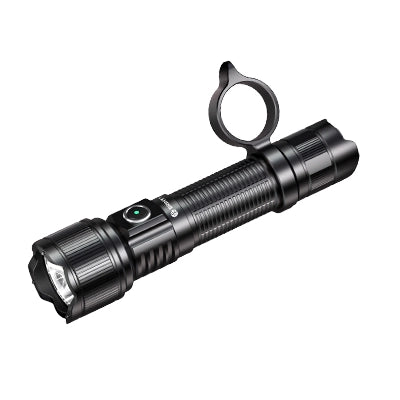
Alkaline batteries leak. They discharge slowly over time. And when you finally need them — during the blackout, at 2 a.m., with your children asking what is happening — the light flickers and dies. A USB-C rechargeable flashlight like the Brinyte PT16A or PT16 solves this by using a lithium-ion battery that holds charge for months and recharges from the same power bank that charges your phone. No hunting for D-cells in the dark.
Test 2: Can Your Family Use It Under Stress?
Emergency lighting must be operable by every capable member of the household — not just the person who reads flashlight manuals. The PT16A and PT16 use a simple dual-switch interface: tailcap for on/off, side switch for mode changes. In an emergency, simple is not a compromise. Simple is survival.
Test 3: Does It Do More Than Just Illuminate?
A survival flashlight should be a multi-role tool. The PT16A and PT16 both include:
- SOS strobe mode — the internationally recognized distress signal (three short, three long, three short). Place the light in a window facing the street during a blackout, and it passively signals for help while you attend to other tasks.
- Defensive strobe — an immediate, disorienting high-frequency pulse that can deter an aggressive person or animal. In the chaos of an extended blackout, security concerns are real.
- Low-lumen navigation mode — preserves battery life while providing enough light for interior navigation, reading labels, and checking on family members.

Test 4: Will It Survive Water and Impact?
Emergencies are not gentle. Floods happen. Flashlights get dropped. In the chaos of evacuating a flooded basement or checking a damaged roof at night, your light will be wet, muddy, and possibly submerged. The PT16A and PT16 are both rated IP68 — fully waterproof and submersible. If your current flashlight does not carry this rating, it is a fair-weather tool in a foul-weather world.
A survival-ready flashlight must (1) power on reliably after months of storage — USB-C rechargeable with lithium-ion battery, not disposable alkaline; (2) operate simply enough for any family member to use under stress; (3) provide multiple modes including SOS distress signaling; and (4) survive water immersion and impact — minimum IP68 rating. A light that fails any one of these tests is not a survival tool. It is a gamble.
4. USB-C: The Real Survival Feature Nobody Talks About

In a prolonged blackout, disposable batteries are a finite resource. When your AA and AAA supply runs out, that is it — no store is open, no delivery is coming. A flashlight that only accepts disposable batteries has a hard expiration date: the moment your last backup battery dies.
A USB-C rechargeable flashlight changes the math entirely. It can be recharged from:
- A power bank — the same one you already own for your phone
- A car USB port — if vehicle fuel is available, you have a charging station
- A solar panel with USB output — indefinite off-grid recharge capability
- A laptop or any USB-C device — every USB-C port in your house is now a flashlight charger
This is not a convenience. In a 72-hour scenario, it is the difference between having light on day 3 and sitting in the dark because your last disposable battery died on day 2. The Brinyte PT16A and PT16 both use standard USB-C fast charging — full recharge in approximately 2.5 hours, compatible with every USB-C charging source you already own.
5. Your Family Emergency Lighting Plan: How Many Lights, Where, and When to Check
A single flashlight in the kitchen drawer is not a family preparedness plan. It is wishful thinking. A real emergency lighting strategy answers three questions: how many lights, where are they stored, and how often are they tested?

The Minimum Viable Setup for a Family of Four
☑ Recommended Emergency Lighting Configuration
- 1 Primary Search & Rescue Light: Brinyte PT16A (3000 lumens, 458m throw, SOS strobe). Stored in the master bedroom with the emergency kit. This is the light you use to sweep the property, signal for help, and search for family members.
- 1 Secondary Perimeter Light: Brinyte PT16 (2000 lumens, 600m throw). Stored near the main entryway. This is the light for checking the street, the yard, and the perimeter — its longer throw is optimized for outdoor distance visibility.
- 1 Power Bank (10,000mAh+): Stored with the primary light. Fully charged. Recharges both flashlights and phones via USB-C.
- Optional: Small EDC backup light in each vehicle glove box — ensures a light source is available even if the emergency occurs while away from home.
Where to Store Them
- Primary light: In or directly next to the family emergency kit — not buried under other supplies. It must be the first thing you touch when you open the kit in the dark.
- Secondary light: In a fixed location near the main entry/exit — on a hook or shelf, never in a drawer that requires searching.
- Critical rule: Store lights with the battery installed and partially charged (approximately 80%). An empty light with batteries stored separately is not a tool — it is a project. In an emergency, you do not have time for projects.
When to Test
| Task | Frequency | What to Check |
|---|---|---|
| Battery check | Every 3 months | Turn light on at high mode for 30 seconds. If brightness drops noticeably from last check, recharge fully. |
| Full recharge | Every 6 months | Top up flashlight and power bank to full charge — even if unused. |
| Family drill | Every 6 months | Simulate a blackout: turn off house lights, have each family member locate and activate their assigned light without assistance. |
| Mode verification | Every 6 months | Cycle through all modes — including SOS and strobe — to confirm proper function. |
A flashlight stored without a testing schedule is a liability, not an asset. The most reliable emergency lighting setup is the one that gets checked and recharged on a fixed calendar — not the one with the highest lumen rating left untested for years.
6. PT16A vs PT16 for Emergency Preparedness: Which One for Which Role?
| Specification | Brinyte PT16A | Brinyte PT16 |
|---|---|---|
| Role in Emergency Kit | Primary search & rescue light | Secondary perimeter / backup light |
| Maximum Output | 3,000 lumens | 2,000 lumens |
| Maximum Throw | 458 meters | 600 meters |
| Best Use | Wide-area search, SOS signaling, interior clearing | Long-range perimeter check, street scanning, open terrain |
| Emergency Modes | SOS + Strobe | SOS + Strobe |
| Waterproof Rating | IP68 (submersion) | IP68 (submersion) |
| Impact Resistance | 2 meters | 1.5 meters |
| Charging | USB-C (2.5 hr full charge) | USB-C (2.5 hr full charge) |
| Weight | ~160g (w/o battery) | ~156g (w/o battery) |
| Shop | Shop PT16A | Shop PT16 |
7. The Light You Have vs. The Light You Need
The EU’s 72-hour preparedness recommendation is not about panic. It is about honesty — the honest recognition that modern infrastructure is fragile, and that emergency services cannot be everywhere at once during a regional crisis. The same logic applies whether you live in Dublin, Houston, or Toronto.
The light in your drawer — the one that has not been tested, with batteries of uncertain age, with no waterproof rating and no SOS mode — is not a survival plan. It is a story you tell yourself so you do not have to think about what would really happen if the power went out for three days.
A USB-C rechargeable, multi-mode, IP68-rated tactical light like the Brinyte PT16A or PT16 is not just a better flashlight. It is a different category of tool — one designed for the reality that light enables every other survival action. Water, food, first aid, communication, security: each one requires reliable illumination to function. The right light does not just brighten a room. It unlocks your entire emergency kit.
Check your flashlights this weekend. Not next month. Not when the storm warning arrives. This weekend. The difference between a light that works and a light that was assumed to work is measured in the dark.
Emergency preparedness is not measured by what you own. It is measured by what works when you need it. The EU’s 72-hour recommendation is a framework; your family’s ability to navigate, signal, and stay safe in the dark comes down to one question: when you reach for that flashlight in the blackout, will it turn on?
📥 Free Download: Family Emergency Lighting Plan (Printable Checklist)
One-page printable PDF: recommended light placement map, testing schedule, and the complete family drill protocol. Tape it to the inside of your emergency kit or pantry door.
Step-by-Step: Build Your Family Emergency Lighting Plan in One Afternoon
- Assess your current lights: Gather every flashlight in your home. Test each one. Discard any with corroded batteries, failed switches, or no waterproof rating. Be honest — a light that does not work reliably is worse than no light because it creates false confidence.
- Assign primary and secondary lights: One high-output, multi-mode light (PT16A) for the main emergency kit. One distance-optimized light (PT16) for the entryway/ perimeter. Label them clearly so family members know which is which.
- Pair each light with a charging source: Store a fully charged USB-C power bank with the primary light. Ensure a USB-C cable is attached to or stored with each light. Eliminate the “where is the charging cable” problem before it happens.
- Set calendar reminders for testing: Recurring event every 3 months: battery check. Every 6 months: full recharge + family blackout drill. The most expensive flashlight in the world is useless if it has not been checked in 18 months.
- Run a family blackout drill: Turn off every light in the house. Have each family member locate their assigned flashlight, activate it, and gather at the designated meeting point. Time the drill. It is not about speed — it is about verifying that everyone knows where the lights are and how to use them.
Ready to Build Your Family’s Emergency Lighting Kit?
Browse Brinyte’s complete collection of USB-C rechargeable, IP68 waterproof tactical flashlights — built for the night the power does not come back on.
Shop Tactical Flashlights →About Brinyte
Founded in 2009, Brinyte specializes in tactical and outdoor lighting with engineering input from working professionals — including law enforcement, military, and search-and-rescue operators. Our products are tested across real-world conditions, from maritime rescue to extended blackouts. Brinyte holds 50+ patents and ISO9001 certification. The PT16A has been adopted by U.S. Coast Guard rescue swimmers — the same light we recommend for family emergency kits.
“Engineered for the mission — proven in the field.”
Founded 2009 · 50+ Patents · ISO9001
❓ Frequently Asked Questions
What is the EU 72-hour survival kit requirement?
In 2026, the European Union formally recommended that every household in member states maintain a 72-hour emergency survival kit capable of sustaining the household without external power, water, or communication. The kit should include water (2 liters per person per day), non-perishable food, first-aid supplies, a flashlight with spare power source, a power bank for mobile devices, a battery-powered or hand-crank radio, and essential medications. Ireland launched a simultaneous nationwide campaign reinforcing the same standard.
Why is a flashlight essential in a 72-hour emergency kit?
Light enables every other survival action. In a blackout, you cannot safely navigate your home, administer first aid, read emergency instructions, locate water and food supplies, or signal for help without reliable illumination. A flashlight is not a convenience item — it is the tool that unlocks access to every other resource in your emergency kit. This is why the EU, FEMA, and all national civil defense agencies list lighting among the top three essential emergency supplies.
Why choose a USB-C rechargeable flashlight instead of one that uses disposable batteries?
USB-C rechargeable flashlights eliminate dependency on disposable batteries that leak, discharge over time, and become unavailable during extended emergencies when stores are closed. A USB-C light can be recharged from power banks, car chargers, solar panels, and laptop ports — the same charging sources you already use for phones. The Brinyte PT16A and PT16 both use standard USB-C fast charging (approximately 2.5 hours for a full charge). One fully charged 10,000mAh power bank can recharge a PT16A approximately 3–4 times, extending usable light from hours to days.
How many flashlights should a family have for emergency preparedness?
A family of four should have at minimum two dedicated emergency flashlights: one primary search-and-rescue light (high output, SOS strobe, wide-area illumination — such as the Brinyte PT16A) stored with the main emergency kit, and one secondary perimeter light (long throw, compact — such as the Brinyte PT16) stored near the main entryway. A 10,000mAh+ USB-C power bank should be stored with the primary light. Small backup lights in vehicle glove boxes are recommended as supplements.
How often should I test my emergency flashlight?
Battery check: every 3 months (turn on at high mode for 30 seconds). Full recharge: every 6 months (top up flashlight and power bank to full charge even if unused). Family blackout drill: every 6 months (simulate a blackout, have each family member locate and activate their assigned light). Mode verification: every 6 months (cycle through all modes including SOS and strobe). Set recurring calendar reminders — an untested flashlight is the most common point of failure in emergency kits.
Which Brinyte flashlight is better for emergencies — PT16A or PT16?
Both are excellent — the choice depends on the role. The PT16A (3000 lumens, 458m throw) is optimized as a primary search-and-rescue light with wide-area illumination for sweeping rooms and signaling. The PT16 (2000 lumens, 600m throw) is optimized for long-range perimeter checks — checking the street, yard, and property boundaries. The ideal family setup uses both: PT16A in the main emergency kit, PT16 near the entryway. Both share USB-C fast charging, IP68 waterproofing, SOS strobe, and the same dual-switch interface.
Does IP68 waterproofing really matter for a home emergency flashlight?
Yes. The emergency that causes a blackout — a hurricane, a flood, a burst pipe — often brings water with it. If your flashlight fails because it got wet while you were checking a flooded basement or navigating a rain-soaked evacuation route, it has failed at the exact moment you needed it most. IP68 means the light survives full submersion, not just splashes. In emergency preparedness, waterproofing is not a luxury. It is insurance against the specific conditions that cause emergencies in the first place.