

48 Hours Offline: When "Touch Grass" Became Rebellion — Why Everyone Wants a Dumb Flashlight in 2026

A dumb flashlight is the smartest rebellion against digital overload. With no firmware, no Bluetooth, and no app, it works every time — and embodies the #touchgrass movement’s rejection of screens that demand constant attention.
✔ Urban professionals craving offline weekends
✔ Anyone who’s been burned by a gadget that needed an update before it worked
1. “Touch Grass” Became a Movement — And It’s Not a Joke Anymore
A cultural rebellion against constant connectivity has quietly replaced the old internet insult. What started as a dismissive command is now a genuine movement: #touchgrass has over 85,000 posts on TikTok, and Expedia reports off‑grid cabin bookings up 43%. The shift is real — people are choosing offline experiences, and that choice extends to the tools they carry.
This is not nostalgia. It’s a reaction to saturation. The average American adult spends 7+ hours staring at screens; Gen Z exceeds 9. The body and brain are voting with their feet, and the “touch grass” movement is the outcome.
Touching grass now means intentionally seeking experiences beyond screens — hiking without service, using paper maps, reading by flashlight. It’s the active decision to be somewhere your phone can’t dictate your attention.
In 2026, #touchgrass evolved from cyberbullying to cultural manifesto. Every off‑grid cabin booked, every dumb flashlight purchased, is a vote against the attention economy — and the tools that get out of your way are the ones that win.
2. The Smart Paradox: When Your Flashlight Needs a Firmware Update, Is It Still a Tool?
Adding a wireless chip and an app to a flashlight doesn’t improve it — it demotes it. A flashlight’s only real job is to produce light when you press a button. Yet in 2026, we have “smart” flashlights that require firmware updates, cloud accounts, and Bluetooth pairing. When that update fails — in the dark, without signal — the tool has failed at its only task.
This is the smart paradox: the more “smart” features a tool accumulates, the more fragile it becomes. A smartphone flashlight app is useless when the battery dies. A firmware‑dependent flashlight is useless when it can’t download an update. The very infrastructure meant to make our lives easier has become a single point of failure.
Q: Can a “smart” flashlight really leave you in the dark?
A: Yes. If its firmware requires an update and you have no signal, it may refuse to turn on. A dumb flashlight with no firmware has zero such dependencies — it simply works.
Every “smart” feature adds a dependency on infrastructure — power grids, cell towers, server uptime. A flashlight that requires an internet connection has been demoted from a standalone tool to a peripheral of the network; it fails when the network does.
3. The Elegance of a Dumb Flashlight: No App, No Update, No Problem
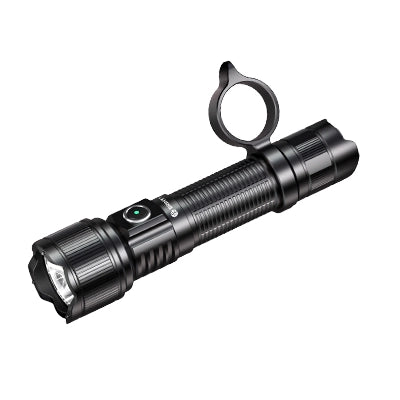
A “dumb flashlight” is not a low‑quality flashlight. It’s a precision tool optimized for reliability. The Brinyte PT16 and PT16A are perfect examples: dual‑switch (tailcap on/off, side switch brightness), no app, no Bluetooth, no firmware. Insert a battery, press the button, get 2000 or 3000 lumens instantly — now, and five years from now.

🔦 Brinyte PT16
2000 lm · 600m throw · IP68
USB‑C rechargeable. Simple dual‑switch. Built for years of silent service.
🔦 Brinyte PT16A
3000 lm · 458m throw · IP68
SOS strobe. USB‑C. The one you grab when you mean it.
A dumb flashlight is optimized for reliability, not novelty. It will work the same in five years regardless of your phone’s OS, the manufacturer’s cloud status, or your signal strength — because it has no idea any of those things exist.
4. The 48‑Hour Offline Experiment: What a Dumb Tool Teaches You
Try 48 hours offline: no cell service, a paper map, and one dumb flashlight. Most participants report the same arc — phantom phone vibrations in hour 1, genuine boredom (and real thought) by hour 8, deep appreciation for a tool that simply works without negotiation by hour 24.

☑ The 48‑Hour Offline Experiment
- Hour 1–3: Phantom buzzes. Your thumb twitches toward absent apps. This passes.
- Hour 4–8: Boredom becomes space. You notice light through trees, birdsong — the first unprompted thoughts in months.
- Hour 9–24: The flashlight earns your respect. One button, total reliability. No friction.
- Hour 25–48: The absence of notifications feels like freedom. The dark is no longer threatening; it’s just night.

Build Your Own Offline Escape Kit in 3 Steps
- Pick a state park, national forest, or your own backyard with Wi‑Fi off and phone locked away.
- Bring a Brinyte PT16 or PT16A — no firmware, no app. It will be your only source of light.
- Notice the mental shift. The goal is not survival — it’s rediscovering what your mind does when it isn’t being interrupted.
Tools that do one thing rebuild confidence the screen economy has eroded. Every time a dumb flashlight lights up without complaint, it reminds you that you’re capable without digital assistance.
5. An Invitation: This Weekend, Leave the Phone. Take the Light.
You don’t need 48 hours. Start with one evening. Put your phone in a drawer, walk to the quietest outdoor place nearby, and carry a flashlight that has no operating system. When it gets dark, turn it on and notice that it works — instantly, silently, with no demands. That small act is a genuine rebellion in 2026.
The best gear in 2026 is the gear that gets out of your way. A flashlight that just turns on is a choice to carry less digital weight, to trust yourself more, and to let the outdoors be what it is.
Carry a Light That Doesn’t Need an Update
Brinyte flashlights are built for people who want tools, not notifications. No firmware. No app. No nonsense.
Find Your FlashlightAbout Brinyte
Founded in 2009. 50+ patents. ISO9001 certified. All tools use standard batteries with onboard USB‑C — no cloud, no subscriptions. No companion app. Never.
"Engineered for the mission — proven in the field."
Founded 2009 · 50+ Patents · ISO9001
❓ Frequently Asked Questions
What is the “touch grass” trend in 2026?
Once a dismissive insult, “touch grass” now describes a real cultural shift toward offline experiences. Over 85,000 TikTok posts and a 43% jump in off‑grid cabin bookings show people are choosing to disconnect — and they’re bringing tools that don’t need an internet connection.
What is a “dumb flashlight”?
A dumb flashlight has no firmware, no Bluetooth, no app — it just produces light. The Brinyte PT16 and PT16A are prime examples: they’ll work the same in five years with zero updates.
Why are analog tools making a comeback?
As everyday objects demand apps and updates, people are rediscovering the reliability of tools that are simple and repairable — mechanical watches, paper notebooks, and dumb flashlights among them.
Can a smart flashlight really fail when it needs an update?
Yes. Some firmware‑dependent flashlights may refuse to operate until an update is applied. If you’re off‑grid with no signal, you’re left in the dark. A dumb flashlight has no such vulnerability.
What flashlight is best for a digital detox weekend?
Brinyte PT16 (2000lm, 600m throw) or PT16A (3000lm, 458m throw). Both are IP68, USB‑C rechargeable, and completely app‑free. They’ll work anywhere.
How do I start a 48‑hour digital detox?
Pick a location without cell service, pack food/water/shelter, a paper map, and one dumb flashlight. Lock your phone away. The goal is to observe how your mind changes when screens disappear.