

Best Home Defense Weapon Light:
Lumens, Legal Rules, Mounted vs Handheld,
and the Right Setup for Your Home
1. Why Every Home Defense Firearm Needs a Dedicated Weapon Light
The FBI's Uniform Crime Report consistently shows the majority of residential burglaries occur between 6 PM and 6 AM — periods of reduced or absent natural light. Target identification in darkness is not optional: in most U.S. jurisdictions, firing at an unidentified target exposes you to criminal liability regardless of your intent.
Positive target identification before firing is a legal obligation in the vast majority of U.S. states. "I couldn't see" is not a defense. A weapon-mounted light provides documented evidence that you made a reasonable effort to identify the threat before engaging — and it can be the difference between justified self-defense and manslaughter charges. Training organizations including Gunsite Academy, Thunder Ranch, and Shivworks Collective consistently include weapon-mounted illumination in foundational home defense curricula.
2. Legal Guide: Home Defense Weapon Lights & Lasers by Region
Before purchasing, understand these critical legal distinctions. Laws vary significantly by jurisdiction, platform, and how the light is used — not just whether you own it.
-
All 50 U.S. States: Weapon-Mounted Lights — Legal Rail-mounted flashlights are legal for lawful firearm owners in all 50 states. No federal restriction on civilian ownership. Class IIIa green laser (<5mW) is also legal nationwide for civilian ownership without special licensing.
-
Castle Doctrine vs Duty to Retreat — Affects How You Use the Light 37 states have some form of Castle Doctrine, giving homeowners broader protection when defending their home without a duty to retreat. However, even in Castle Doctrine states, you must be able to demonstrate you reasonably believed the threat was imminent. A weapon light's ability to document your attempt to identify the target strengthens this legal position significantly.
-
Brandishing Risk — The Investigative Phase Problem In most jurisdictions, pointing a firearm at a non-threat — even with a light to investigate a sound — can constitute criminal brandishing or assault. This is exactly why the two-tool protocol matters: use a handheld flashlight to investigate sounds (light without muzzle direction), switch to a mounted weapon light only when you have identified an actual threat requiring engagement.
-
Hunting Restriction — Critical for Multi-Use Lights Weapon-mounted lights are NOT legal for hunting in most U.S. states. This matters because many home defense lights are also marketed for hunting. Keep your home defense light separate from any hunting equipment to avoid inadvertent regulatory violations.
-
Canada & UK — Significantly Different Rules In Canada, weapon-mounted lights for handguns face significant restrictions depending on provincial regulations and firearm classification. The UK's near-total civilian firearm prohibition also restricts weapon light ownership by extension. Verify local laws before importing or purchasing.
State-by-State Legal Snapshot
This guide is for informational purposes only and does not constitute legal advice. Firearm and self-defense laws change frequently and vary significantly by jurisdiction. Consult a qualified firearms attorney in your state before making home defense decisions.
3. Mounted vs Handheld: The Right Tool for Every Scenario
The mounted vs handheld debate is persistently framed as either/or. It should not be. Each tool solves a distinct problem at a distinct phase of a home defense scenario — and choosing the wrong one for the wrong phase creates both safety and legal risk.
Scenario-by-Scenario Decision Matrix
The chart below resolves the mounted vs handheld question for every common home defense situation. Use this as your decision framework.
Points gun at unknown — potential family member, pet, or non-threat
Illuminate without muzzle direction. Safer legally and tactically.
Full grip, both hands on gun, muzzle and light on threat
Handheld becomes secondary when engagement is imminent
Muzzle would track family member — legal and safety disaster
Light only. No firearm involved unless confirmed threat.
If you've already determined likely threat, mount light works
Light ahead without committing muzzle; firearm follows identification
Door-covering position — both hands on gun, light ready
Phone in one hand already; mounted light frees both hands
Muzzle tracking in outdoor space with neighbors increases risk
PT16A at 3,000 lm covers 400m+ without muzzle direction required
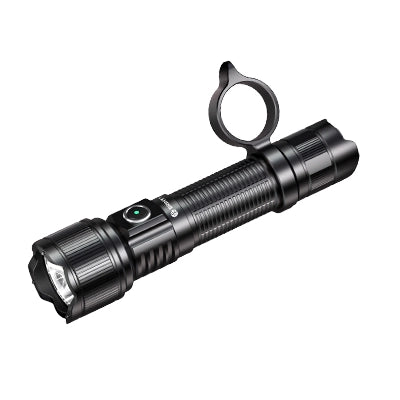
Instructors at Gunsite Academy, Thunder Ranch, and Shivworks Collective teach the same two-tool protocol: handheld for the investigative phase, mounted for the engagement phase. If you can only choose one tool to start, prioritize the mounted light — it solves the highest-stakes problem. Stage a handheld (the Brinyte PT16A works perfectly) near your primary defensive position as your second tool.
4. Lumens & Candela for Indoors: The Indoor Illumination Paradox
Standard residential drywall reflects 70–85% of incident light. A 1,000+ lumen beam aimed at a white wall 10 feet away bounces back and temporarily blinds you — not the intruder. The threat may actually see better than you in this scenario. More lumens is not always better indoors. Candela (beam intensity and focus) matters more than raw lumen count.
Lumen Output by Environment
All Brinyte lumen ratings are measured to the ANSI/NEMA FL1 standard — tested at 30 seconds in a calibrated integrating sphere at 22°C. Uncertified brands typically inflate lumen claims by 30–60%. When comparing the XP22 MK3 (1,600 lm), SureFire X300U-A (1,000 lm), and Streamlight TLR-1 HL (1,000 lm), verify that all figures are ANSI FL1-compliant before drawing conclusions.
5. Brinyte vs SureFire vs Streamlight: Home Defense Scenario Comparison
SureFire is widely considered the gold standard in weapon-mounted lights — trusted by USSOCOM and law enforcement worldwide. Streamlight offers strong value at a lower price point. Brinyte delivers comparable or superior specifications at 50–65% lower cost, with modern features like USB-C charging and IP68 waterproofing that older duty-grade lights lack.
This isn't about which brand is "best" in the abstract — it's about which configuration solves your specific home defense scenario most effectively.
Home Defense Scenario: Mounted Weapon Light (Rifle / PCC)
| Specification | Brinyte XP22 MK3 $119.95 |
SureFire X300U-A ~$329 |
Streamlight TLR-1 HL ~$169 |
|---|---|---|---|
| Max Lumens (ANSI FL1) | 1,600 lm | 1,000 lm | 1,000 lm |
| Candela (beam intensity) | — | 11,300 cd | 20,000 cd |
| Beam Distance | 374m | 213m | 283m |
| Profile Height | 14.55mm ultra-low | Standard | Standard |
| Integrated Green Laser | ✅ Class IIIa <5mW | ❌ None | ❌ None |
| Charging / Battery | Magnetic USB on-rail (no light removal needed) |
CR123A batteries (no recharging) |
CR123A batteries (no recharging) |
| IP Waterproofing | IP66 | IPX7 (1m/30min) | IPX7 (1m/30min) |
| Mount Included | Picatinny (included) | Rail-Lock (included) | Picatinny (included) |
| Made in | China (ISO9001) | USA | USA |
| Price | $119.95 | ~$329 | ~$169 |
| Best Home Defense Scenario | Apt · compact rifle · AR pistol · laser needed | Duty · LE · holster ecosystem priority | Budget AR · handgun · candela priority |
Home Defense Scenario: High-Output Handheld / Mountable
| Specification | Brinyte PT16A ~$90–100 |
SureFire M640DF ~$350–400 |
Streamlight ProTac HL-X ~$130 |
|---|---|---|---|
| Max Lumens (ANSI FL1) | 3,000 lm | 1,500 lm | 1,000 lm |
| Candela | 52,500 cd | ~50,000 cd | ~15,000 cd |
| Beam Distance | 458m | ~447m | ~245m |
| Selectable Output Modes | 5 lm / 120 lm / 900 lm / 3,000 lm | 2 modes | 3 modes |
| Charging | USB-C fast charge (waterproof port) | CR123A or 18650 (dual fuel) | USB (some models) |
| Battery | 21700 5,000mAh removable — swap spares | Proprietary 18650 or CR123A | CR123A (non-rechargeable) |
| IP Waterproofing | IP68 (2m / 30 min) | IPX7 (1m / 30 min) | IPX7 |
| Independent Strobe Button | ✅ Dedicated tail button | Mode cycling required | Mode cycling required |
| Price | ~$90–100 | ~$350–400 | ~$130 |
| Best Home Defense Scenario | Large home · rural · shotgun · handheld backup | Duty rifle · LE · mil-spec ecosystem | Budget AR · value-focused buyer |
The Honest Assessment: When SureFire Is Worth the Premium
SureFire commands a $200–300 premium for real reasons: American manufacturing, a decades-long proven track record in combat and law enforcement, and — critically — the deepest holster ecosystem. The X300U-A has more OEM holster support than any other weapon light, which matters for duty officers or armed professionals who carry daily.
For civilian home defense specifically, that holster ecosystem advantage is largely irrelevant — your home defense gun stays staged, not holstered. The XP22 MK3 at $119.95 delivers more lumens (1,600 vs 1,000), longer beam distance (374m vs 213m), an integrated green laser SureFire doesn't offer at this price point, and magnetic on-rail USB charging that keeps your light topped off without ever removing it from the gun.
For duty / law enforcement: SureFire X300U-A — the holster ecosystem and US-made durability justify the premium for professionals. For civilian home defense with a rifle or PCC: XP22 MK3 — superior lumens, green laser, and on-rail charging at 64% less cost. For a high-output handheld backup or shotgun light: PT16A — 3,000 lumens and 52,500 candela at a fraction of the M640DF price.
6. Apartment vs Large Home: Fundamentally Different Requirements
7. Platform-Specific Setup Guide: Handgun, Rifle & Shotgun
- Picatinny / Universal rail required (most modern service pistols)
- Profile must not extend past muzzle — creates snag points
- Ambidextrous activation critical for one-handed use
- Target: 400–700 lm, simple 2-position switch
- XP22 MK3: verify rail compatibility with your specific pistol model
- Holster selection is impacted by light choice — verify fit before purchase
- M-LOK or Picatinny handguard — aftermarket mount required
- Profile height matters when running LPVOs or red dots
- XP22 MK3 at 14.55mm clears every optic without compromise
- Pressure pad or tape switch recommended for longer barrel setups
- Mount at 1:30 or 10:30 to avoid blocking optic and reduce barrel shadow
- Factory Picatinny rail preferred; barrel clamp if none exists
- PT16A Tactical Kit: remote pressure switch for pump-action forend operation
- Semi-auto shotguns with factory rail — standard Picatinny mounting
- Avoid under-barrel clamps on pump-actions — interferes with pump stroke
- Forend-mounted activation is safest for two-handed pump operation
8. Mounting Placement & Barrel Shadow
Recoil — even from 9mm — will loosen mounting screws over time without threadlocker. Apply medium-strength Loctite Blue (243) to all mounting screws. A loose weapon light shifts your zero and can disengage under fire. See our complete mounting guide for torque specifications and step-by-step photos.
9. Green Laser for Home Defense: When It Genuinely Helps
When a Green Laser Adds Genuine Value
- Non-standard shooting positions: Firing from behind a doorframe or in a low crouch where iron sights can't be brought to eye level — the laser gives you instant aim reference without exposing your head
- One-handed shooting: When your non-dominant hand is occupied — holding a child, calling 911, opening a door — a laser enables accurate engagement that a one-handed sight picture doesn't
- Deterrence effect: In documented incidents, a visible green dot has ended threats before a shot was fired — a non-lethal outcome that benefits everyone
- Close-range speed indoors: Inside 15 feet, a laser enables sub-second acquisition faster than sight alignment under stress, particularly in darkness
The XP22 MK3's Class IIIa (<5mW) green laser is rated to 500 vibration test cycles for zero retention — point of impact remains calibrated after extended recoil use, verified by Brinyte's engineering team. The SureFire X300U-A does not include a laser at any price point; laser integration would require a separate Streamlight TLR-8A ($199) or a dedicated laser module.
10. Strobe Function: The Honest Assessment
Train with constant-on as your primary mode. If you use strobe, it must be on a dedicated independent switch — not by cycling through modes under stress. The PT16A's dual tail buttons implement this correctly. The SureFire X300U-A requires mode cycling to access strobe, which creates a critical delay in high-stress situations.
11. Low-Light Training Drills You Can Do Tonight
No range, no ammo, no cost. Only your cleared firearm, your weapon light, and your home. These four drills address the specific failure modes that get people killed in home defense scenarios.
12. 2026 Top Picks: XP22 MK3 vs PT16A — Full Comparison
| Specification | XP22 MK3 $119.95 |
PT16A ~$90-100 |
|---|---|---|
| Max Lumens | 1,600 lm | 3,000 lm |
| Candela | — | 52,500 cd |
| Beam Distance | 374m | 458m |
| Profile Height | 14.55mm ultra-low | Standard handheld |
| Green Laser | ✅ Class IIIa <5mW | ❌ None |
| Mounting | Picatinny (rail-mounted) | BRM21 (Tactical Kit) |
| IP Rating | IP66 | IP68 (2m/30min) |
| Charging | Magnetic USB on-rail (no removal) | USB-C fast charge |
| Battery | Integrated | 21700 5,000mAh removable |
| Output Modes | 2 modes + laser | 5 lm / 120 lm / 900 lm / 3,000 lm |
| Independent Strobe Button | ✅ | ✅ Dedicated tail button |
| vs SureFire X300U | +600 lm · +161m · green laser · $209 less | 3× the lumens at 25% the M640DF price |
| Best for | Apartments · compact rifles · AR pistols · laser needed | Large homes · rural · shotgun · outdoor perimeter |
- ✓600 more lumens than the X300U-A (1,600 vs 1,000 lm) at 64% less cost ($119.95 vs ~$329)
- ✓14.55mm profile clears any LPVO, red dot, or scope without compromising your sight picture — a critical advantage SureFire doesn't address at this price
- ✓Integrated green laser — SureFire requires a separate purchase (TLR-8A ~$199) to add any laser capability
- ✓Magnetic on-rail USB charging — top off without ever removing the light; your firearm stays configured and ready
Choose the XP22 MK3 if you are: An apartment dweller, AR pistol or PCC owner, anyone running an optic who can't sacrifice profile height, or anyone who wants integrated green laser without adding a second accessory.
Shop XP22 MK3 →- ✓4 selectable modes — use 120 lm (Medium) for indoor hallways, 3,000 lm (Turbo) for driveway or property perimeter identification at 400m+
- ✓Removable 21700 battery — swap to a fully charged cell in seconds; keep a spare staged near your firearm for zero downtime
- ✓IP68 submersible waterproofing — functions in any weather for outdoor perimeter response; SureFire M640DF is only IPX7
- ✓52,500 candela — comparable to the SureFire M640DF (~$350–400) at approximately 25% of the price
"Sometimes when you pick up an item and feel it in your hands it just oozes quality. This is the best way I can describe the PT16A." — 1lumen.com independent review
Choose the PT16A if you are: A rural homeowner, large-home owner with outdoor perimeters, someone who wants one light covering both mounted (with Tactical Kit) and handheld use, or anyone who wants handheld backup to a mounted light.
Shop PT16A →13. Monthly Readiness Checklist
Run this checklist on the first of every month. A weapon light you haven't verified in 30 days is a liability, not an asset.
-
Light secured — Loctite appliedMounting screws tight · Loctite Blue 243 applied · no movement under vigorous shake
-
Activation without grip shiftAll switches activate naturally without repositioning your hand — test both light and laser independently
-
Battery above 50%PT16A: USB-C charge verified · XP22 MK3: magnetic charge on-rail · spare 21700 also charged
-
Mode familiarity confirmedCan cycle to your preferred indoor output mode without looking at the light — in the dark
-
Laser zero verified (XP22 MK3)Point of impact confirmed at your expected engagement distances (5–25 feet for most interiors)
-
Light discipline drill completedWithin the last 30 days · minimum 15 reps · in the dark
-
White-wall calibration doneKnow the correct output mode for each room — especially hallways and bedrooms
-
Family identification protocol practicedEvery adult understands the low-light defense plan · handheld flashlight staged in accessible location
-
Handheld backup stagedPT16A or equivalent handheld positioned near your primary defensive location — not in a drawer
-
Local laws confirmed currentSelf-defense laws change — verify your state's current Castle Doctrine and weapon light regulations annually
14. Frequently Asked Questions
What is the best lumen range for a home defense weapon light?
Is a weapon-mounted light legal for home defense in all U.S. states?
Should I use a mounted weapon light or handheld flashlight for home defense?
How does the Brinyte XP22 MK3 compare to the SureFire X300U for home defense?
Is a green laser useful for home defense?
Does the PT16A have too many lumens for indoor home defense?
What is Castle Doctrine and how does it affect weapon light use?
© 2026 Brinyte — Shenzhen Yeguang Technology Co., Ltd.