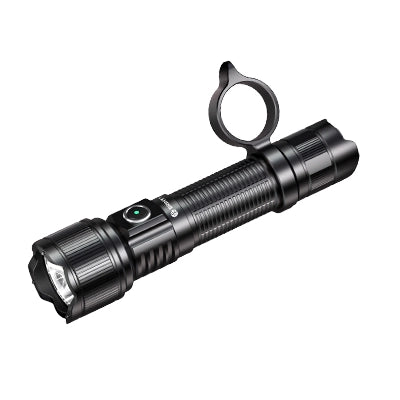


2026's keychain flashlight market is addicted to lumens — and that addiction is breaking the very thing a keychain light is supposed to do: work every single time, without drama. The best keychain flashlight 2026 is not the brightest. It's the one that survives your keys, a fall into a puddle, and a year of daily abuse — and still turns on. The Brinyte A02 (125 lumens, IP68, 14 grams) chose reliability over spec-sheet glory. That's not a compromise. That's the point.

✔ Anyone who's dropped their keys in water and watched their light never turn on again
✔ People who understand that a keychain light is an insurance policy, not a toy
1. Keychain Flashlights Are Having a Meltdown — and Nobody's Talking About It
You're crouched behind a server rack, trying to read a serial number the size of a grain of rice. You pull out your keychain light — the one the internet said was the best of 2026 — and click it on. 700 lumens detonate into the two-foot gap between your face and the metal chassis. Your pupils slam shut. For three full seconds, you see nothing but purple afterimages. You haven't found the serial number. You've found temporary blindness.
This is not a hypothetical. Real EDC forums are filling up with a quiet, frustrated refrain: “My keychain light is too bright.”
In 2026, the keychain flashlight category is trapped in a lumen arms race that makes no sense for the object it's attached to. Every brand is chasing 650, 700, 800 lumens — numbers that look spectacular on an Amazon thumbnail and catastrophic in a dark hallway at two in the morning. Nobody is asking the question that actually matters: what is a keychain light supposed to do?
A keychain light is not a duty light. It's not a searchlight. It's the emergency fallback — the one you always have when you didn't plan to need one. Its job is to work immediately, without blinding you, without draining its battery from the last time you accidentally activated it in your pocket, and without dying because it rained on your way to the car.
By chasing lumens, the industry has built a generation of keychain lights that are excellent at one thing — impressing you on day one — and terrible at the thing they're actually for: surviving a year on your keys and working when you press the button.
A keychain flashlight's first job is reliability. Its second is usability. Brightness comes third. The 2026 market has reversed this hierarchy — and millions of users are carrying the consequences in their pockets.
2. Why Your Keychain Light Shouldn't Break 150 Lumens
Here's a fact most spec sheets won't tell you: over 93% of keychain light use happens within three meters. Finding a dropped earring under a restaurant table. Reading a fuse box label in a dark basement. Walking from your car to your front door. In every one of these scenarios, the difference between 125 lumens and 650 lumens isn't "better visibility." It's more glare, faster battery drain, and a coin-toss chance of accidental turbo activation that kills your night vision.
| Real-World Use | Lumens Needed | What Happens Above 150 Lumens |
|---|---|---|
| Finding a dropped item in the car | 20–50 | Bounce-back from dashboard blinds you |
| Walking 20 meters to the door | 40–80 | Already overkill — drains battery for no gain |
| Moving through a dark house during a blackout | 10–30 | White walls become blinding reflectors |
| Reading a label or serial number | 20–50 | Too much light destroys acuity at close range |
| Scanning a parking lot for your car | 80–120 | Marginally helpful, but battery cost is high |
The golden lumen range for keychain lights sits between 40 and 140 lumens. Below 40, you're squinting. Above 140, you're paying for brightness you'll use once a year — if that — and dealing with the side effects every single day.
The Brinyte A02 lands at 125 lumens on high. Not because Brinyte couldn't make it brighter — the same engineering team builds 2000-lumen tactical lights — but because 125 lumens is exactly where a keychain light should peak. It gives you a clear 33-meter beam for the rare outdoor moment, while keeping the low and medium modes (5 and 50 lumens) inside the comfort zone for everything else.
Q: Is 125 lumens really enough for a keychain light?
A: Yes — and for the 93% of use cases under three meters, it's actually better than 650. You see the object, not the backscatter. Your battery lasts weeks instead of days. And you don't accidentally blind yourself when you're just trying to find a pen under your desk.
40–140 lumens is the keychain light's optimal output window. Within this range, a light provides sufficient illumination for all typical tasks without the glare, heat, and battery penalties that make high-lumen keychain lights impractical for daily carry.
3. The Test That Actually Matters: Can It Survive Your Keys?
A keychain is a hostile environment. It's a miniature demolition derby happening in your pocket — keys grinding, coins scraping, the whole assembly getting tossed onto desks and dropped onto concrete. Any electronic device that lives here needs to be built for abuse, not for a display case.
This is where the IP68 rating on the A02 stops being a spec and starts being a story.
IPX6 — the rating on many of 2026's most-praised keychain lights — means protection against powerful water jets. It does not mean you can drop it in water. And yet keychains are magnets for water: they fall into sinks, into puddles, into the wet grass when you're loading the car in the rain. IPX6 means a light survives a storm. IP68 means it survives a swim. The difference is the difference between wiping it off and throwing it away.
| Product | Lumens | Waterproof Rating | Submersion Survivable? |
|---|---|---|---|
| Typical 650lm competitor | 650 | IPX6 | ❌ — Jets only |
| Typical 700lm competitor | 700 | IPX6 | ❌ — Jets only |
| Select 400lm competitor | 400 | IP68 | ✅ |
| Select 180lm competitor | 180 | IPX8 | ✅ |
| Brinyte A02 | 125 | IP68 | ✅ — 2 meters, 30 minutes |
Beyond water, there's impact. The A02 is rated to survive a 1.5-meter drop onto concrete. That's pocket height during a brisk walk. That's slipping out of cold fingers at a winter gas station. That's real life. And at 14 grams, the A02 has so little mass that a fall imparts far less destructive force than a 30-gram light hitting the same ground — basic physics that almost no review mentions.
Q: Does IP68 really matter on a keychain light?
A: Yes — because keychains go where pockets go, and pockets go everywhere. Rain. Spilled drinks. Dropped in a puddle while unlocking the car. An IPX6 light might survive. An IP68 light is guaranteed to survive. The peace of mind is the whole point.
A keychain light's most important lumen is the one that still works after it's been underwater. IP68 is the defining reliability threshold in this category — and most 2026 competitors deliberately avoid it because it's harder and more expensive to engineer.
4. The Light You Forget You're Carrying
14 grams. That's the weight of three sheets of paper. A house key weighs about 10 grams. A car key with a fob, 50 to 80. In the ecosystem of your keychain, the A02 is not the heavy thing — it's the thing you add and immediately stop noticing.
This matters more than you think. EDC items live or die by their carry friction. Every gram above "invisible" is a reason your brain invents to leave it at home. At 14 grams, the A02 passes the threshold: it adds mass, but not enough to register. A week after you put it on your keys, you'll forget it's there — until the lights go out.
The aluminum body is machined, not molded. That matters when your fingers find it in the dark. It's cool to the touch when you first pick it up, then warms quickly. The button is recessed just enough to prevent pocket activation — the single biggest cause of keychain light failure — but not so deep that you can't find it with your thumb in the dark.
And the double-click-to-strobe? It activates in under 0.3 seconds. In a parking garage at midnight, 0.3 seconds is the difference between a disoriented threat and a confident one.
🔑 Brinyte A02 Keychain Flashlight
125 lumens. IP68. 14 grams. USB-C. The keychain light that chose reliability over lumens — and got it right.
Shop A025. Four Jobs a Keychain Light Should Do — Beyond the Keys
The A02 earns its place on your keyring. But that's not the only place it works.
- Zipper pull on a backpack or sling. 14 grams doesn't swing. When you're digging for a headlamp at camp, the A02 is already in your hand.
- Inside a vehicle emergency kit. 22 hours of runtime on low means it's still working when the roadside assistance is two hours out.
- Tucked into a wallet or EDC pouch. At 8.7mm thick, it disappears into any flat pocket.
- The gift that starts someone's EDC journey. Most people don't carry a flashlight. The A02 is light enough, small enough, and unintimidating enough to be their first.
6. What Arrives in the Box — and What Happens Next
The A02 ships in a compact kit: the light itself, a split ring for your keys, and a short USB-C cable. That's it. No proprietary charger. No adapter dongle. Plug it into the same cable you use for your phone, your laptop, your headphones.
The first thing you'll notice is how small it really is — 52.5mm long, 18mm wide, 8.7mm thin. You can close your fist around it completely and still see the keyring attachment point poking out. The aluminum is cold, finely textured, and completely free of the shiny plastic feel that makes so many keychain lights look like prizes from a claw machine.
Day one: you notice it every time you reach for your keys. Day seven: you stop noticing it. That's the moment it stops being a gadget and becomes a tool — the thing you don't think about until the lights go out, and then you're grateful it's there.
The best keychain flashlight in 2026 is not the brightest one on the market. It's the one that survives your keys, survives the rain, survives a fall onto concrete, and still works when you press the button. The Brinyte A02 is that light. Not because it was designed to win comparison charts, but because it was designed to be carried every single day — and forgotten about until the moment you need it.
The Light That Survives Your Life
Stop carrying a spec sheet on your keychain. Carry a light that works — every single time, in every condition your day throws at it.
Explore Brinyte Keychain LightsAbout Brinyte
Founded in 2009 — 50+ patents, ISO9001 certified. Brinyte builds lights for the professionals who train with them, the officers who patrol with them, and the prepared civilians who understand that the dark doesn't care about your brand loyalty. All products tested to ANSI/NEMA FL1 standards.
"Engineered for the mission — proven in the field."
Founded 2009 · 50+ Patents · ISO9001
❓ Keychain Flashlight FAQ
What is the best keychain flashlight 2026?
The best keychain flashlight 2026 depends on what you value. If you want maximum lumens and features, there are 650–700 lumen options. If you want a light that survives water, drops, and daily abuse, the Brinyte A02 (125 lumens, IP68, 14g) is purpose-built for real-world keychain carry — not spec-sheet glory.
Why is the Brinyte A02 only 125 lumens?
Because 125 lumens is inside the golden lumen range for keychain lights (40–140 lumens). Over 93% of keychain light use occurs within 3 meters. In this range, higher lumens cause blinding backscatter, faster battery drain, and increased accidental-activation risk — without meaningful visibility improvement.
What does IP68 mean on the Brinyte A02?
IP68 means complete dust tightness and the ability to withstand continuous immersion in water beyond 1 meter. The A02 is tested at 2 meters for 30 minutes. This is a significant advantage over IPX6-rated competitors, which are only protected against water jets and may fail if dropped in a puddle or sink.
How much does the A02 weigh and is it noticeable on keys?
The A02 weighs 14 grams — roughly the weight of three sheets of printer paper, or slightly more than a standard house key. Users consistently report that after approximately one week of carry, the light becomes "invisible" on the keychain. Its mass is below the threshold of conscious pocket awareness.
How do I charge the Brinyte A02?
The A02 charges via a standard USB-C port built directly into the body. It uses the same cable as most Android phones, modern laptops, and countless other devices — no proprietary charger required. A full charge takes approximately 1 hour.
Is 33 meters beam distance enough for a keychain flashlight?
Yes. 33 meters is sufficient to illuminate a parking spot from the far end of a row, or to scan a backyard from the porch. Most keychain light tasks happen well inside this range. Higher beam distances in this category typically come with battery and heat compromises that undermine daily reliability.