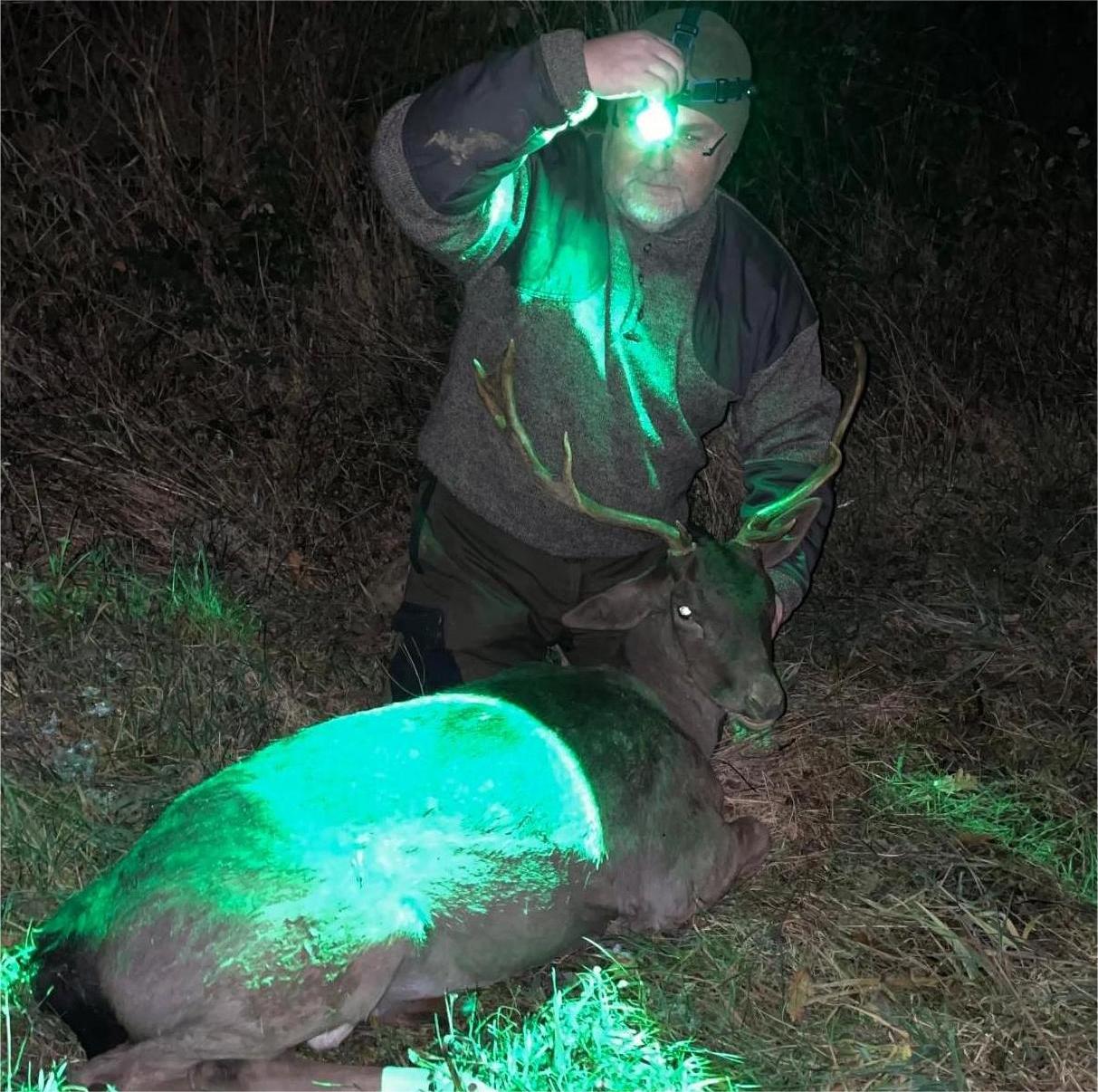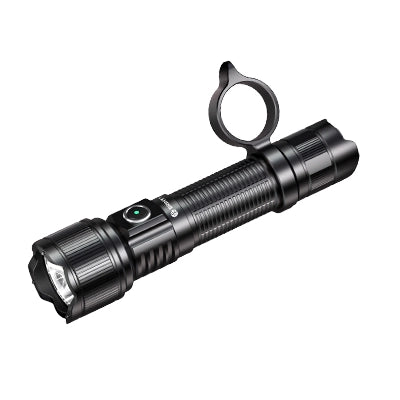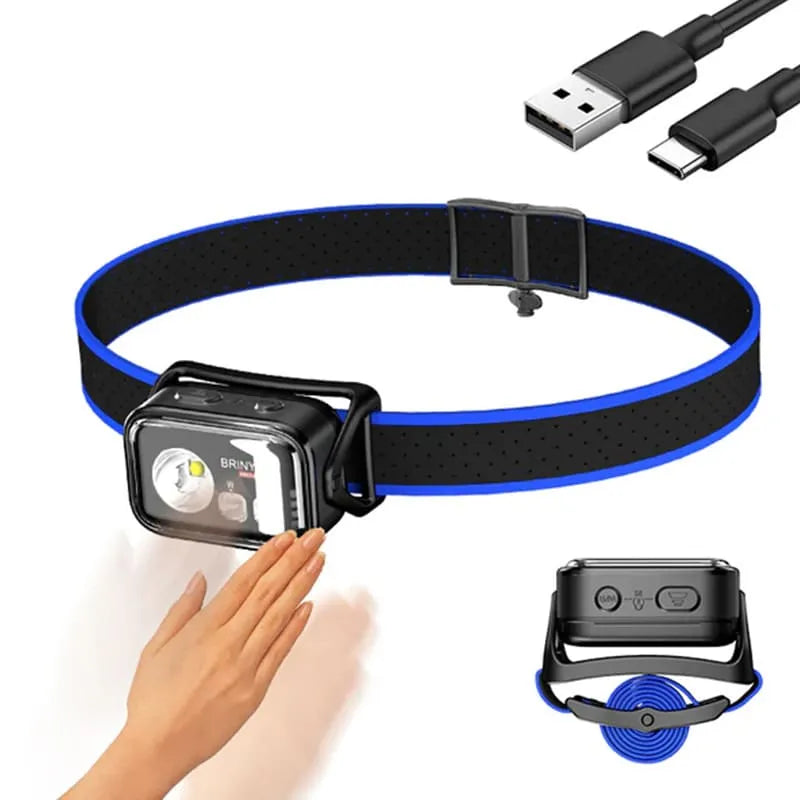


Deer cannot see red light as a distinct color. Their dichromatic vision lacks red-sensitive cone cells, so red wavelengths (620–750nm) appear as a dim, featureless gray — making red light the safest choice for nighttime approaches.
Full breakdown by species and light color:
- Deer: Dichromatic — red appears dim gray → red light is stealthiest. Blue/UV are highly visible — avoid.
- Hogs: Poor visual acuity; tolerate green light without alarm → green is ideal for scanning.
- Coyotes: Excellent night vision via tapetum lucidum; least sensitive to red, moderately sensitive to green.
- UV/Blue: Highly visible to all three — avoid for stealth; UV only for blood tracking.
- IR (850–940nm): Completely invisible to all game — absolute stealth with night vision gear.
Golden Rule: Red for approach, green for field scanning, white for ID, UV for tracking.
✔ Those targeting deer, hogs, or coyotes at night
✔ Anyone choosing lights based on biology, not guesswork

Introduction
Most hunters have heard "deer can't see red" or "hogs don't mind green light." But how accurate is that — and does it actually hold up to science?
Understanding exactly how your target species perceives color and light is one of the most powerful — and most underused — tools in a night hunter's arsenal. The difference between red and green isn't just tradition. It's biology, and getting it wrong costs you the shot.
In this guide, we break down the visual systems of whitetail deer, wild hogs, coyotes, and other common game animals. You'll learn precisely how each species perceives red, green, white, UV, and IR light — and how to translate that knowledge into smarter, quieter hunts.
Most game mammals are dichromatic, with retinas dominated by rod cells for superior night vision. This gives them excellent motion detection but limited color discrimination — particularly in the red spectrum. Understanding this biological constraint is the foundation of every effective hunting light decision.
1. How Animal Vision Differs from Human Vision

Humans are trichromatic — we have three types of cone cells sensitive to red, green, and blue light, giving us rich color vision especially in daylight.
Most game animals are dichromatic — they have only two types of cones. Their color spectrum is shifted toward shorter wavelengths, and they are significantly less sensitive to long wavelengths (reds and oranges). They also have a much higher density of rod cells, which gives them superior night vision at the cost of color discrimination. According to comparative retinal anatomy research published by the National Institutes of Health, the rod-to-cone ratio in ungulates like deer is significantly higher than in humans.
- Animals see movement better than detail, especially in low light.
- They are highly sensitive to UV and blue light — the wavelengths hunters most often overlook.
- Red light appears dim or gray to most mammals, making it an effective stealth tool across nearly all game species.
Source: Comparative retinal anatomy in mammals – National Institutes of Health (NIH)
2. Whitetail Deer Vision — Can Deer See Red or Green Light?

Can Deer See Red Light?
Deer cannot see red light as a distinct color. Their dichromatic vision system lacks red-sensitive (L-cone) photoreceptors, so red wavelengths in the 620–750nm range register as a dim, featureless gray — essentially the same as a dark shadow. This is why experienced hunters have trusted red lights for stand approaches for decades: the light illuminates the path for the hunter, but registers as almost nothing to the deer.
Research from the University of Georgia's Warnell School of Forestry confirms that deer possess a high ratio of rods to cones, giving them excellent low-light vision at the cost of color discrimination. Their two cone types peak in sensitivity around 455nm (blue/UV) and 537nm (green) — leaving them functionally blind to anything above approximately 620nm.
- Blue light — appears bright and highly alarming. Highest detection risk.
- Green light — muted but detectable; deer can perceive it at moderate brightness.
- Red light — appears as dim gray; lowest detection risk of any visible wavelength.
- UV light — extremely visible to deer; UV-brightened clothing glows like a beacon.
Can Deer See Green Light?
Yes, deer can see green light — but it appears muted compared to blue. Their medium-wavelength cone cells peak around 537nm, which overlaps with the green spectrum (520–560nm). A green light at high intensity will be detectable to deer, though it triggers less of an alarm response than blue or white light.
For this reason, green is not recommended for deer hunting approaches. While deer can tolerate dim green at distance, any movement paired with green light is more likely to draw attention than the same movement under red. Save green light for scanning open fields for hogs or predators — not for walking into a deer stand.

Deer's Wide Field of View — Motion Is the Real Threat
Deer have approximately 310° of visual coverage with only a small blind spot directly behind them. Their retinas are rod-dominant and optimized for detecting motion in low light — not for resolving fine color detail. This means that regardless of light color, any rapid movement will alert a deer. Red light minimizes the visual signal; slow, deliberate movement eliminates the motion trigger.
Whitetail deer are functionally red-green colorblind. Red wavelengths (620–750nm) register as dim gray rather than a distinct color. Their blue-shifted dichromatic vision, combined with a rod-dominated retina optimized for motion detection, makes red light the optimal choice for stealthy approaches, stand setup, and any movement in deer country at night.
3. Wild Hog Vision — Can Hogs See Green Light?

Can Hogs See Green Light?
Yes, hogs can see green light — but they are not alarmed by it under normal hunting conditions. Wild hogs (feral swine, Sus scrofa) are dichromatic, with cones sensitive to blue and green wavelengths. However, their overall visual acuity is considerably lower than deer, and they rely far more heavily on their sense of smell and hearing than on vision.
Research from Texas A&M University's Department of Wildlife and Fisheries Sciences indicates that feral hogs depend primarily on olfactory cues for threat detection, but their dichromatic visual system still influences their response to artificial light. Green light registers as a medium brightness without triggering the flight response that white or blue light tends to cause.
Can Hogs See Red Light?
Hogs can perceive red light faintly, but it is poorly visible to them. Some field studies suggest wild hogs may be marginally more sensitive to red wavelengths than deer — but the difference is small and rarely affects hunting outcomes. Red light remains a safe, low-disturbance option for hog approaches, especially at close range.
The practical hunter's choice between red and green for hogs comes down to distance:
- Close range (0–50 yards): Either red or green works. Red is slightly safer.
- Mid-range scanning (50–150 yards): Green is preferred — it's brighter to the human eye for target identification, while remaining low-disturbance to hogs.
- Long-range spotting (150+ yards): Green gives the hunter a significant visual range advantage while hogs at that distance rarely react to a steady, non-moving green source.

Hog Vision vs Deer Vision: Key Differences
Understanding why the recommended light color differs between hogs and deer comes down to two biological differences:
| Factor | Whitetail Deer | Wild Hog |
|---|---|---|
| Visual acuity | Moderate — better spatial resolution | Low — poor detail vision |
| Primary threat detection | Vision + hearing (motion-dominant) | Smell + hearing (vision secondary) |
| Green light response | Detectable — moderate alarm risk | Visible but low alarm response |
| Red light response | Dim gray — minimal response | Very dim — minimal response |
| Best hunting light | 🔴 Red (approach + setup) | 🟢 Green (scan) / 🔴 Red (close approach) |
Wild hogs have poor overall visual acuity and minimal color discrimination, relying primarily on olfactory cues for threat detection. Their dichromatic vision means green light registers as a benign brightness without triggering alarm, making it the preferred color for hog scanning at distances from 50 to 200+ yards. Red remains a safe alternative at close range.
4. Coyote & Predator Vision — Can Coyotes See Red or Green Light?

Can Coyotes See Red Light?
Coyotes can detect red light faintly, but it is the light color they are least sensitive to. As dichromatic carnivores, coyotes have cone cells tuned primarily to blue-violet and yellow-green wavelengths. Red wavelengths (620–750nm) fall outside their peak sensitivity range and appear very dim. A low-intensity red light at hunting distances is unlikely to trigger alarm — making red the preferred stealth color for coyote approaches.
Can Coyotes See Green Light?
Yes — coyotes can see green light more clearly than red, but it is still well below their sensitivity to blue or white light. Green falls closer to the peak of their medium-wavelength cone sensitivity, so a bright green light at close range can be detected. For coyote hunting, the accepted practice is: red for close-range stalking and set-up, and green for long-range scanning where the light source is steady and distant (200+ yards).
Are Coyotes Color Blind?
Coyotes are not fully color blind, but they have limited color vision compared to humans. They are dichromatic — seeing the world primarily in blues and yellows, similar to a human with red-green color blindness. They cannot distinguish red from green as separate colors; both appear as variations of yellow-gray. Their exceptional night vision comes not from color perception but from their high rod density and tapetum lucidum.
According to USDA Wildlife Services research, canids like coyotes possess a reflective layer behind the retina — the tapetum lucidum — that amplifies available light, giving them superior night vision compared to humans and making them the most visually acute of the three major game species at night.
- They distinguish blue and green fairly well.
- Red light is hardest for them to see — lowest detection risk.
- UV light is very visible; UV-reflective clothing makes hunters visible in darkness.
- Their tapetum lucidum amplifies all available light — including any color — so intensity matters as much as wavelength.

Coyotes possess a tapetum lucidum that amplifies low-light visibility, making them the most visually acute of the three major game species at night. They are sensitive to UV and blue wavelengths, moderately responsive to green, and least sensitive to red. Red is the preferred stealth color for close approaches; green can be used safely at distances beyond 200 yards when the light source is held steady.
5. Field Insights: What Experienced Hunting Guides Observe
"Across hundreds of guided night hunts, the patterns are consistent: deer freeze under white light but barely react to red. Hogs will walk right under a green light if you keep it steady and stay downwind. The biggest mistake we see is hunters using the wrong color for the wrong phase — green for walking in, white for scanning. A multi-color system like the Brinyte SPECTRA T5X solves this: one light, four colors, no mistakes."
— Based on field observations from licensed hunting guides and contributors to the Pope and Young Club
6. How Other Game Animals React to Light

| Animal | Best Light Color | Why |
|---|---|---|
| Mule Deer / Elk | 🔴 Red | Similar dichromatic system to whitetail; red is least visible. |
| Black Bear | 🔴 Red (approach) / ⚪ White (ID) | Bears have better color vision than deer; use red for stealth, white briefly for species confirmation. |
| Mountain Lion | 🔴 Red (scan) / ⚪ White (final ID) | Red minimizes detection; white only for safety ID — never skip species confirmation. |
| Raccoon / Small Game | 🔴 Red | Red reduces disturbance and flight response. Raccoons have some color sensitivity but poor red perception. |
| Fox | 🔴 Red | Canid dichromat; similar to coyote — red is least alarming, green acceptable at distance. |
7. Quick Reference: Animal Visual Sensitivity to Light Colors

| Light Color | Wavelength | Deer | Hogs | Coyotes | Best Use |
|---|---|---|---|---|---|
| 🔴 Red | 620–750nm | Very low | Low | Low | Approach, close stalking, stand setup |
| 🟢 Green | 520–560nm | Moderate | Moderate (low alarm) | Moderate–High | Long-range scanning, hog hunting (50–200+ yds) |
| ⚪ White | Full spectrum | High | High | High | Final species ID only (brief burst) |
| 🔎 UV | 365–395nm | Very high | Very high | Very high | Blood tracking only (post-shot) |
| 🌙 IR | 850–940nm | None | None | None | Night vision optics only — absolute stealth |

8. Frequently Asked Questions
Can deer see red light?
Deer cannot see red light as a distinct color. Their dichromatic vision system lacks red-sensitive cone cells (L-cones). Red wavelengths (620–750nm) register as a dim, featureless gray — essentially the same visual signature as a dark shadow. This biological limitation is why hunters have successfully used red lights for stand approaches for decades. Research from the University of Georgia Warnell School of Forestry confirms this through analysis of deer retinal anatomy.
Can deer see green light?
Yes, deer can see green light — but it appears muted compared to blue or white. Their medium-wavelength cone cells peak around 537nm, which overlaps with green (520–560nm). At moderate brightness, green light is detectable to deer and more likely to cause a reaction than red. For deer hunting, red is always the safer choice; green should be reserved for hog or predator hunting in open fields.
Do hogs see green light?
Yes, hogs can see green light, but they are not strongly alarmed by it. Wild hogs have lower visual acuity than deer and rely heavily on smell rather than vision for threat detection. Green light is widely considered the best color for hog hunting because it provides excellent visibility for the hunter at scanning distances (50–200+ yards) without causing panic in the animal. Red is an acceptable alternative at closer ranges.
Can coyotes see red or green light?
Coyotes can detect both red and green light, but with very different sensitivity levels. Red light is the least visible to coyotes — their cone cells are tuned to blue-violet and yellow-green wavelengths, so red falls outside their peak range. Green is more detectable but still much less alarming than white or blue. Use red for close-range approaches and green for long-distance scanning at 200+ yards. Keep intensity low either way — coyotes' tapetum lucidum amplifies available light.
Are coyotes color blind?
Coyotes are not fully color blind, but they have limited color vision. As dichromats, they perceive the world primarily in blues and yellows — similar to a human with red-green color blindness. They cannot distinguish red from green as separate hues; both appear as variations of dull yellow-gray. Their exceptional night vision comes from high rod density and a tapetum lucidum (reflective eye layer), not from color perception.
Can coyotes see UV light?
Yes, coyotes are highly sensitive to UV light. Their short-wavelength cone cells and UV-permissive eye lenses make them very responsive to ultraviolet wavelengths. Many common hunting fabrics reflect UV light, making a hunter's outline visible to coyotes in darkness even without artificial light. Use UV-treated or UV-blocking hunting clothing, and avoid UV illuminators entirely except for post-shot blood tracking.
Why do deer spook at blue or white light?
Deer have high sensitivity to short wavelengths (blue and UV). White light contains the full visible spectrum including blue, so it appears exceptionally bright to a deer's dichromatic vision and triggers an immediate alert response. Blue light is the single most visible wavelength to deer — even brief exposure at low intensity can cause them to flag and bolt. Always use red for any movement in deer territory at night.
Can deer see infrared (IR) light?
No — deer cannot see infrared light. IR wavelengths (850–940nm) are completely beyond the visible range of deer, hogs, and coyotes. Their photoreceptors physically cannot respond to wavelengths above approximately 700nm. This makes IR the only light that offers truly absolute stealth — provided you are using a compatible night vision device or thermal optic. IR is used exclusively with night vision equipment; it provides no usable illumination to the naked eye.
What light color can deer not see?
Deer cannot see red light as a distinct color — red wavelengths (620–750nm) register as dim gray due to their lack of L-cone (red-sensitive) photoreceptors. Infrared light (850–940nm) is completely invisible to deer. Of all visible light colors, red provides the lowest detection risk. Blue and white light are the most visible and alarming to deer.
What is the best red light for deer hunting?
The best red light for deer hunting is a dedicated multi-color flashlight with a true red LED (620–750nm) and adjustable brightness, like the Brinyte SPECTRA T5X or T28 Artemis. Red light preserves your night vision and is the least detectable wavelength to deer. For a complete breakdown of top-rated red hunting lights for 2026, read our Best Red Light for Deer Hunting Guide.
9. Putting Science into Practice
| Hunting Phase | Light Color | Scientific Rationale |
|---|---|---|
| Approach & Setup | 🔴 Red | Deer, hogs, and coyotes all have minimal red sensitivity → lowest detection risk across all species |
| Field Scanning (hogs/predators) | 🟢 Green | Hogs tolerate green; human eye resolves green better than red at distance → more effective target identification |
| Final Species ID | ⚪ White (brief burst only) | True color rendering required for safe, legal identification — never skip this step |
| Blood Tracking | 🔎 UV | Blood fluoresces under UV, dramatically improving trail visibility. Animals already spooked post-shot. |
| Night Vision Mode | 🌙 IR (850–940nm) | Completely invisible to all game species — absolute stealth when paired with compatible NV optics |
👉 Ready to execute this science in the field? See our step-by-step Night Hunting Light Tactics Guide for the complete 4-phase sequence.
The most effective hunters match light color to both the target species' visual biology and the specific hunting phase. Red for approach (lowest detection across all game mammals), green for field scanning (maximizes human visual range while minimizing disturbance to hogs and predators), white for final species identification (only in brief bursts — never skip this safety step), and UV exclusively for post-shot blood tracking. A multi-color system enables this full scientific approach without carrying multiple lights.
Step-by-Step: How to Choose a Hunting Light Based on Animal Vision Science
- Identify your target species: Determine whether you are hunting deer (dichromatic, effectively red-blind), hogs (poor visual acuity, smell-dominant, tolerant of green), or predators like coyotes (excellent night vision via tapetum lucidum, UV-sensitive). Each species has a distinct visual system that responds differently to light colors — and the wrong choice can alert the animal before you ever see it.
- Select light color by species: For deer, use red light for all movement and setup — it registers as near-invisible gray. For hogs, use green for scanning at distance (50+ yards), red for close approaches. For coyotes, use red for close approaches and green for long-distance scanning at 200+ yards. White light must be reserved for final species confirmation only.
- Apply the color to the hunting phase: Use red during approach and stand setup. Switch to green for scanning open fields for hogs or predators. Use white only for a brief final ID burst — never skip species confirmation. Switch to UV exclusively for post-shot blood tracking; this is the only phase where UV is appropriate.
- Control light intensity — lower is safer: Even the "safest" color becomes detectable at high intensity. Coyotes' tapetum lucidum amplifies dim light; deer are motion-sensitive regardless of color. Use the minimum brightness needed for navigation and identification, and never sweep a light rapidly — slow, deliberate sweeps dramatically reduce alert risk across all species.
- Choose a multi-color light for versatility: Select a hunting light that allows instant switching between red, green, white, and UV so you can adapt to any game species or hunting phase without carrying multiple lights. A system with adjustable intensity adds another layer of control — letting you dial down to the minimum effective brightness for maximum stealth.
10. Gear That Matches Your Game

| Animal | Recommended Mode | Why It Works | Shop |
|---|---|---|---|
| Whitetail Deer | 🔴 Red | Deer's lack of L-cones means red registers as dim gray — lowest possible detection risk | Shop Now |
| Wild Hog | 🟢 Green (scan) / 🔴 Red (close) | Hogs tolerate green at range; excellent human visual range for target ID | Shop Now |
| Coyote | 🔴 Red (approach) / 🟢 Green (200+ yds) | Red for stealth at close range; green for long-distance scanning only | Shop Now |
| Blood Tracking | 🔎 UV + Dual-Frequency Strobe | UV makes blood fluoresce; dual-frequency strobe enhances contrast against varied terrain | Shop Now |
Why the Brinyte SPECTRA T5X for Your Hunt: Its multi-color system — red, green, white, UV, and IR — means you can use red for stealthy deer approaches, switch to green for scanning hogs at distance, activate UV for blood tracking, and rely on white for final identification. All four science-based phases, one light, instant switching.
📥 Free Download: Animal Vision Cheat Sheet (PDF)
One-page printable guide: deer/hog/coyote vision summary + complete light color sensitivity table + science-based hunting phase strategy. Keep it in your pack.
Ready to Apply Animal Vision Science to Your Hunt?
Browse our complete collection of multi-color hunting lights — engineered for every species and every terrain.
Shop Hunting Lights →About Brinyte
Brinyte was founded in 2009 and has specialized in hunting and tactical lighting ever since. Our products are developed with input from experienced hunters, field-tested in real conditions, and engineered for reliability. Brinyte holds 50+ patents and ISO9001 certification.
👉 About Brinyte | Hunting Lights Collection | About the Author
"Professional tools for responsible hunters."
Founded 2009 · 50+ Patents · ISO9001
• Comparative retinal anatomy in mammals – NIH (PMC4380109)
• University of Georgia Warnell School of Forestry – Deer Vision Studies
• Texas A&M Wildlife & Fisheries Sciences – Feral Hog Research
• USDA APHIS Wildlife Services – Coyote Behavior Research
• Quality Deer Management Association
• Pope and Young Club – Ethical Hunting Resources