

Women’s Night Safety: A Quiet Revolution — Why Light, Not Strobe, Is the Real Defense

✔ Runners who train before sunrise or after sunset and need visibility without bulk
✔ Anyone who has ever gripped their keys between their knuckles and wished for a better option
✔ People who want practical solutions, not fear-based marketing
1. The Performance of Safety: What Women Do That Men Rarely See
Ask almost any woman what she does when walking alone at night, and you will hear a list of behaviors so consistent they might as well be choreographed. Keys threaded between fingers. Phone held to the ear in a fake conversation. Walking speed increased to just short of a jog. Eyes scanning for the lit part of the street. The mental calculation of whether that person behind you is walking at a normal pace or matching yours.
Sociologists have a name for this: safety performance. They are the unconscious rituals women perform in public spaces to signal vigilance — to demonstrate to potential threats that they are aware, prepared, and not an easy target. The performance is exhausting. More importantly, it is not actually safety. It is the appearance of safety, which is not the same thing.
Clenching your keys does not illuminate a dark corner. Pretending to be on the phone does not let you see who is standing near your car. Walking faster shortens your response time, but it does not expand your awareness. The safety performance is a coping mechanism for a lack of better tools. And in 2026, there are better tools.
Safety performance is not a character flaw. It is a rational adaptation to an environment where women have been told their entire lives that their safety is their own responsibility — but have rarely been given tools that actually shift the balance of awareness in their favor. A flashlight shifts that balance.
2. Light as Proactive Safety: See It Before You’re in It
Most personal safety advice for women focuses on reaction. What to do when someone grabs you. How to use your keys as a weapon. Whether pepper spray or a personal alarm is more effective. The underlying assumption is that the dangerous moment has already arrived, and now you must respond.
There is a different approach. It is called proactive safety, and its central tool is not a weapon. It is a bright, reliable light.
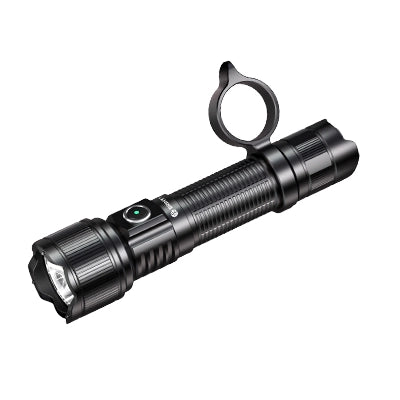
Proactive safety means illuminating a parking lot before you walk into it. It means shining a beam into the backseat of your car before you unlock the door. It means lighting up a dark stretch of running path from fifty meters away, so you can see whether it is empty before you commit to it. It means using the Brinyte PT16A’s 3000 lumens to flood a wide area with daylight-quality visibility — or the PT16’s 600-meter beam to check the far end of a parking lot without walking there first.
Light is not a weapon. It is information. And information is what turns a potential threat into a problem you can see, assess, and avoid — rather than one you stumble into and then have to survive.
Proactive safety is a personal security approach focused on preventing dangerous situations before they develop — by seeing, assessing, and avoiding — rather than relying solely on reactive measures like self-defense tools or improvised weapons. The core tool of proactive safety is reliable illumination: a bright, always-ready flashlight that expands your awareness beyond what ambient light or a phone can provide.
3. The Four Night Scenarios — And What Actually Works for Each
Women’s night safety is not one problem. It is a set of distinct scenarios, each with different visibility needs, different carry constraints, and different priorities. Here is what works for each — and why.
The Parking Lot Walk — After Work, After Dinner, After Dark
You are leaving work at 9 p.m. The parking structure is half-empty. Your car is parked in a corner because that was the only spot when you arrived this morning. The overhead lights flicker. You have done this a hundred times. It never feels normal.
What works: A light with reach. The Brinyte PT16 throws 600 meters — enough to illuminate the far side of any parking structure before you leave the stairwell. The PT16A offers 3000 lumens of wide-area flood, turning the entire walkway into daylight. Both are IP68 waterproof, so rain does not matter. Both fit in a purse or coat pocket. The goal is simple: light up the space before you enter it. If something is wrong, you will see it from a distance — not when you are already three steps from your car.
The Pre-Dawn or Post-Sunset Run — Moving Through Dark Spaces
Runners who train around work schedules run in the dark. There is no way around it. The question is not whether to carry light — it is what kind of light can keep up with movement.

What works: The PT16A or PT16 in hand — not buried in a running belt, not hanging from a keychain. In-hand carry gives you instant directional control. You can sweep the beam toward a sound, check a side path, or signal to an approaching vehicle without breaking stride. Both lights are compact enough (164mm × 25.4mm body) to hold comfortably for a full run. The USB-C rechargeable design means no disposable batteries to replace after every few runs. A fully charged PT16A runs 4+ hours on medium — enough for a week of pre-dawn training.
The Doorstep Fumble — Keys, Lock, Dark Porch, Vulnerable Seconds
This is the moment no one talks about: you are standing at your front door, back to the street, fumbling with keys in a lock you cannot see because the porch light is burnt out or was never installed. For ten to fifteen seconds, you are stationary, partially blind, and completely focused on a mechanical task. It is the most vulnerable moment in the entire nighttime routine.
What works: A light small enough to hold in the same hand as your keys. The PT16A and PT16 share the same 25.4mm body diameter — about the width of a highlighter — and a tailcap switch that activates with thumb pressure. You grip the light and your keys together. One thumb press lights up the lock, the door, and the immediate area behind you reflected in the door’s surface. The moment the door opens, you are inside. The light goes back in your pocket. Total time vulnerable: reduced from fifteen seconds to three.
The Wait — Ride-Share Pickup, Dark Corner, Engine Off
Waiting for a ride-share at night means sitting in a stationary vehicle or standing at a pickup point with limited visibility. If your car battery dies or you are waiting in a lot where the lights have timed out, your phone screen becomes your only light source — and using it drains the very device you need to confirm the driver’s license plate, track the arrival, or make a call.

What works: A light stored in the glove box or center console — always there, always charged. The PT16A’s SOS strobe mode can be placed on the dashboard facing outward, passively signaling your location to the arriving driver or to passersby in an emergency. The USB-C charging means the same cable that charges your phone in the car can top up the flashlight. No specialty batteries. No separate charger. One cable. Two devices. Both ready when you need them.
At a Glance: Which Light for Which Scenario?
| Scenario | Primary Need | Recommended Light | Key Feature |
|---|---|---|---|
| Parking Lot Walk | Long reach to scan ahead | PT16 (600m throw) or PT16A (3000lm flood) | See the far end before you enter |
| Pre-Dawn Run | Light, compact, in-hand control | PT16A or PT16 | USB-C · 164mm · one-hand operation |
| Doorstep Fumble | Small enough to hold with keys | PT16A or PT16 | 25.4mm body · tailcap instant-on |
| Ride-Share Wait | Glove-box reliable, SOS signal | PT16A | SOS strobe · USB-C car recharge |
Women’s night safety is not one situation. It is a pattern of distinct moments — the parking lot, the run, the doorstep, the wait — each with its own visibility need and its own carry constraint. The right tool is the one that fits the scenario you actually live, not the one designed for a tactical fantasy that will never happen.
4. Beyond the Light: A Small Safety Ecosystem

A flashlight is the center of a proactive safety strategy. But it is not the whole picture. Here are two other tools worth considering — not because they are expensive or tactical, but because they address specific vulnerabilities that light alone does not cover.
A personal alarm with a pull-pin. Unlike a phone-based alert, a pull-pin alarm does not require unlocking a screen, opening an app, or waiting for a connection. One pull produces a 150+ decibel siren — disorienting to an attacker, attention-grabbing to everyone in earshot. It is the audible equivalent of what a flashlight does visually: it draws attention to a situation before it escalates. Small enough to clip to a running belt or keychain.
Your phone — but not as a light. A smartphone is a communication device first. In a safety context, its job is to call for help, share your location, and confirm the identity of a ride-share driver. Every percentage point of battery used for flashlight mode during a walk home is a percentage point not available for an emergency call. Separate your light from your phone. Let the flashlight be the flashlight. Let the phone be the phone. Both perform better when they are not trying to do each other’s job.
5. Getting Started: No Manual Required
One of the quiet benefits of a tool like the PT16A or PT16 is that it does not require training. It does not require practice. It does not require you to read a manual or watch a tutorial. You put the battery in. You press the tailcap. Light comes out. That is the entire learning curve.
Here is the five-minute setup:
- Charge it. Plug the USB-C cable into the same charger you use for your phone. The indicator light tells you when it is done. A full charge takes about 2.5 hours.
- Place it. Purse. Glove box. Nightstand. Running belt. Wherever you will actually reach for it. The best light is the one you have with you — not the one sitting at home fully charged.
- Test it once. Press the tailcap. Cycle through the modes with the side switch. Know that low is for reading a door number, medium is for walking, and high is for scanning a parking lot. That is all you need to know.
- Forget it. The light will hold its charge for months. When you need it, it will work. No updates. No pairing. No notifications. Just light.
The most effective safety tool is the one you actually carry. A tactical flashlight left in a drawer because it is too heavy, too complicated, or too intimidating is not a safety tool — it is a paperweight. The Brinyte PT16A earns its place in a purse or glove box not by being the most powerful light on the market, but by being the most powerful light that is simple enough to become part of a daily routine.
📥 Free Download: Night Safety Quick Reference — Four Scenarios, One Light
One-page printable PDF: the four night scenarios, recommended lights, key features, and setup checklist. Share it with a friend.
Looking for a Light That Fits Your Daily Life?
Brinyte flashlights are built for reliability, not novelty. Simple. Bright. Always ready.
Browse Flashlights →About Brinyte
Founded in 2009, Brinyte designs lighting tools trusted by professionals — and increasingly, by people who simply want to feel safer in the dark. Our products are IP68 waterproof, USB-C rechargeable, and built without unnecessary complexity. 50+ patents. ISO9001 certification. No companion app required.
“Engineered for the mission — proven in the field.”
Founded 2009 · 50+ Patents · ISO9001
❓ Frequently Asked Questions
What is the best flashlight for women’s night safety?
The best safety flashlight is one that you will actually carry — compact enough for a purse or coat pocket, bright enough to illuminate a parking lot, and simple enough to operate without thinking. The Brinyte PT16A (3000 lumens, USB-C rechargeable, IP68 waterproof) and PT16 (2000 lumens, 600m throw, same compact body) are designed for exactly this — no apps, no firmware, just dependable light when you need it.
Is a strobe flashlight effective for self-defense?
A strobe can be disorienting at close range, but it is a reactive tool — it only becomes relevant after a threat is already imminent. A better strategy is proactive: using a bright, long-throw light to illuminate your surroundings before you walk into them. The Brinyte PT16A includes both a defensive strobe and an SOS signal mode — but its most important safety feature is simply the 3000 lumens that let you see what’s ahead.
Why should I carry a dedicated flashlight instead of using my phone’s light?
Three reasons: brightness, battery preservation, and durability. A phone flashlight produces approximately 40–50 lumens — a PT16A produces 3000, which is 60 times more light to identify potential risks at a distance. Using your phone as a flashlight drains the battery you need for emergency calls, ride tracking, and location sharing. And a dedicated flashlight like the PT16A is IP68 waterproof and drop-resistant — it survives rain, puddles, and falls that would destroy a smartphone.
What flashlight is best for running at night?
For night running, choose a compact handheld light that gives you directional control — the ability to sweep the beam toward sounds, check side paths, or signal to vehicles. The Brinyte PT16A and PT16 weigh approximately 160g with battery, fit comfortably in one hand, and run 4+ hours on medium mode. USB-C charging means no disposable batteries to replace. In urban mixed-use environments, a handheld light offers more versatility than a fixed headlamp.
How can I feel safer walking alone at night?
Feeling safer comes from having control over your environment. The most effective tool for this is a bright, reliable flashlight that lets you see what’s ahead, check corners before you reach them, and illuminate your path clearly. This is proactive safety — replacing the mental energy spent on vigilance rituals with actual visibility. Pair a dedicated light like the Brinyte PT16A with a personal alarm, preserve your phone battery for communication, and trust your instincts.