

The Night Shift Lighting Checklist: A Flashlight for Every After-Dark Profession
✔ Warehouse, dock, and logistics workers on graveyard shifts
✔ Commercial fishermen, longshoremen, and marine crew
✔ Nurses, paramedics, and healthcare staff commuting in darkness
✔ Anyone who has ever been issued a $5 plastic flashlight and expected to work through the night with it

1. The 440 Million People the Industry Forgot
The International Labour Organization estimates that over 440 million people work at night globally. Security guards. Warehouse pickers. Longshoremen. Nurses. Paramedics. Factory operators. Taxi drivers. They share one thing in common: darkness is their workplace. And they share another: almost every one of them is using a lighting tool that was chosen by someone who never works nights.
The tactical and outdoor lighting industry launches dozens of new models every year — each one engineered for a specific scenario. Hiking. Hunting. Room clearing. Everyday carry. But no major brand has ever published a dedicated lighting guide for the people who use flashlights more hours per week than anyone else on the planet. Until now.
An illumination system designed for professional use during overnight working hours. Differs from tactical, outdoor, or EDC lighting in four ways: (1) it prioritizes sustained, regulated output over peak lumens; (2) it accounts for the impact of light on coworkers' night vision; (3) it integrates into uniform, belt, or vehicle systems rather than being pocket-carried; and (4) it must survive repeated, unglamorous use — rain, dust, drops, and neglect — without failure.
This guide is organized by profession because the tool that fits a security guard's belt is wrong for a nurse's bag, and the light that works on a fishing boat is useless in a warehouse. Every recommendation is based on one question: "If I were doing your shift tonight, what would I want in my hand?"
2. Security Patrol: The Light Is Your Partner

Here's what nobody tells you about working security on the night shift: your flashlight is the only thing between you and whatever is in that dark corner. You don't have a partner on every round. You don't have a weapon on every site. But you always have a light — and the right light can do more than illuminate. It can deter. It can disorient. It can buy you the seconds you need to assess and retreat.
What Security Patrol Actually Needs
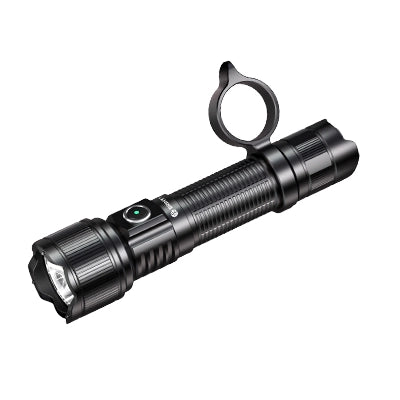
- Instant strobe access, no thinking required: When someone steps out of a shadow at 3 AM, you don't have time to remember which button cycles through modes. You need one button that means "strobe." The PT16A's dual tail switch gives you exactly that — one for on/off and momentary, one that fires strobe from any state.
- 3000 lumens for deterrence: A blast of 3000 lumens to the face is not a weapon, but it is the closest thing to one you can legally carry everywhere. It buys you a reflexive flinch and a three-second window. In security work, that window is everything.
- A wrist lanyard you trust: A light that gets snatched from your hand is a liability. The PT16A's included tactical wrist lanyard keeps the light attached to you. If someone grabs it, they're grabbing you — and that's a different problem with a different response.
- Runtime that covers a 12-hour shift: On High mode (900 lumens), the PT16A runs for nearly 4 hours of continuous use — more than enough for intermittent patrol rounds. On Low (5 lumens), it runs for 300 hours. You charge it once between shifts. It never dies mid-round.
- IP68: Rain, puddles, dropped in a drainage ditch. The light keeps working.
A security guard's flashlight has three jobs, in order: deter, identify, navigate. Most consumer lights only do the third. The PT16A's dual tail switch architecture is designed for job one: instant strobe without mode cycling. If your light requires you to look at it to activate its most important defensive feature, it's the wrong light for security work.
3. Warehouse Logistics: Hands-Free, Magnet-Mounted, Flood Beam
Warehouse work at night is a different kind of dark. It's not about threat deterrence — it's about seeing what you're doing without blinding yourself or the guy on the next aisle. The problem with most "tactical" lights in a warehouse: they're too bright, too focused, and too dependent on one hand that you need for a clipboard or a box.
What Warehouse and Logistics Workers Actually Need
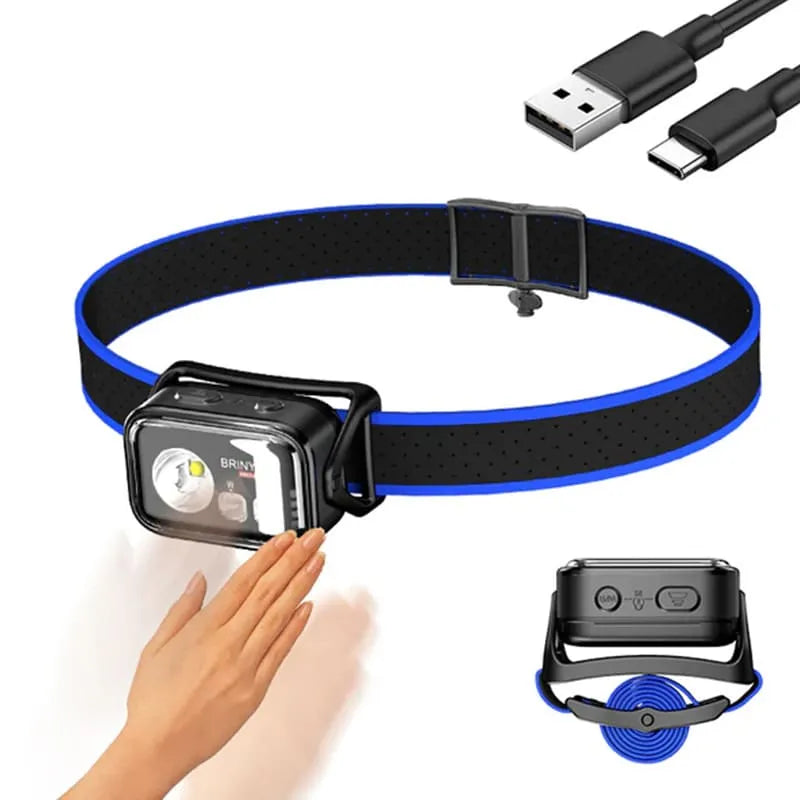
- Medium brightness with wide flood: 500–1000 lumens max. Anything more bounces off high-gloss warehouse shelving and destroys your night adaptation. The Brinyte HL28 Explorer headlamp (white/red/green, IP66, 21700 USB-C) provides hands-free wide illumination that follows your gaze — not your hand.
- Magnetic tail or base mounting: You need both hands to scan a barcode or lift a carton. A light with a magnetic tail cap sticks to any steel shelf, beam aimed exactly where you need it. The Brinyte PT16 (2000 lumens, 92,500 cd, 21700 USB-C) has a magnetic tail option for this use case — stick it, aim it, work under it.
- Red light mode for shared spaces: If you work alongside other pickers or operators, switching to red preserves everyone's dark adaptation. A white blast in a dark warehouse is a social offense.
4. Marine and Fishing: Surviving Salt, Spray, and Submersion
If you work on the water at night, your light has one job that no other profession demands: it must survive going overboard. Not "it might." It will, eventually. A line catches the lanyard. A wave hits the deck. Someone stumbles in the dark. Your light is going in the water — the only question is whether it comes back out still working.
What Marine Workers Actually Need
- IPX8 minimum — IP68 preferred: Submersion rating at 2 meters. The Brinyte ZT40 (1650 lumens, 490m throw, IPX8, 21700 USB-C) is rated for continuous submersion. The hidden USB-C port maintains the seal. Saltwater aftercare: rinse the light with fresh water after every shift, dry the O-rings, apply a thin film of silicone grease monthly.
- Red light mode is mandatory: A white light on a boat deck at night is a hazard. It destroys the night vision of everyone aboard — helmsman, crew, spotters — for up to 30 minutes. Red light preserves scotopic vision. The ZT40 Red version is purpose-built for this: 450 lumens, 273m throw, dedicated red LED. No filter. No white leakage.
- Floating lanyard attachment: The light itself may not float, but a bright-colored floating lanyard means you can retrieve it before it sinks beyond reach.
- Corrosion resistance: Type III hard anodizing on 6061 aluminum resists salt corrosion better than bare metal. Stainless steel bezels and switch components prevent rust at contact points.
On the water, red light is not a preference — it's a safety protocol. White light at night destroys scotopic (rod-mediated) vision. Recovery takes 20–30 minutes. A single white beam on deck can disable an entire crew's night vision for half an hour. The ZT40 Red's dedicated 450-lumen red LED — not a white LED with a red filter — preserves night adaptation while providing enough throw (273m) to spot buoys, hazards, and crew in the water.
5. Healthcare Commute: Lightweight, Discreet, Reliable
A nurse finishing a 12-hour shift at 2 AM walks through a dark parking garage, keys in one hand, phone in the other. She's not thinking about tactical strobe or candela ratings. She's thinking about getting to her car safely and getting home. Her light should require zero thought to operate and zero fashion statement to carry.
What Healthcare Commuters Actually Need
- Lightweight, bag-mountable: Under 70 grams. Clips to a backpack strap or belt loop without pulling. The Brinyte E18 Pheme (1200 lumens, 66g, IP68, 18650 USB-C) is designed for this — compact, faceted grip, magnetic tail cap. Clips to a bag strap. Vanishes when not in use.
- One-button simplicity: No dual switches. No mode cycling you didn't intend. Click on, click off. Hold for momentary. That's it. A brain exhausted from 12 hours of patient care cannot navigate a complex UI.
- Discreet design — no "tactical" aesthetic: A nurse walking through a hospital parking lot should not look like she's carrying a weapon light. The E18 Pheme's blue switch accent and clean faceted body are designed to look like a tool, not a threat.
- Magnetic tail for incidental use: If the power goes out in a patient room, stick the E18 to a metal cabinet or bed frame. It's an instant area light.
6. Night Shift Charging Habits That Actually Stick
The biggest problem with night shift lighting is not choosing the wrong light. It's forgetting to charge the right one. Here are habits that work with a night shift schedule, not against it.
| Shift Type | Charging Habit | Backup Strategy |
|---|---|---|
| Rotating shifts (variable schedule) | Charge at the end of every shift block, not the beginning. A light charged on your last shift is ready for your first. | Keep a USB-C power bank in your work bag — one charge will top off the light three times |
| Permanent night shift (fixed schedule) | Charge every Sunday night — it's your Monday morning. Set a recurring phone alarm. | Spare 21700 battery in your locker or vehicle glovebox |
| On-call / intermittent | Charge after every use. The light goes back on the charger when you go back to bed. | Wireless charging dock (WT01 Apollo) — drop it on the pad, it charges automatically, no cable to forget |
| Marine / remote site | Charge from the vehicle or vessel USB port while commuting or underway. Rinse with fresh water after salt exposure before charging. | Carry two lights: one primary, one sealed in a dry bag with a spare battery |
❓ Frequently Asked Questions — Night Shift Lighting
What is the best flashlight for security guards on night patrol?
A security patrol light needs instant strobe access without mode cycling, high output for deterrence (2000+ lumens), IP68 waterproofing for all-weather patrol, and a wrist lanyard against snatching. The Brinyte PT16A is purpose-built for this role: dual tail switch separates on/off from strobe, 3000 lumens with 52,500 cd throw, and a 21700 battery with 300-hour low mode for extended shifts.
What kind of flashlight do warehouse workers need?
Warehouse workers need medium brightness (500–1000 lumens max) with wide flood beam to avoid harsh reflections off metal shelving, hands-free options (headlamp or magnetic tail mount), and red light mode for shared spaces where white light blinds coworkers. A headlamp like the Brinyte HL28 handles continuous task lighting, paired with a magnetic-tail PT16 for area illumination on steel shelving.
What is the best flashlight for marine and fishing night work?
Marine lights need IPX8 minimum submersion rating, a dedicated red LED (not white with a filter) to preserve crew night vision, corrosion-resistant Type III hard anodizing, and a floating lanyard. The Brinyte ZT40 Red version meets all four: IPX8 to 2 meters, 450 lumens of dedicated red light with 273m throw, and a 21700 USB-C battery. Rinse with fresh water after every saltwater shift.
What is a good flashlight for nurses and healthcare workers commuting at night?
Healthcare commuters need lightweight (under 70g), discreet design (no aggressive bezels or "tactical" appearance), one-button simplicity, and the ability to clip to a bag strap. The Brinyte E18 Pheme weighs 66g, uses a single-button interface with a magnetic tail cap, and charges via USB-C — the same cable as a phone. Its faceted design and blue switch accent look like a professional tool, not a weapon light.
How often should I charge my flashlight if I work night shifts?
Charge at the end of every shift block, not the beginning. For permanent night shift workers, set a recurring weekly alarm — Sunday night / Monday morning works well as a routine anchor. For rotating shifts, charge when your block ends. Keep a USB-C power bank in your work bag as a backup — one full power bank charges a 21700 light three times. If your light has a battery indicator, check it when you set your wake-up alarm. That habit takes three seconds.
Find the Light That Fits Your Shift
Explore Brinyte professional and EDC flashlights — from 3000-lumen patrol lights to pocket-sized commuter lights. All USB-C rechargeable, all rated for the conditions you actually work in.
Explore Professional LightsAbout Brinyte
Founded in 2009, Brinyte designs and manufactures professional-grade illumination tools at our Shenzhen facility under ISO9001 certification. Our products are developed with input from the professionals who use them — security guards, marine crew, logistics workers, and first responders. Brinyte holds 50+ patents covering optical design, switching mechanisms, and battery architecture. Every professional-series light carries a 5-year warranty.
👉 About Brinyte | Professional Collection | About the Author
🔍 Fact-Checking Policy: Night shift workforce statistics sourced from International Labour Organization (ILO) published data. All product specifications verified against official Brinyte documentation.
"Engineered for the mission — proven in the field."
Founded 2009 · 50+ Patents · ISO9001 · 5-Year Warranty
• International Labour Organization — Working Time and Shift Work Statistics
• Brinyte PT16A / ZT40 / E18 Pheme / HL28 Official Product Specifications
• Industry Feedback — Security, Logistics, Marine, and Healthcare Professional Consultations (2025–2026)