

Hunting Light Discipline: Stealth Techniques & Best Flashlight Colors for Night Hunts (2026)

✔ Bow and crossbow hunters who operate at close range where light discipline is critical
✔ Anyone who has watched a buck freeze, then bolt, because of a misplaced beam
✔ Hunters building a complete light strategy for approach, observation, tracking, and recovery
1. Introduction: The Unspoken Rule of Successful Night Hunting
You have been tracking a buck for two hours. It is 5:42 a.m. — the last stretch of darkness before the gray light of dawn. You are 80 yards out, closing slowly. You reach for your flashlight to check the terrain ahead. A quick burst of white light. The buck's head snaps up. He is gone before you hear the branches break.
Ask any seasoned hunter about their most valuable skill, and they will likely talk about stealth, patience, or marksmanship. But the scene above — a hunt undone by a single misplaced beam — points to a quieter, equally crucial skill: light discipline. It is not about how bright your flashlight is. It is about when you turn it on, what color it is, where you point it, and for how long.
The best hunter in the woods is not the one with the most powerful light. It is the one whose light is invisible until the exact moment they choose to be seen. Light discipline is the difference between a beam that reveals and a beam that betrays.
2. What Is Light Discipline — and Why Most Hunters Get It Wrong
Light discipline is the strategic management of artificial light in the field. It means illuminating only when necessary, at the right intensity, in the right color, and in a way that either conceals your presence or reveals only what you intend to see.
The most common error — even among experienced hunters — is over-lighting. Flooding a dark field with 2,000 lumens of white light may feel safer. It may even let you see farther. But to every animal within 400 yards, that beam is a screaming alarm. Deer do not understand lumens. They understand sudden brightness where there should be none.
Mastering light discipline means balancing your need to see with the animal's sensitivity to disturbance. In practice, this means:
- Using a low-lumen red headlamp or handheld to navigate to your stand — enough to see roots and branches, not enough to silhouette yourself against the treeline.
- Switching to a focused green beam only when scanning open terrain at distance, where the animal's reduced sensitivity to green gives you a margin of safety.
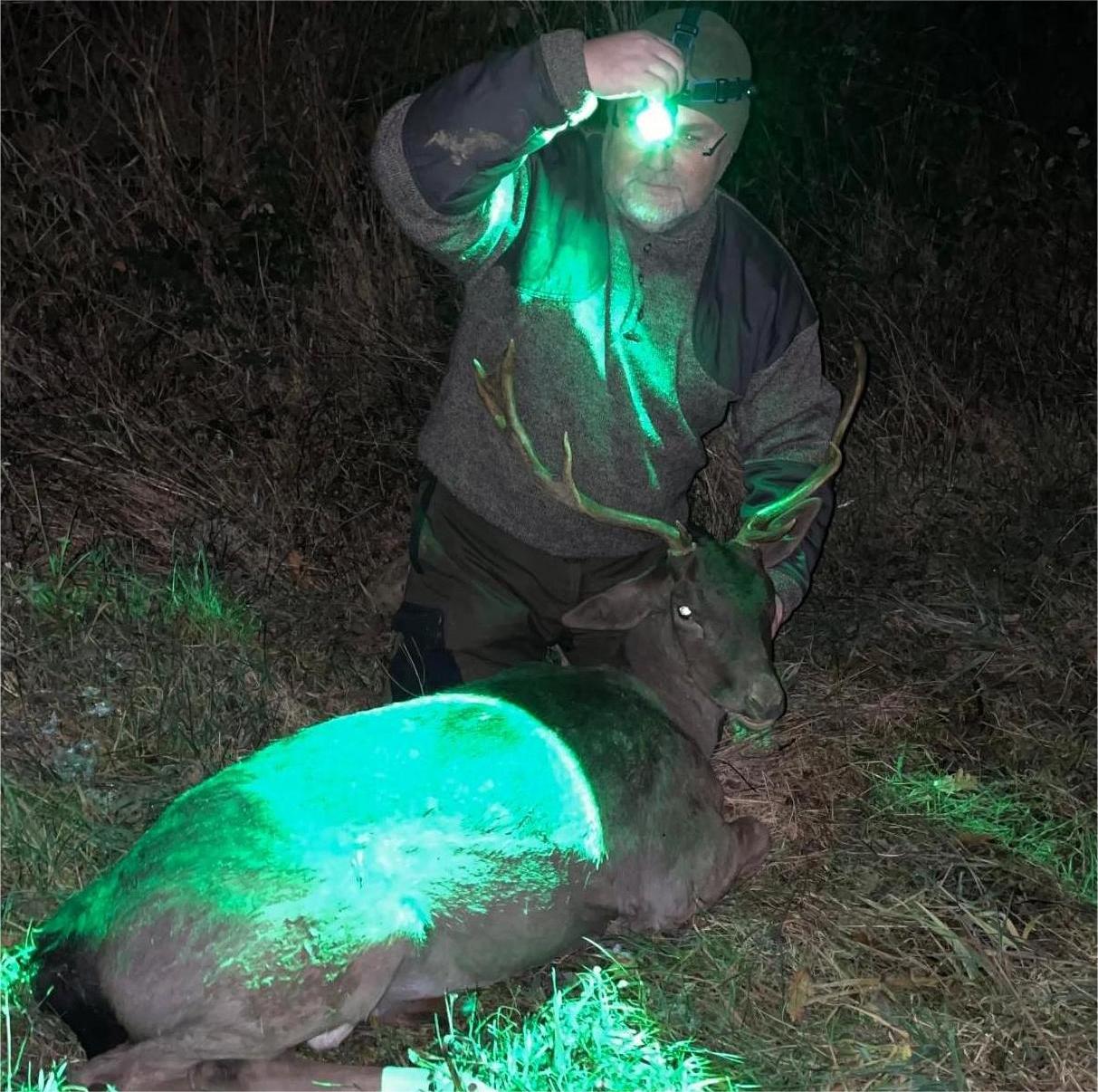
- Reserving white light for post-shot tasks — blood tracking, target confirmation after the shot, or emergency signaling — never for active stalking.
Light discipline is the deliberate, phase-appropriate control of artificial illumination sources in the field. It requires the hunter to match beam color, brightness, angle, and activation timing to the specific demands of each hunting phase — approach, observation, stalking, shooting, tracking, and recovery — so that the light serves the hunter's vision without alerting the target.
3. The Science Behind Stealth Lighting: What Animals Actually See
To practice light discipline effectively, you need to understand what the animal sees when your beam hits it — not what you see looking through the beam.

Most game mammals — including deer, elk, and wild hogs — have dichromatic vision, meaning their retinas contain only two types of cone photoreceptors. This is roughly analogous to red-green color blindness in humans. Their eyes are tuned for the blue-violet end of the spectrum (short wavelengths, optimized for dawn and dusk) and have very weak sensitivity to wavelengths above 600nm — the red zone. This is not a learned behavior or a preference. It is a physical limitation of their biology.
What this means in the field:
- Red light (~620–750nm) registers as dim gray to a deer — roughly equivalent to moonlight. They can detect it at close range if the intensity is high, but at moderate output, it is functionally invisible. Red also preserves the hunter's own dark-adapted vision — after red light exposure, your eyes re-adapt to darkness in seconds, not the 20–30 minutes required after white or green exposure.
- Green light (~520–560nm) sits at the peak of human photopic sensitivity. This makes it the best choice for long-range scanning — your eyes pick up detail in a green-illuminated field far better than in red. For hogs, which have minimal color discrimination across all wavelengths, green is effectively as stealthy as red. For deer and coyotes, green is more detectable than red — so it is appropriate for distance scanning where the range itself provides a buffer, but not for close approach.
- White light (full spectrum) is the most detectable across all species and all distances. Its role in disciplined hunting is narrow and specific: final target identification before a shot, blood tracking with high color accuracy, and emergency signaling. Extended white light use during stalking is the single most common cause of spooked game.
Light color is not a preference. It is a biological exploit. Red light exploits the physical absence of red-sensitive cone cells in game mammals. Green light exploits the peak sensitivity of the human eye while remaining below the alarm threshold of hogs. White light is honest illumination — use it only when you are ready to announce your presence to everything within line of sight.
4. Practical Light Discipline Techniques: The Four-Phase Strategy
Putting theory into practice requires a deliberate, phase-by-phase approach:
| Hunting Phase | Light Color | Brightness | Technique |
|---|---|---|---|
| 1. Approach & Navigation | Red | Low (30–80 lm) | Angle beam downward 10–15°. Use short, intermittent bursts — never constant-on. Walk slowly; let your eyes adapt between bursts. |
| 2. Scanning & Observation | Green (or red if deer are primary target) | Medium (100–300 lm) | Use balanced beam (between flood and spot). Sweep fields in wide arcs from your position, not forward movement. Keep beam duration under 3 seconds per sweep. |
| 3. Final ID & Shot | White (brief burst) | High (500–1000+ lm) | Confirm species, sex, and safe backdrop. One burst, one decision. Light off immediately after — do not keep the animal illuminated after the shot. |
| 4. Tracking & Recovery | UV (365nm) or White | As needed | Switch to UV for blood fluorescence on dark terrain. White only if full-color identification of blood vs. sap or mud is needed. Keep beam angled downward; avoid sweeping the horizon. |
Additional habits that form the instinct of true light discipline:
- Avoid shining your beam directly ahead for long periods. Even a low-lumen red beam, held static at eye level for minutes, becomes detectable as an anomaly in the forest. Keep the beam moving or angled down.
- Limit unnecessary activation. Every click produces sound. Every flicker is a visual event. If you do not need light in this moment, do not turn it on.
- Plan your light strategy before leaving the vehicle. Know which light is on your head, which is in your hand, and what mode each is set to. Fumbling with a side switch while a buck is 60 yards out is not light discipline — it is a confession that you did not prepare.
- Avoid reflective surfaces. A glossy watch face, a shiny zipper, or an uncovered phone screen can catch your own beam and flash light back toward the animal. Matte and subdued gear is part of the discipline.
Light discipline is not a single setting — it is a sequence of deliberate transitions matched to the four phases of every hunt. The hunter who uses the same light color and brightness from approach to recovery is not practicing discipline. They are broadcasting their position to every animal with line of sight.
5. Recommended Brinyte Tools for Controlled Illumination
Not all lights support true light discipline. The models below — T28 Artemis, T5X SPECTRA, and ZT40 — are built around the features that matter most when stealth is the priority: multi-color output, silent switching, variable beam geometry, and removable batteries for cold-weather reliability.

🔴 Brinyte T28 Artemis
Tri-color (White / Red / Green) in one light. Patented silent rotary dimmer — switch between colors without clicking, without cycling through white, without making a sound. IP68 waterproof. Removable 21700 battery with USB-C fast charging. 650 lumens white, 525m throw.
Light discipline role: Your approach-and-scanning light. Red for silent navigation. Green for hog field scanning. White reserved for final confirmation — and the rotary dimmer ensures you never cycle through white to reach red.
Shop T28 Artemis🔦 Brinyte T5X SPECTRA
White / Red / Green / UV in one light. Dual-frequency strobe (10Hz and 5Hz) for blood tracking — causes hemoglobin to fluoresce against dark soil and leaf litter. IPX7 waterproof. Removable 21700 battery with USB-C charging. 120° flood angle.
Light discipline role: Your post-shot recovery light. After the shot, switch to UV tracking mode — no white light, no sweeping beams that could alert other game in the area. Clean, silent, precise recovery.
Shop T5X SPECTRA🔦 Brinyte ZT40
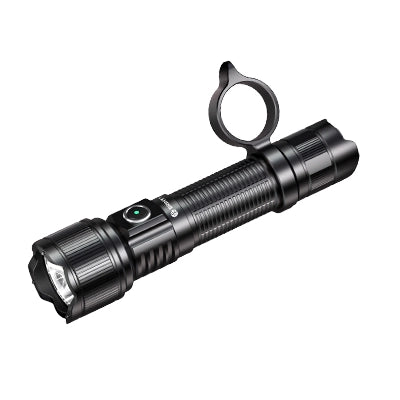
6°–70° zoomable beam. 1650 lumens white, 490m throw on Low mode. Also available in Red, Green, IR, and UV. IPX8 waterproof. Removable 21700 battery with hidden USB-C charging port.
Light discipline role: Your terrain-adaptive light. Twist to 70° flood for close-range navigation in thick brush. Twist to 6° spot for long-range scanning across open terrain. One light, one hand, instant adaptation — without changing equipment.
Shop ZT406. Pro Tips from Experienced Hunters
From field-tested experience, professional hunters recommend these additional light discipline habits:
- Pre-set your brightness and color modes before leaving the vehicle — avoid fumbling with controls in the dark. The T28's rotary dimmer makes this muscle memory; the ZT40's two-mode interface means you never cycle past your target setting.
- Keep your light silent. Choose gear with soft switches or silent rotary controls. Every click is a sound that travels farther in cold, still air than you think.
- Use your hand or hat brim to block spill light from reaching your own face or reflecting off nearby surfaces.
- Carry a backup light or spare battery. In cold weather, keep the spare cell in an inside pocket — body heat preserves capacity. When the light dims, swap the warm cell in and place the cold one in your pocket to recover.
- Practice light timing. Short, intentional bursts of 1–3 seconds are more effective — and less detectable — than constant illumination. Animals notice change, not steady state. A light that comes on and stays on is a permanent anomaly. A light that flickers briefly and disappears could be anything.
Step-by-Step: Build Your Light Discipline Strategy for Any Hunt
- Assign a light color to each hunting phase: Red for approach and navigation. Green for scanning (if hogs are present; use red if deer only). White for final target ID and blood tracking. UV for post-shot recovery on dark terrain. Write it down or pre-set your lights before leaving the vehicle.
- Set brightness to the minimum effective level: Start at the lowest mode your light offers. Increase only if you cannot navigate or observe at the current level. More lumens equal more detectable photons — and more risk. The right brightness is the lowest one that accomplishes the task.
- Control beam angle and activation timing: Angle downward 10–15° in all phases except scanning. Use short bursts of 1–3 seconds rather than constant-on. Move the beam deliberately — do not let it rest on the same spot for more than a few seconds unless you have already confirmed the animal is not present.
- Debrief and adjust after every hunt: Did an animal react to your light? At what distance? What color and brightness were you using? Adjust your strategy for the next outing. Light discipline improves through honest self-assessment, not through buying a brighter flashlight.
Ready to Master the Dark?
Brinyte hunting lights are built for control, not chaos — multi-color, silent switching, removable batteries, IP68 waterproofing.
Shop Hunting Lights →About Brinyte
Founded in 2009, Brinyte designs hunting and tactical lighting for professionals who depend on their gear in real conditions. All core hunting models use standard removable 21700 batteries with onboard USB-C charging — no sealed landfill, no proprietary chargers. IP68 waterproof. FL1-tested specs. 30+ patents. ISO9001 certification.
“Engineered for the mission — invisible until you choose to be seen.”
Founded 2009 · 30+ Patents · ISO9001
7. Frequently Asked Questions
What does "light discipline" mean in hunting?
Light discipline is the strategic, phase-appropriate control of your flashlight — its brightness, beam angle, activation timing, and color — to maintain your ability to navigate and observe without alerting game animals. It is not about limiting light use entirely. It is about using the minimum effective illumination for each specific hunting phase.
Why is red or green light better for hunting at night?
Red light (620–750nm) sits at the edge of the mammalian visual spectrum. Most game animals — deer, hogs, elk — have dichromatic vision and lack the cone cells to perceive red wavelengths strongly. It registers as dim gray rather than an alarm. Red also preserves the hunter's dark-adapted night vision. Green light (520–560nm) is ideal for scanning at distance because it aligns with peak human visual sensitivity while remaining minimally detectable to hogs. For deer, red is stealthier at close range; green is appropriate for distance scanning only.
How bright should my flashlight be for hunting?
You rarely need maximum brightness. For navigation and setup, low to medium modes (30–150 lumens) are sufficient. Reserve high modes (500+ lumens) for distance scanning or final target identification. More lumens equals more detectable photons — and more risk. The right brightness is the lowest one that accomplishes the task. Multi-output lights like the Brinyte T28, T5X, and ZT40 let you adjust brightness to match the phase of the hunt.
What are the most common lighting mistakes hunters make?
The biggest errors: (1) overusing white or turbo mode during approach, (2) shining beams too high or directly ahead for extended periods, (3) ignoring light color strategy entirely — treating all colors as interchangeable, (4) using constant-on illumination instead of short, intentional bursts, and (5) failing to pre-set modes before leaving the vehicle. These mistakes often lead to spooked game or unnecessary battery drain. Practicing light discipline and using a multi-color light with silent switching prevents all of them.
How can I keep my flashlight hidden while still seeing where I'm going?
Angle your beam toward the ground 10–15° below horizontal to reduce forward glare. Use the lowest brightness setting that provides adequate visibility. Choose red light mode while walking — it is the least detectable wavelength to game mammals. Avoid shining your light on reflective surfaces or other hunters' gear. Use short bursts of 1–3 seconds rather than constant-on illumination. A multi-color light like the Brinyte T28 Artemis allows you to switch from red (navigation) to green (scanning) without cycling through white.
What lighting setup do professional hunters recommend?
Experienced hunters often carry a dual or triple setup matched to hunting phases: a multi-color handheld or headlamp (like the Brinyte T28 Artemis — White/Red/Green, silent rotary dimmer) for approach and scanning; a specialized tracking light (like the Brinyte T5X SPECTRA — White/Red/Green/UV) for post-shot blood tracking; and optionally a zoomable light (like the Brinyte ZT40 — 6°–70° beam) for terrain-adaptive illumination. This combination offers precise light for every phase, from silent approach to clean recovery.