

The Ninth Essential: Why a Car Emergency Flashlight Is Replacing the Tow Rope in 2026
✔ Anyone who has changed a tire using a phone flashlight
✔ Road trip drivers, campers, and rural commuters
✔ Parents who want their teenagers to have real emergency gear

1. From Tow Rope to Flashlight: The New Trunk Essential
For decades, the standard car emergency kit was eight items: spare tire, jack, lug wrench, jumper cables, first-aid kit, reflective triangle, tow rope, and a blanket. Every driver knew the list. Every dad made sure the list was in the trunk before a road trip.
The ninth item was always missing.
AAA data makes the case: on Memorial Day weekend alone, the organization responds to over 356,000 roadside emergencies — flat tires, dead batteries, and lockouts lead the list[reference:2]. On Independence Day weekend, that number jumps to over 700,000[reference:3]. In every one of those scenarios, the driver's first action after pulling over is the same: they need to see. They need to see the lug nuts. They need to see the engine bay. They need to see the road behind them. They need to be seen by oncoming traffic.
TikTok's fastest-growing automotive category in 2026 isn't tow ropes or jumper cables — it's car emergency flashlights. One Chinese export brand, BougeRV, sold 6,400 units in 15 days for $1.39 million[reference:4][reference:5]. A single 18-second video did $129,000 in sales[reference:6]. This isn't a fad. It's a realignment of what drivers now recognize as essential.
The tow rope saves someone else. The flashlight saves you. Most drivers spend $100+ on jumper cables they've used once and a tow rope they've never used — but zero dollars on the tool they'd reach for in every single roadside situation, day or night. That's the gap the car emergency flashlight category is filling.
2. Four Real Scenarios, One Light
Every roadside emergency has different lighting requirements. A single-purpose light — a headlamp, a magnetic work light, a signal flare — solves one scenario and fails the other three. Here's what a single professional-grade flashlight needs to handle.

Scenario 1: Highway Blowout at 11 PM
You hear the thump. You feel the car pull right. You ease onto the shoulder of a highway where traffic is still moving at 70 mph. Your hazards are on. Your reflective triangle is out — but it's dark, and a reflective triangle doesn't actively warn drivers. It just sits there.
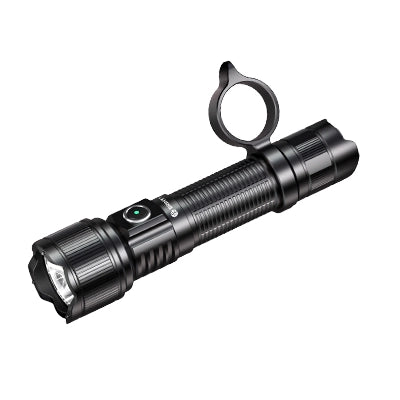
This is where the Brinyte PT16A's instant strobe changes the equation. The dual tail switch gives you independent access to the 3000-lumen strobe mode — no cycling through brightness levels, no fumbling in the dark. One press on the dedicated mode switch, and your roadside becomes actively, visibly dangerous to ignore. Pairing a reflective triangle with an active strobe warning creates a layered safety system that covers both passive reflection and active attention-grabbing.
And if the worst happens — if you're trapped in the vehicle after a collision — the PT16A's strike bezel has three tungsten steel tips designed for emergency glass breaking. Understanding the physics helps: the force required to break tempered auto glass isn't about raw strength — it's about concentrating force onto the smallest possible surface area (pressure = force / area). A rounded flashlight head distributes impact across a wide surface. The PT16A's three tungsten micro-protrusions concentrate that same force into three pinpoints, each with the hardness to initiate the fracture propagation that tempered glass is engineered to complete. You don't need to swing hard. You need to swing precisely — and the tool needs to be harder than the glass. Tungsten steel is.
Scenario 2: Engine Bay Rattle at a Rest Stop
You're 200 miles from home, and a new rattle has started somewhere under the hood. You pull into a rest stop. It's dark. Your phone flashlight illuminates a 6-inch circle directly in front of the lens and nothing else.
The PT16A's 3000-lumen Turbo mode — powered by a Luminus SFT70 LED — floods the entire engine bay with daylight-quality illumination[reference:7]. You see the serpentine belt. You see the coolant hoses. You see the alternator mounting bracket — and there it is, the loose bolt that's been rattling for the last 50 miles. You found it because you could see, and you could see because the light reached every corner.
After one minute, the PT16A smart-steps down to approximately 900 lumens to manage heat — but that's still nine times brighter than a phone flashlight, and it lasts for nearly four hours on High mode[reference:8]. The IP68 waterproof rating means you can use it in the rain with the hood up, no problem.
Scenario 3: Lost on a Forest Service Road
Your GPS died. Your phone has no signal. It's getting dark, and you're on a gravel road that all looks the same. You need to signal for help — but you also need to conserve battery, because you don't know how long this will take.
The PT16A's SOS mode (300 lumens, international Morse distress signal) is designed for exactly this. At 458 meters of beam throw with 52,500 candela intensity, the SOS signal is visible from over a quarter mile away — far enough that a search aircraft, a ridge-top ranger station, or a distant highway can register it. That's the ANSI FL1 standard: the distance at which the beam produces 0.25 lux, equivalent to full-moon illumination on a clear night[reference:9].
And when you're not signaling — when you're waiting and watching — the PT16A's 5-lumen Moonlight mode runs for up to 300 hours on a single charge. That's nearly two weeks of continuous low-level illumination. No phone flashlight can touch that runtime.
Scenario 4: Camping — One Light for Everything
You've set up camp. The tent is pitched, the fire is going, and now you need a light that handles four different tasks without four different devices.
The PT16A's six output modes map cleanly onto camping life: 5 lumens (Moonlight) for reading in the tent without waking your partner, 120 lumens (Medium) for camp kitchen tasks and gear sorting, 900 lumens (High) for scanning the treeline or checking on noises, and 3000 lumens (Turbo) if you need to momentarily flood the entire campsite. The dual tail switch means you never cycle through modes accidentally — one button controls on/off and momentary, the other handles brightness and strobe.
And in the morning, when you pack up and drive home, the light goes back in the trunk — charged and ready for the next emergency. The USB-C port built into the 21700 battery means you charged it from the same cable that charges your phone.
3. The "Cold Storage Test": Parked for a Year, Works Instantly
Here's the problem with most flashlights in cars: they get buried under a pile of windshield washer fluid and reusable grocery bags. They sit there for six months, a year, maybe two. The batteries leak. The contacts corrode. The switch gets stiff. And the one time you actually need it — a blowout on a dark highway at midnight — you click the button and nothing happens.
This is the test that separates a real car emergency flashlight from a toy. It's what we call the "cold storage test": the light must sit untouched in a vehicle through temperature swings from -20°C to 50°C, for months at a time, and activate instantly when needed.
| Threat | What Happens in a Car Trunk | How PT16A Handles It |
|---|---|---|
| Battery Leakage | Alkaline cells leak KOH electrolyte, corroding contacts beyond repair | Sealed 21700 5000mAh Li-ion — no liquid electrolyte to leak. Self-discharge rate ~3% per month |
| Temperature Extremes | -20°C freezes alkaline electrolyte; 50°C accelerates degradation | 21700 Li-ion operational range: -20°C to 60°C. Store at full charge for maximum readiness |
| Moisture & Dust | Humidity corrodes contacts, dust fouls switch mechanisms | IP68 — fully dust-tight and submersible to 2 meters. Sealed dual O-rings at every opening |
| Switch Degradation | Rubber boot stiffens with age; mechanical switches oxidize | Dual independent tail switches rated for 50,000+ cycles. Tactile feedback doesn't degrade |
A car emergency flashlight is defined by one test: does it work after being ignored for a year? IP68 sealing keeps out the moisture that kills contacts. Li-ion chemistry avoids the leakage that destroys alkaline-powered lights. And USB-C charging means you can top it off from your car's USB port before a road trip — no proprietary charger to lose in the glovebox.
4. How Many Lights? Where Do They Go?
The answer depends on your driving habits, but a practical framework covers most people:
| Driver Profile | Recommended Setup | Storage Location |
|---|---|---|
| Daily commuter (urban) | 1 × PT16A | Glovebox or driver's door pocket |
| Road trip driver | 1 × PT16A + spare 21700 battery | Trunk emergency kit + battery in center console |
| Rural / off-road driver | PT16A (primary) + ZT40 (zoomable secondary) | PT16A in glovebox, ZT40 in trunk bag |
| Family vehicle | PT16A (driver) + compact backup | PT16A in glovebox, backup in trunk emergency kit |
❓ Frequently Asked Questions — Car Emergency Flashlights
What is the best flashlight to keep in a car?
The best car flashlight is one that works after sitting ignored for months. Look for Li-ion battery chemistry (not alkaline — they leak), IP68 waterproofing, multiple brightness modes including strobe for roadside signaling, and a strike bezel for emergency window breaking. The Brinyte PT16A covers all four with a 21700 USB-C battery, 3000 lumens, and IP68 sealing.
How often should I charge a flashlight kept in a car?
Every six months is sufficient for a 21700 Li-ion light like the PT16A. Lithium-ion cells lose approximately 3% charge per month in storage — after six months, you'll still have about 80% of a full charge. Set a calendar reminder tied to another routine (oil change, tire rotation, daylight saving time). A quick function check takes two minutes.
Can a flashlight really break a car window?
Yes — if it has a dedicated strike bezel with hardened tips. Tempered auto glass is strong against distributed force but fractures easily under concentrated point pressure. The PT16A's three tungsten steel protrusions on the bezel concentrate impact force into pinpoints — each hard enough (tungsten steel measures 8–9 on the Mohs scale, glass is 5–6) to initiate fracture propagation. Aim for the corner of the side window, not the center. A firm, focused strike is more effective than a wild swing.
Is it safe to leave a lithium-ion flashlight in a hot car?
Yes — within limits. Quality 21700 Li-ion cells are rated for storage up to 60°C (140°F). A car interior in direct summer sun can reach 65–70°C, which exceeds the rating. Solution: store the flashlight in the glovebox (insulated from direct sun) or trunk (cooler than the cabin). Avoid the dashboard or center console in full sun. If you live in an extreme climate (Phoenix, Las Vegas), bring the light inside during July and August.
Do I need a special flashlight for a car vs a regular EDC light?
A car flashlight faces challenges an EDC light doesn't: months of storage neglect, extreme temperature cycling, and the need for emergency-specific modes (strobe/SOS/glass breaking). A dedicated car light should have IP68 sealing, Li-ion chemistry, a strike bezel, and high output for engine bay inspection. The PT16A serves well in both roles — sized for EDC carry but engineered for vehicle storage durability.
Put a Real Light in Your Trunk
Shop the Brinyte PT16A — 3000 lumens, IP68 waterproof, USB-C charging, strike bezel with tungsten steel tips. The light you'll reach for in every roadside emergency.
Shop PT16AAbout Brinyte
Founded in 2009, Brinyte designs and manufactures professional-grade illumination tools at our Shenzhen facility under ISO9001 certification. Our products are field-tested in operational conditions — including the trunks of our own engineers' cars. Brinyte holds 50+ patents covering optical design, switching mechanisms, and battery architecture. Every professional-series light carries a 5-year warranty.
👉 About Brinyte | Professional Collection | About the Author
🔍 Fact-Checking Policy: Roadside emergency statistics sourced from AAA published data. TikTok sales data sourced from published market reports. All product specifications verified against official Brinyte documentation.
"Engineered for the mission — proven in the field."
Founded 2009 · 50+ Patents · ISO9001 · 5-Year Warranty
• AAA Roadside Emergency Statistics — Memorial Day & Independence Day Weekends (2025)
• TikTok Automotive Accessories Sales Data — Published Market Reports (2026)
• Brinyte PT16A Official Product Specifications
• 1Lumen Independent Review — Brinyte PT16A (2024)