

Brinyte HL16 Noctua Headlamp Review: 90° Rotatable, Magnetic Tail, Lightweight (2026)

✔ Mechanics and DIYers looking for a magnetic work light
✔ Night runners seeking a lightweight, stay-put headlamp
✔ EDC enthusiasts who appreciate right-angle versatility
1. Introduction: A Headlamp That Refuses to Be Just a Headlamp
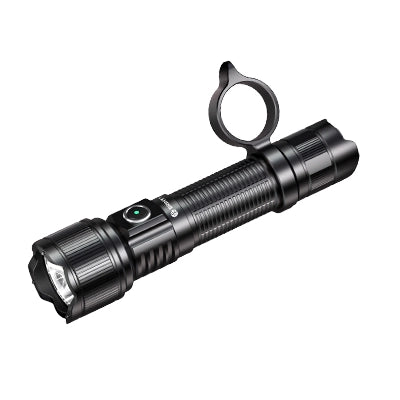
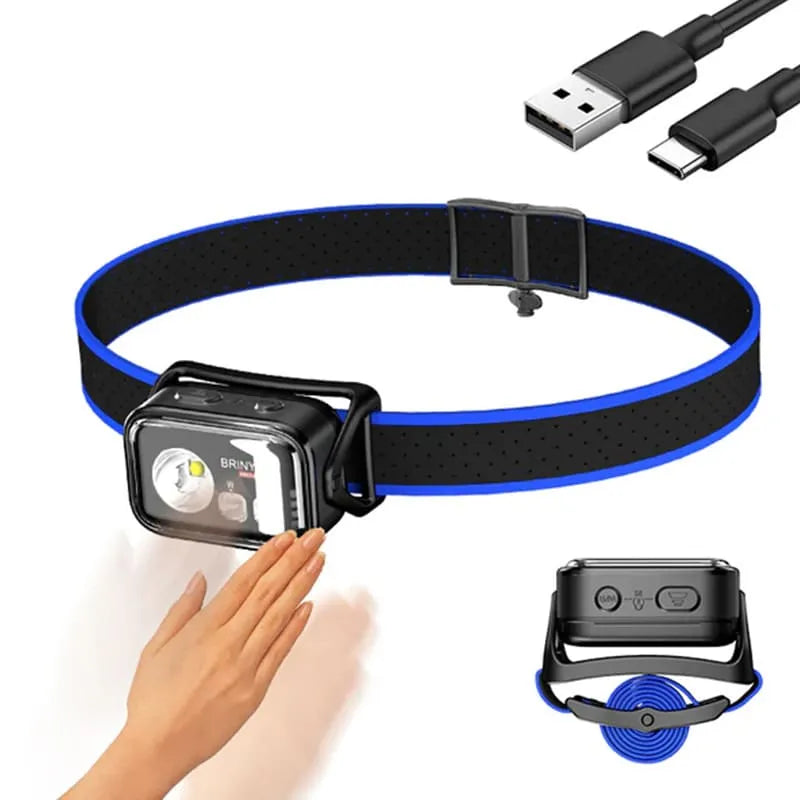
The Brinyte HL16 Noctua enters a crowded headlamp market with a clear differentiator: it is not just a headlamp. The 90° rotatable head — the feature that gives the Noctua its name (after the Greek goddess Athena's owl, symbolizing wisdom and adaptability) — allows it to function as a forward-facing headlamp, a right-angle EDC flashlight, or a magnetic work light. This flexibility, combined with a compact 51g weight and a simple one-button interface, positions it as a tool for people who need one light to cover multiple roles.
Originally prototyped as the HL12 with an interchangeable light engine system, Brinyte abandoned that approach and redesigned the light from the ground up. The result — the HL16 Noctua — has been on the market since 2021 and continues to hold its own in the sub-$60 headlamp category. This review draws on hands-on testing by Cheule's Flashlight Reviews and independent data from 1Lumen and ZeroAir.
2. Key Features — What Sets the HL16 Apart
Magnetic Tail Cap: The Mechanic's Best Friend
The HL16's tail cap contains a strong magnet that allows it to attach securely to any ferrous metal surface — a car hood, a server rack, a steel beam, a tent pole. Combined with the rotatable head, you can angle the beam exactly where you need it and work with both hands free. For mechanics, electricians, and DIYers, this single feature transforms the light from a headlamp into an instant task light.

Comfortable Headlamp Mode: Stays Put When You Move
The included headband distributes the light's 51g weight evenly across the forehead. The silicone holder grips the light body securely without being difficult to remove, and the straps adjust in both directions. Reviewers consistently note that the HL16 stays in position during running and active movement — a critical requirement for a headlamp that will be used at pace.

Balanced Beam Pattern: Hotspot + Spill, Not One or the Other
The HL16 uses a custom TIR (Total Internal Reflection) optic paired with a CREE XP-G3 LED. The beam is a classic TIR pattern: a defined central hotspot for distance visibility surrounded by diffuse spill for peripheral awareness. This makes it suitable for both close-up work (reading a map, tying knots) and moderate-distance spotting (identifying trail markers 80–100 meters ahead). The color temperature is approximately 6000–6500K with a measured CRI of approximately 70 — functional for task work, but not a high-CRI emitter.
Simple One-Button Interface: No Learning Curve
The UI is intentionally simple: press and hold to turn on/off, single click to cycle through Moonlight → Low → Medium → High, double-click from any state to activate strobe. Mode memory recalls the last-used brightness level. There is no lockout mode, but a quarter-turn of the tailcap physically disconnects the circuit — a reliable mechanical alternative.
The HL16's design language rejects feature bloat. A rotatable head, a magnetic tail, a single button, and a headband — these four elements combine into more practical use cases than any spec-sheet feature could add. It is a tool that adapts to the user's environment, not a gadget that demands the user adapt to it.
3. Build Quality & Durability: IP66, 6061 Aluminum, and the Fine Print
The HL16 is constructed from 6061 aluminum with a Type III hard anodized finish in a semi-gloss dark gray. At 85.5mm long and 22.5mm in head diameter, it is slightly larger than a typical 16340-powered EDC light — but the extra volume accommodates the rotating head mechanism and the magnetic charging circuitry.
The rotatable head uses a spring detent system that holds its position with minimal side-to-side play. It clicks firmly through the 0–90° range, and the pivot feels durable in hand — though long-term wear on the detent mechanism has not been independently tested beyond the first year of use.

Waterproofing: Rated IP66 — completely dust-tight and protected against powerful water jets. It is not submersible. For campers and runners who encounter rain and splashes, IP66 is sufficient. For kayakers, divers, or anyone who might drop the light into water, an IP68-rated alternative like the Brinyte PT16A would be more appropriate.
Noted weaknesses from independent testing:
- The pocket clip can mark the anodizing when removed and reattached — a cosmetic concern, not a structural one.
- The LED is not protected by a glass lens, only by a recessed TIR optic. While the LED sits approximately 2mm below the bezel for protection, this is a cost-saving measure that leaves the emitter more exposed than on competing lights with sealed glass lenses.
- LED centering varies between units. 1Lumen's review sample showed a slightly misaligned LED, producing a mildly asymmetrical hotspot. This is visible on a white wall at close range but is not noticeable in practical outdoor use.
4. Who This Light Is For — And Who It Isn't
| User Profile | HL16 Fit | Why |
|---|---|---|
| Campers & Backpackers | ✅ Excellent | Lightweight, hands-free, magnetic tail for tent use, 80h runtime on moonlight mode |
| Mechanics & DIYers | ✅ Excellent | Magnetic tail + rotatable head = instant work light on any metal surface |
| Night Runners | ✅ Good | Secure headband, 51g weight, balanced beam for path visibility |
| EDC Enthusiasts | ✅ Good | Right-angle versatility, compact size, pocket clip included |
| Search & Rescue | ❌ Not suited | 140m throw and 520 lumens insufficient for wide-area search; IP66 not rated for immersion |
| Long-Range Spotters | ❌ Not suited | 5,000 cd beam intensity is designed for close-to-medium tasks, not distance identification |
5. Performance & Specifications — What the Numbers Actually Mean
| Specification | Brinyte HL16 Noctua | Notes |
|---|---|---|
| LED | CREE XP-G3 | Cool white, ~6500K, ~70 CRI |
| Max Output | 520 lumens (FL1 tested) | Independent test: 496 lm at 30 sec, 453 lm at 10 min on High |
| Beam Intensity | 5,000 cd | Calculated throw: √(5000×4) = 141 meters |
| Max Throw | 140 meters (FL1) | Usable identification range: ~70m in practice |
| Modes | Moonlight: 5 lm / Low: 60 lm / Med: 200 lm / High: 520 lm / Strobe | Well-spaced, mode memory |
| Runtime (High) | 1h 5min (rated) / 1h 21min (tested) | 1Lumen test exceeded Brinyte's 65-min rating |
| Runtime (Med) | 1h 40min (rated) / 4h 2min (tested) | 1Lumen test significantly exceeded rating |
| Runtime (Moonlight) | 80 hours (rated) | Excellent for emergency use |
| Battery | 1×16340 (650mAh, included) or CR123A | Brinyte-branded, protected cell |
| Charging | Proprietary magnetic USB-A cable (included) | Red/green indicator; full charge ~2h |
| Waterproof | IP66 (dust-tight, powerful water jets) | NOT submersible; rain and splashes only |
| Weight | 51g (without battery) | ~68g with 16340 cell |
| Dimensions | 85.5mm × 22.5mm (head diameter) | 3.36 × 0.89 inches |
| Material | 6061 aluminum, Type III HA anodized | Semi-gloss dark gray finish |
| In the Box | HL16 light, 16340 battery, headband, pocket clip, magnetic USB charging cable, 2 spare O-rings, manual | Everything needed to start |
| Warranty | 30-day free replacement, 2-year free repair, lifetime support | Consumer pays shipping for repair |
Runtime Behavior
Independent testing by 1Lumen revealed that the HL16's High mode exhibits a characteristic thermal step-down pattern. Starting at approximately 500 lumens, output drops below 450 lumens within 35 seconds and continues to decline to approximately 290 lumens by the 2-minute mark. From there, it holds a stable 260–200 lumens for the next 46 minutes, followed by a staged reduction toward the 1-hour-21-minute mark when the low-voltage protection activates.
On Medium mode, the HL16 delivers a much more stable output curve — approximately 203 lumens at start, maintaining above 190 lumens for 10 minutes, with total runtime exceeding 4 hours. This makes Medium the most practical mode for extended tasks.
The HL16's 520-lumen headline number is a peak, not a plateau. Like most compact lights in this class, the High mode serves as a short-duration turbo for momentary distance needs. For sustained hands-free work, Medium mode (~200 lumens for 4+ hours) is the light's true functional baseline — and in that mode, it significantly outperforms Brinyte's own published runtime figures.
6. Pros & Cons — The Honest Balance
✅ Pros
- Exceptional versatility: 90° rotatable head + magnetic tail + headband = 3 lights in one
- Lightweight and comfortable: 51g disappears on the head; secure fit even during running
- Simple UI: One-button interface with mode memory — no manual needed
- Runtime exceeds specs: Medium mode tested at 4+ hours vs. 1h 40min rated
- CR123A compatible: Accepts common lithium primary cells when rechargeable isn't an option
- Complete kit: Battery, headband, clip, and cable included — no additional purchases
- Smart battery indicator: Green/red LED on charging port shows battery status at a glance
❌ Cons
- Proprietary magnetic charger: Lose the cable, lose the ability to charge without an external Li-ion charger
- No glass lens protection: Exposed TIR optic leaves the LED more vulnerable than sealed designs
- Press-and-hold for on/off: Not ideal for users accustomed to instant-click activation
- No lockout mode: Must mechanically lock out via tailcap to prevent accidental activation in a bag
- IP66, not IP68: Weather-resistant but not submersible — limits use around water
- LED centering variance: Some units show slight misalignment (cosmetic, not functional outdoors)
7. Final Verdict: The Right Light for the Right User
The Brinyte HL16 Noctua earns its place by refusing to be just one thing. It is a headlamp that works as an EDC light. It is an EDC light that works as a magnetic work light. It is a magnetic work light that weighs less than a golf ball. This flexibility — not raw lumen output — is its real value proposition.
For campers, mechanics, runners, and DIYers who need a single light to cover multiple hands-free scenarios, the HL16 is a strong choice at its price point. The runtime on Medium mode — independently verified at over four hours — is genuinely impressive for a 16340-powered light, and the inclusion of a full accessory kit means you are not nickel-and-dimed for the headband or battery after purchase.
For tactical users, search-and-rescue personnel, or anyone who needs long-distance throw or submersible waterproofing, the HL16 is not the right tool. Brinyte's PT16A or T28 Artemis would be better-suited alternatives in those categories.
The proprietary magnetic charger is the HL16's most significant practical limitation — lose that cable, and you lose the convenience of onboard charging. But if the charger lives on your nightstand or in your tool bag where it belongs, this is a non-issue for most users.
The Brinyte HL16 Noctua is not the brightest headlamp, not the longest-throwing, and not the most waterproof. It is the most adaptable — and for the user who needs one light to cover camping, car repairs, and night runs without changing equipment, that adaptability is worth more than any single spec could offer.
Ready to Add the HL16 to Your Gear Kit?
Everything you need is in the box — headlamp, battery, headband, and magnetic charger. Free shipping on orders over $49.
Shop HL16 Noctua →About Brinyte
Founded in 2009, Brinyte designs and manufactures lighting tools for professionals and outdoor enthusiasts. All products are engineered and produced in-house — no OEM outsourcing — giving Brinyte direct control over quality from concept to final assembly. 50+ patents. ISO9001 certification. This review was conducted independently by Cheule's Flashlight Reviews and reproduced with permission.
“Engineered for the mission — proven in the field.”
Founded 2009 · 50+ Patents · ISO9001
8. Frequently Asked Questions
What is the Brinyte HL16's maximum brightness?
The HL16 Noctua is rated at 520 lumens on High mode (ANSI/NEMA FL1 standard). Independent testing measured 496 lumens at 30 seconds and 453 lumens at 10 minutes. Medium mode provides approximately 200 lumens with significantly longer runtime.
Can the Brinyte HL16 be used as a regular flashlight?
Yes. The HL16 is a right-angle flashlight that functions equally well as a handheld EDC light and a headlamp. Rotate the head to 0° for forward-facing handheld use, or to 90° for hands-free headlamp mode. The included pocket clip and magnetic tail cap add additional carry and mounting options.
How long does the HL16 battery last?
Runtime varies by mode. High (520 lm): ~1h 5min (rated), tested at 1h 21min. Medium (200 lm): ~1h 40min (rated), tested at 4h 2min. Low (60 lm): ~4h 50min (rated). Moonlight (5 lm): ~80 hours (rated). Medium mode offers the best balance of brightness and endurance for extended tasks.
Is the Brinyte HL16 waterproof?
The HL16 is rated IP66 — completely dust-tight and protected against powerful water jets. It is weather-resistant for rain, snow, and splashes, but not submersible. If you need a light that can survive being dropped into water, consider an IP68-rated model like the Brinyte PT16A.
Can I use a CR123A battery in the HL16?
Yes. The HL16 is compatible with both the included 650mAh 16340 rechargeable Li-ion cell and disposable CR123A lithium primary batteries. This dual compatibility is useful for extended trips where recharging is not possible — carry CR123A backups and swap them in as needed.
What is the difference between the HL16 and a traditional headlamp?
Unlike traditional headlamps with fixed forward-facing emitters, the HL16 features a 0–90° rotatable head that functions as a right-angle light. Combined with a magnetic tail cap, this allows it to serve as a headlamp, a handheld EDC flashlight, and a magnetic work light — three tools in one compact body.