

Introduction: Why Grip & Operation Matter More Than Lumens
Most users focus on lumens, beam distance, or batteries.
But in real-world tactical environments—urban patrol, nighttime EDC, home-defense—the way you hold, activate, and deploy a tactical flashlight often matters more than raw power.
A proper grip determines:
- how fast you can respond
- whether you expose your position
- whether you control the beam precisely
- whether the light helps you escape or escalates the situation
Knowing how to use the light is the real tactical advantage.
This guide breaks down the essential grips and techniques used by professionals.
Core Tactical Principles Before Learning Grip Techniques
Use Light Sparingly (“Light Discipline”)
- Short pulses, not long beams.
- Momentary mode > constant-on.
Keep the Light Off Your Centerline
- Never illuminate directly from your body position.
- The beam should not reveal your exact location.
Prioritize Identification Over Engagement
A tactical flashlight is primarily for:
- identifying targets
- disorienting threats
- creating escape windows
Not for aggression.

Essential Tactical Flashlight Grip Techniques
To control a tactical flashlight under stress, your grip must be stable, repeatable, and compatible with rapid movement. Below are the core grip methods used by law enforcement officers and experienced defenders.
Ice-Pick (Reverse) Grip – Maximum Retention & Power
Best for: Close-quarters movement, identifying threats around corners, defensive strobe use
How it works: Hold the flashlight like a knife in reverse grip with your thumb placed naturally over the tail switch.
Advantages:
- Fast momentary activation
- Works well with strobe in high-pressure encounters
- Excellent retention; harder for an assailant to grab
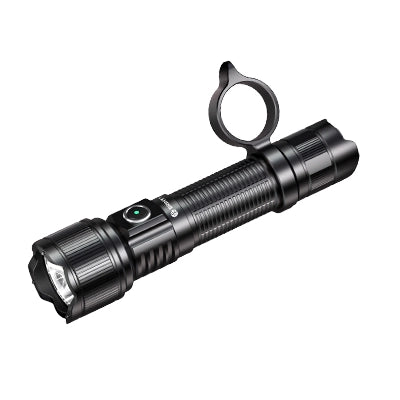
- Ideal for compact tactical flashlights like Brinyte PT28
Pro Tip:
Use this grip when scanning hallways, staircases, or checking blind spots indoors.
Forward (Syringe) Grip – Fast Target Identification
Best for: Medium-distance light control, outdoor scanning, pairing with a firearm (low-ready only)
Hold the body like a syringe so the thumb naturally presses the tail switch.
Advantages:
- Immediate access to momentary / turbo
- Great for fast scanning and long-range identification
- Works well with larger tactical models like Brinyte PT16A
When to use:
When you need to keep the beam steady while quickly transitioning between threats or scanning deeper distances.
The Harries Technique – Classic Law Enforcement Method
Best for: Coordinating a handgun with a flashlight
How it works:
- Flashlight in ice-pick grip
- Support arm crosses under your weapon hand
- Wrists press together to stabilize recoil
Advantages:
- Strong two-hand structure
- Keeps beam aligned with your sight picture
- Proven for decades of defensive use
Best tools:
Compact models with strong tail switches like Brinyte PT28 or Brinyte XP22 PRO (for weapon-mounted use)
Neck Index Technique – Maximum Spatial Awareness
Best for: Indoor clearing, close-quarter decision making
Hold your flashlight high at the jawline/neck.
Advantages:
- Allows rapid movement and scanning
- Minimizes “light tracking” (people following your beam)
- Great when identifying faces or hands in tight spaces
Note:Use with lights offering stable medium brightness rather than turbo.
Rogers / SureFire Technique – Precision Beam Control
Best for: Trained shooters needing maximum accuracy
You press the flashlight between two fingers while supporting a firearm.
Advantages:
- Allows a quasi two-handed shooting stance
- Very stable alignment
- Excellent for professionals
Requires:
A flashlight with a pronounced tail switch and anti-slip knurling

Core Tactical Operation Skills (Movement, Switching, and Light Discipline)
Mastering Momentary-On for Stealth
Momentary use prevents you from exposing your location while giving you bursts of visibility.
Why it matters:
- Conserves battery
- Avoids creating a fixed target
- Allows controlled scanning
Flash and Move: Never Stay Where You Lit
This is a fundamental professional principle:
- Flash the area
- Get information
- Move to a new position
- Flash again
Why?
Because standing where your beam was just visible makes you predictable.
Strobe as a Disruption, Not a Search Tool
Strobe is highly effective—but only when used deliberately.
Use strobe for:
- Breaking an attacker’s visual focus
- Creating escape time
- Defensive disorientation
Do NOT use strobe for:
- Searching
- Walking
- Long-range scanning
Brinyte XP22 PRO is known for its instant strobe, perfect for defensive sudden engagements.
Using Low/Medium Modes for Navigation
Medium brightness (300–600 lm) is the sweet spot for:
- Moving through forests
- Indoor clearing
- Vehicle inspection
- Avoiding self-blinding
High turbo mode should only be used for brief identification bursts.
Avoid Light Washing
Beginners often illuminate the entire scene, which:
- Removes contrast
- Makes it harder to identify threats
- Exposes your own position
- Causes tunnel vision
Correct approach:
Use tight beams or controlled hotspot placement for selective visibility.
Brinyte PT16A’s long-throw beam is ideal for controlled, distance-based identification.
Advanced Tactical Techniques for Real-World Scenarios
Doorway and Corner Techniques
When approaching a corner or doorway:
- Keep the light away from your body
- Use momentary bursts to “slice the pie”
- Illuminate only the sector you are ready to engage
Movement in Open Fields
For outdoor patrol or night operations:
- Use medium mode
- Keep the flashlight low
- Scan left-to-right in wide arcs
- Avoid shining directly in front of your feet
Vehicle-Based Techniques
When checking inside a car at night:
- Use low brightness to avoid glare
- Hold the beam at an oblique angle
- Avoid lighting the rearview mirror to prevent rebound flash
When to Activate Turbo
Turbo should be used only when:
- Identifying a distant threat
- Signaling
- Conducting a rapid “hard check”
- You need maximum visual dominance for a brief moment

Recommended Brinyte Tactical Models
Brinyte PT16A — Long-Range Tactical Power
- 3000 lumens
- Excellent throw
- Ideal for outdoor or hunting-tactical crossover use
Brinyte PT28 — The Balanced All-Round Tactical Choice
- Versatile beam
- Dual-tail switches
- Perfect for law enforcement & EDC defenders
Brinyte XP22 PRO — Ultimate Weapon-Mounted Control
- Dual tactical switches
- Instant strobe
- Shockproof design for mounted applications
Tactical Flashlight FAQ
1. What’s the best grip for tactical flashlight use?
The ice-pick grip offers the best balance of retention, control, and rapid activation, especially with tail-switch flashlights.
2. Which brightness level is ideal for tactical situations?
Use 1000–1600 lumens for indoor control and 2000+ lumens for outdoor identification.
3. Do I need strobe mode for tactical use?
Yes. Strobe quickly disrupts visual focus and provides a defensive advantage during high-pressure situations.
4. Should I use constant-on or momentary mode?
Momentary mode is preferred for tactical use because it prevents location exposure and improves movement discipline.
5. Which Brinyte model is best for tactical professionals?
Brinyte PT28 offers the best blend of control, ergonomics, and tactical readiness.
6. What’s the best flashlight for weapon-mounted applications?
Brinyte XP22 PRO is engineered for high-pressure, weapon-light roles.
7. Should a tactical flashlight be used for searching indoors?
Use medium brightness—turbo is too bright and can cause self-blindness or wash out details.
8. How important is the tail switch?
Very important. A good tail switch allows reliable momentary activation and rapid mode changes under stress.
9. Can a tactical flashlight replace other defensive tools?
No, but it enhances situational awareness and can help de-escalate or disengage safely.
10. What beam pattern is most useful for tactical operations?
A balanced beam (hotspot + spill) is ideal for identification, movement, and general tactical response.
Conclusion: Mastery Comes from Technique, Not Just Lumens
Owning a tactical flashlight doesn’t make you tactically ready—using it correctly does.
Whether you’re a professional officer, a defender, or an advanced outdoor user, mastering grip, movement, momentary activation, and light discipline is what transforms a flashlight into a true tactical tool.
Brinyte’s PT16A, PT28, and XP22 PRO provide the performance foundation.
Your technique provides the advantage.