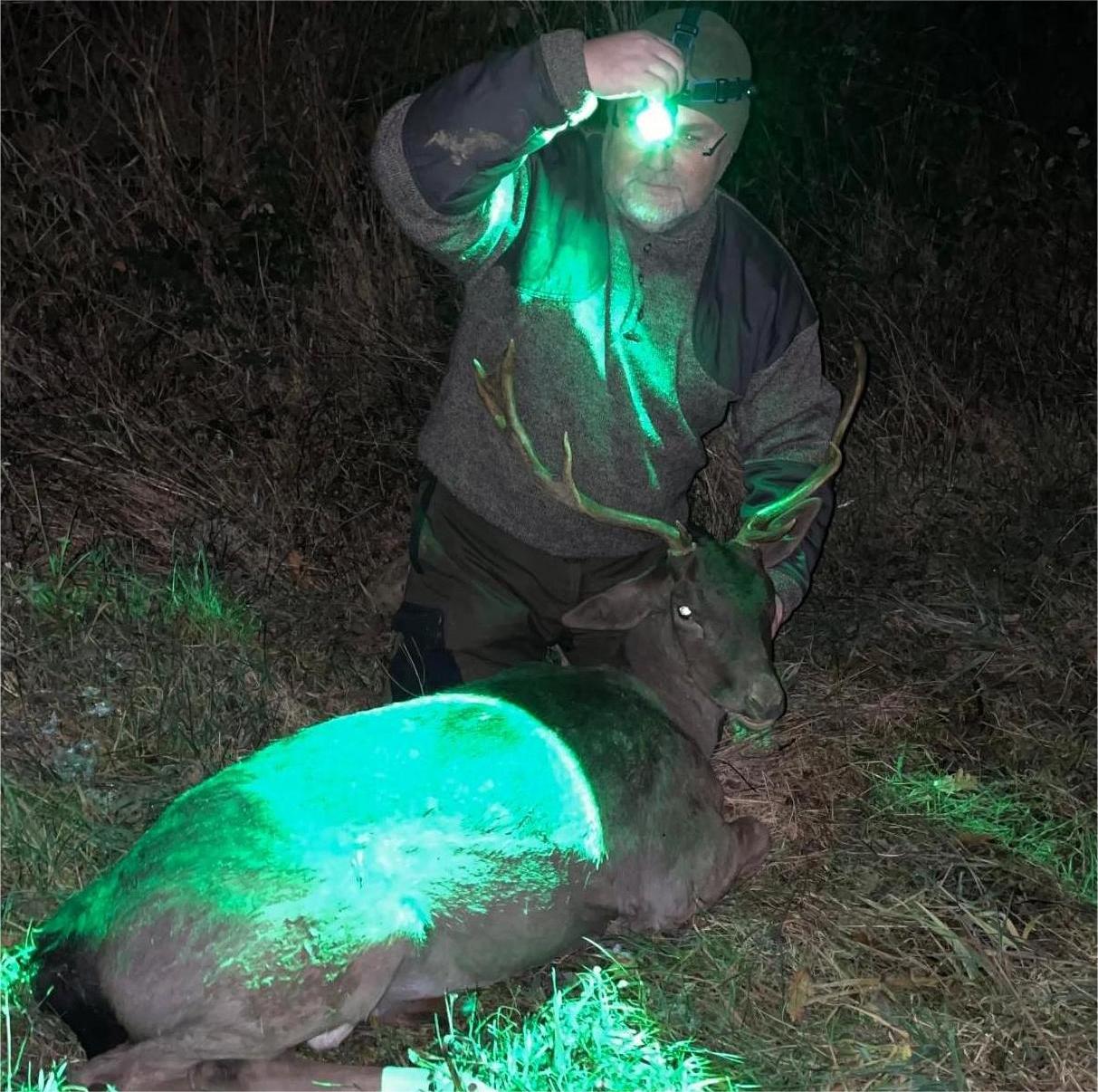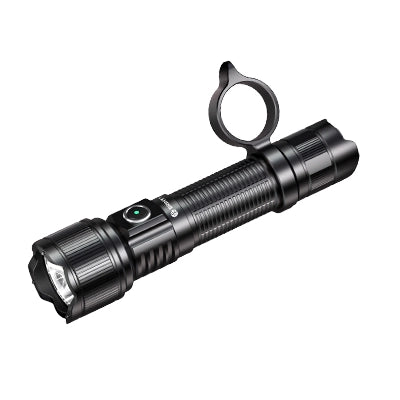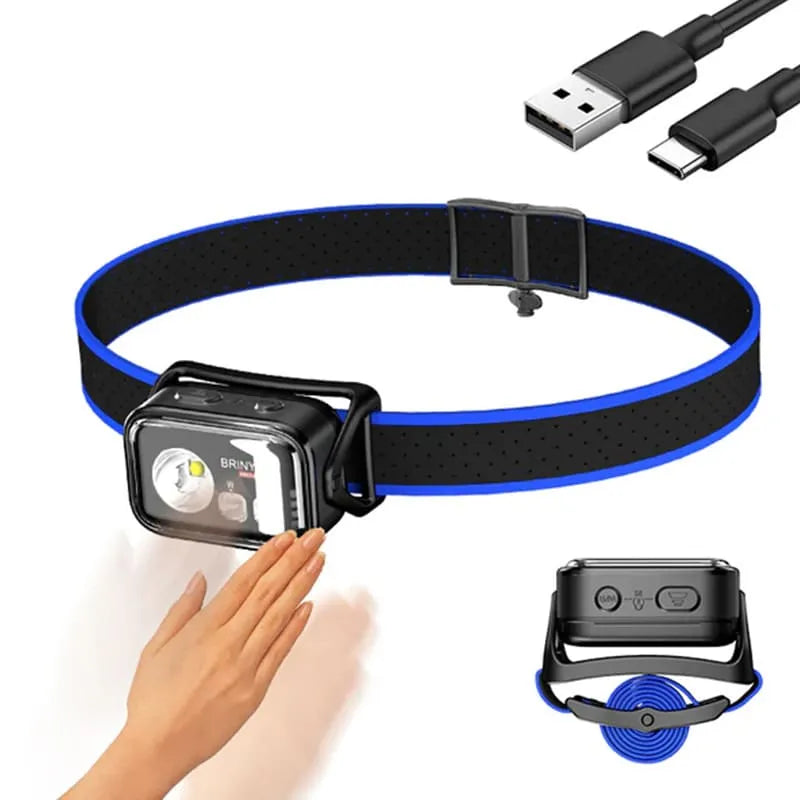


Deer see green. They ignore red. Most "best hunting flashlight" lists don't know the difference. The best hunting flashlight for deer is not one light — it's a three-light system. One to get you into the stand unseen. One to find deer at distance. One to track blood when the shot is done.

✔ The bowhunter who's lost a blood trail in the leaves because his "best EDC" washed the color out
✔ Anyone who suspects that one light for three completely different tasks doesn't add up
1. The Predawn Woods — Two Hunters. One Difference.
4:47 a.m. Hardwood ridge. November. Two hunters are walking into the same stretch of public land, half a mile apart. They'll hunt the same deer. They'll face the same cold, the same wind, the same pre-rut movement patterns. One of them will see deer. The other won't. The difference isn't luck. It's not scent control. It's not the brand of their boots.
The difference is the light in their hand.
Hunter A clicks on a 1000-lumen white beam — the kind every "best hunting flashlight" list recommended to him. He walks in along the logging road, illuminating the path fifty feet ahead. Bright. Clean. Efficient. And to every whitetail within half a mile, he's just announced himself like a lighthouse on a dark coast. Deer have dichromatic vision — two types of cone cells, sensitive to blue and green wavelengths. White light contains the full visible spectrum. It hits their eyes like a camera flash. By the time Hunter A reaches his stand, the deer he came to hunt have already melted into the deeper timber.
Hunter B is holding a Brinyte T28. The rotary ring is twisted to red. Not bright red — dim red. Just enough to see five paces ahead. He walks the same half mile, same terrain. The deer bedded a hundred yards off the trail never lift their heads. Deer cannot perceive red wavelengths between 620 and 750 nanometers. To them, Hunter B is not a threat. He's not even a shape. He isn't there at all.
This isn't guesswork. It's retinal anatomy, confirmed by decades of wildlife biology. And it establishes the first principle of everything that follows: hunting deer isn't about what you can see. It's about what the deer can't.
A white light in the predawn woods is a broadcast signal. A red light is a whisper. Deer have spent millions of years evolving to detect the former and ignore the latter. The best hunting flashlight for deer starts with one non-negotiable: red mode. Without it, you're not hunting — you're announcing.
2. What the "Best" Lists Won't Tell You — Three Gaps Every Deer Hunter Pays For
Type "best hunting flashlight for deer" into Google. You'll find listicles. You'll find forums. You'll find roundups that put a 1400-meter white-light thrower at the top and call it a day. Here's what you won't find.
Gap One: Deer Are Not Hogs. Stop Treating Them the Same.
Feral hogs have dichromatic vision that makes them nearly blind to green wavelengths — which is why every hog hunting guide pushes green light. Deer also have dichromatic vision, but their sensitivity peaks in the blue-green range. Green light is visible to deer. It won't spook them as fast as white, but it's not invisible. Red light is invisible to deer. Period. Most "best hunting flashlight" lists lump hog hunting and deer hunting into the same category. They're not the same animal. They're not even the same optical problem.
Gap Two: The Shot Is Not the End. It's the Midpoint.
Every generic "best deer hunting flashlight" article assumes the job ends when you pull the trigger. It doesn't. After the shot comes the track — and tracking a wounded whitetail through November leaf litter at last light is one of the hardest visual tasks in the outdoors. A standard white beam washes blood into the brown of dead leaves. A green beam provides contrast through hemoglobin absorption. A dedicated blood tracking strobe at 5–10Hz makes droplets appear to pulse in three dimensions against the forest floor. Your hunting light needs to do this. Most don't.
Gap Three: One Light Cannot Do Three Jobs.
A true deer hunter needs three completely different optical profiles in one season, sometimes in one morning. A flood beam for walking in. A throw beam for scanning field edges at first light. A strobe-capable flood for blood tracking. The industry has convinced hunters that a "zoomable" light bridges all three. It doesn't. Zoom changes beam shape — it doesn't change light color, it doesn't add a strobe circuit, and it doesn't turn a thrower into a dedicated tracking tool. One light is not a system. One light is a compromise.

Your grandfather hunted deer with one light because he had no choice. You hunt with one light because the internet told you it was enough. Both of you are leaving deer in the woods that a three-light system would have recovered.
3. The Four-Phase Light Color Rotation — How Deer See, and How to Stay Invisible
How a Deer Sees Your Light
A whitetail's retina contains two types of cone photopigments: one sensitive to short wavelengths (blue, ~450nm), one sensitive to medium wavelengths (green, ~537nm). This is dichromatic vision — the same color perception range as a human with red-green colorblindness. Green light is visible to deer, but less alarming than white. Red light (620–750nm) is invisible. The deer's retina literally cannot register it.
This dictates the following sequence — a four-phase rotation that covers every stage of a deer hunt with the correct light for that specific task.
| Phase | Color | Optimal Product | Why |
|---|---|---|---|
| ① Walk-In | Red, dimmest usable output | T28 Rotary Red | Invisible to deer. Preserves your night vision. The T28's rotary ring lets you find the exact brightness where you can see the next step without illuminating anything you don't need to. |
| ② Scan | Green or White, spot beam | T28 Zoom to 6° | Once in the stand, you're glassing field edges at 200+ yards. Green gives high contrast with vegetation. White gives full color for antler identification. |
| ③ Identify & Shoot | White, full output | T28 560lm Turbo | At the moment of truth, you need full-spectrum color to confirm species, sex, and shot placement. This is the only phase where white light is correct. |
| ④ Track | Green + Strobe | T5X Blood Tracking Strobe | Post-shot, wait 20–30 minutes. Then the T5X's 10Hz strobe makes blood visually pulse against dead leaves. This isn't a setting on a general-purpose light. It's a dedicated tracking instrument. |
Q: Can I just use a green light for the entire deer hunt?
A: No — and here's why. Green is visible to deer. A bright green beam sweeping through the predawn woods is still a signal that something is moving. Red is invisible. Green is for scanning after you're in the stand — not for walking in. And neither red nor green can track blood the way a dedicated 10Hz strobe can in Phase ④. Three tasks. Three light profiles. No single light covers all three.
Every deer hunt has four lighting phases. Most hunters use white for all four. That's not a strategy — it's a surrender to the industry that told them one light is enough. Walk in invisible. Scan with precision. Identify with certainty. Track with relentless contrast.
4. The 3-Light Deer Hunting System — T28, T5X, ZT40
You don't need a dozen lights. You need three — each purpose-built for a phase of the hunt that no other light can cover. Here they are.
🔦 Brinyte T28 Tri-Color Kit — Deer Hunting Main Light
$89.95 — price as of 2026-05-12
The heart of the system. Phases ①–③ live here. The patented rotary ring switches from red to green to white without clicks — in the dark, with gloves, your hand knows where it is. The smooth reflector gives you 6° spot for field-edge scanning and 70° flood for walking. 125mm body — thumb naturally falls on the color ring. IP66 so the November rain doesn't end your hunt.
Shop T28🔦 Brinyte SPECTRA T5X — Blood Tracking Specialist
$119.95 — price as of 2026-05-12
Phase ④ lives here. When the shot is done and the deer runs into thick cover, the T5X is the light you reach for. The 10Hz strobe makes dark red blood appear to lift off the forest floor — a 3D contrast effect that a constant beam can't produce. 120° flood illuminates the entire tracking corridor. 146g. IPX7 so crossing a creek doesn't end the track.
Shop T5X🔦 Brinyte ZT40 — All-Weather Backup
$129.95 — price as of 2026-05-12
Not required. Strongly recommended. The ZT40 is the light that stays in your pack, glove box, or camp kit — and works as a backup to both the T28 and T5X. Its 6°–70° zoom covers scanning and walking if your primary fails. Same 21700 battery as your T28 and T5X — if one light dies, borrow its cell and keep hunting.
Shop ZT40Three lights. One battery platform. Zero compromises. The T28 walks you in, finds your deer, and confirms the shot. The T5X recovers the animal when the trail goes cold. The ZT40 ensures no equipment failure ends your hunt early. Buy them as a set or build the system over two seasons — either way, you're no longer a hunter with a good flashlight. You're a hunter with an optical plan.
5. Know the Law — Because a Trophy Is Not Worth a Court Date
Night hunting regulations for deer are significantly stricter than for nuisance species like feral hogs. 27 states maintain strict prohibitions or severe restrictions on any artificial light use in deer hunting. Several key legal realities every deer hunter must know:
- Deer are protected game animals in all 50 states. Unlike feral hogs — which are classified as nuisance species with year-round, no-bag-limit night hunting in many southern states — whitetail deer are subject to strict seasons, bag limits, and equipment restrictions. Night hunting for deer is illegal in nearly every jurisdiction.
- The Illinois CWD targeted culling program was suspended in spring 2026. Chronic Wasting Disease management rules are evolving rapidly across the Midwest. What was permitted last season may not be permitted this season.
- Pennsylvania's 2025–26 deer harvest broke a 20-year record at 505,600 whitetails — a 6% increase year-over-year. More hunters are in the woods. Compliance is under greater scrutiny.
- Texas Parks & Wildlife approved multiple amendments to the 2026–27 deer hunting season including changes to antler restrictions in 8 counties. If you hunt Texas, your regulations may have changed since last season.
⚠️ Critical reminder: The light techniques described in this article — including red-light walk-in and post-shot blood tracking — must be verified against your state's specific hunting regulations. Many states permit handheld artificial light for tracking wounded deer but prohibit carrying a firearm while doing so. Others restrict light use entirely during deer season. Always verify current regulations with your state wildlife agency before hunting. This guide is informational, not legal advice.
6. From Stand to Table — One Hunter, Three Lights, Zero Missed Opportunities
Hunters don't lose deer because they can't shoot. They lose deer because they walk in wrong, and the deer are gone before daylight. Or because the shot was good but the blood trail disappeared in the leaves. Those aren't skill failures. They're equipment failures disguised as bad luck.
A Brinyte T28 gets you to your stand unseen. Brinyte T5X finds the blood that dead leaves hide. Brinyte ZT40 ensures that if anything fails — battery, drop, weather — your hunt doesn't end. That's not three flashlights. That's one system.
The best hunting flashlight for deer is a three-light system, not a single light. Red light (620–750nm) is invisible to deer and is the only safe color for the predawn walk-in phase. Green light provides maximum hemoglobin contrast for blood tracking, and a dedicated 10Hz strobe makes blood droplets visually pulse against forest floor debris. No single flashlight provides all three optical profiles simultaneously — a zoomable light changes beam shape but can't change color or add a strobe circuit. The T28 covers approach, scanning, and identification (Phases ①–③); the T5X covers blood tracking (Phase ④); the ZT40 provides a backup on the same 21700 battery platform.
Build Your Deer Hunting Light System
Browse Brinyte's purpose-built hunting lights — engineered for the four-phase rotation and backed by hunters who know that the best hunting flashlight for deer is not one light. It's three.
Shop Deer Hunting Lights❓ Deer Hunting Lighting FAQ
What is the best hunting flashlight for deer?
The best hunting flashlight for deer is not a single light — it's a three-light system because deer hunting has three distinct lighting phases with incompatible requirements. The Brinyte T28 covers Phases ①–③ with red (invisible walk-in), green (scanning), and white (identification). The Brinyte T5X covers Phase ④ with a dedicated 10Hz blood tracking strobe. The Brinyte ZT40 serves as an all-weather backup sharing the same 21700 battery platform.
Can deer see red light?
No. Deer have dichromatic vision — only two types of cone photopigments, sensitive to blue and green wavelengths. Red light (620–750nm) falls completely outside their visual perception range. This is documented cervid retinal anatomy, confirmed by wildlife biology research. A deer won't react to a red beam even at close range, making it the only safe color for walking into your stand before dawn.
Why not just use one zoomable light for all deer hunting phases?
Zoom changes beam shape — it doesn't change light color, and it doesn't add a dedicated blood tracking strobe. Walking in requires red light (invisible to deer). Scanning requires green or white throw. Blood tracking requires a 120° flood with 10Hz strobe for the 3D contrast effect on droplets. No single light provides all three. The three-light system exists because the physics of each phase are incompatible in a single housing.
Do green lights spook deer?
Green light is visible to deer — less alarming than white, but not invisible the way red is. A deer's dichromatic vision includes sensitivity to green wavelengths. This is why green is appropriate after you're in the stand — for scanning field edges and timber lines at distance — but not for the walk-in phase. Use red for approach. Use green for scanning. They are not interchangeable.
What is the best light for blood tracking a wounded deer?
A dedicated blood tracking light like the Brinyte SPECTRA T5X provides three things a general-purpose hunting light can't: a 120° flood beam (illuminates the entire tracking corridor without dark gaps), a dual-frequency strobe (5Hz for fresh blood, 10Hz for dried blood) that exploits the Hunt-Drude effect to make blood droplets pulse in 3D against the forest floor, and green LED mode for maximum hemoglobin absorption contrast. A standard white zoom light aimed at the ground creates shadows that hide small drops. The T5X was purpose-built to eliminate this problem.
Is night deer hunting legal?
Night hunting for deer is illegal in nearly all 50 states. Deer are classified as protected game animals — not nuisance species like feral hogs. However, many states permit the use of handheld artificial light for tracking wounded deer after the shot, often with the restriction that no firearm may be carried during tracking. Always verify your state's specific regulations before using any artificial light in conjunction with deer hunting. This guide assumes you are hunting during legal shooting hours and using lights only for walk-in before dawn and post-shot blood tracking where legally permitted.
About Brinyte
Brinyte was founded in 2009 by Xuping Feng with a single focus: building lights for people whose lives depend on reliable illumination. With 50+ patents and ISO9001 certification, our products are used by hunters, law enforcement, and outdoor professionals across North America. Every design decision starts with real field feedback — including the T28's red-first mode sequence, which came directly from hunters who accidentally activated white light at the worst possible moment.
All products are tested to ANSI/NEMA FL1 standards. No companion app. No firmware updates. Just a rotary ring, a button, and the confidence that the light will work when the buck steps out.
👉 About Brinyte | Hunting Lights | About the Author
"Engineered for the mission — proven in the field."