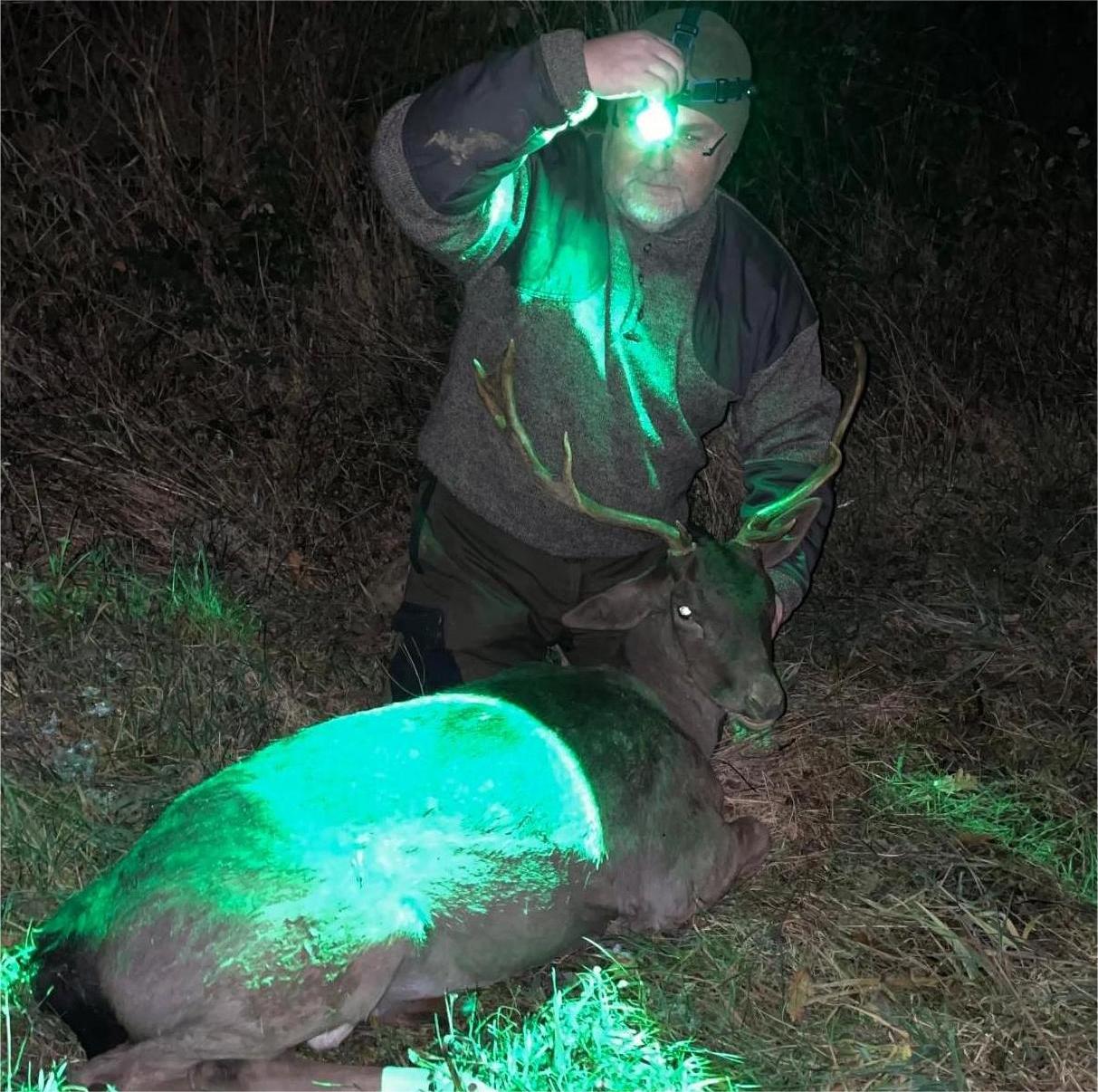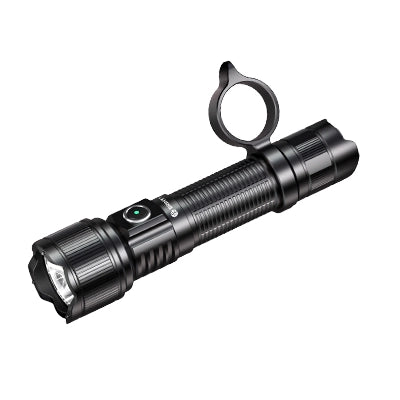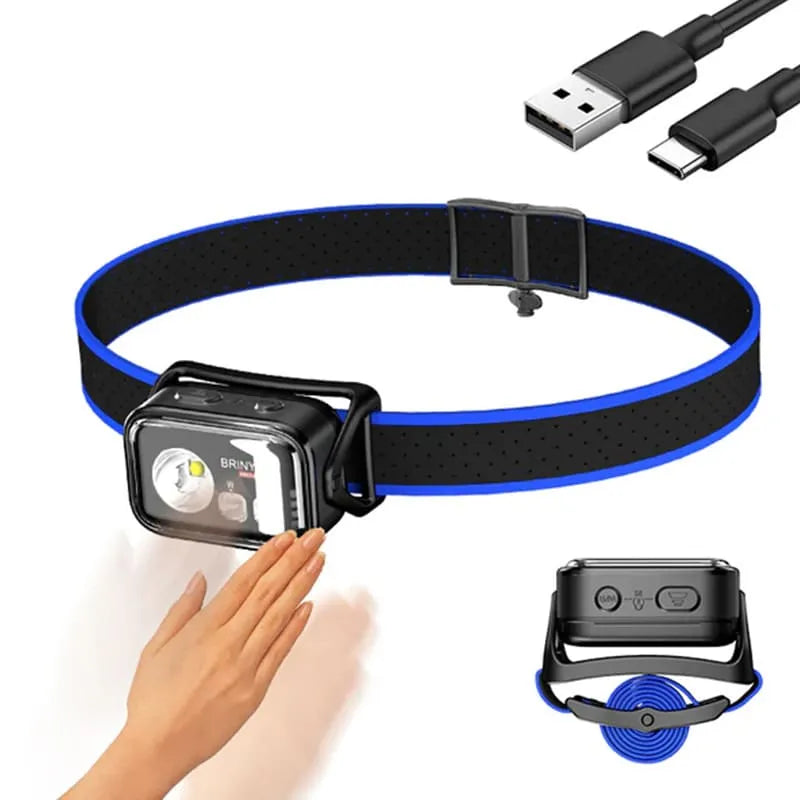


- 3,000 ANSI FL1 lumens — the most independently verified output under $100
- 52,500 candela / 458m throw — 175m more reach than Fenix PD36R at the same lumen count
- Independent strobe tail switch — one gross-motor press, no mode cycling, accessible under stress
- IP68 waterproof USB-C port — charges in rain without removing any cover
- User-replaceable 21700 battery — dead light fixed with a $10 swap in 30 seconds
- $99 vs $229 SureFire EDCL2-T — 2.5× more lumens, 2× more throw distance, $130 saved
Verdict: If you need serious outdoor throw and a ready-state strobe that works under stress — and you're not paying for a Made-in-USA stamp — the PT16A is the correct 2026 answer at this price. See current pricing and kit options →

1. Why This Review Exists — And Why It's Different
Most PT16A reviews quote the spec sheet and call it a day. You already found three of those before landing here.
This one is different for one reason: I designed this light. I can tell you what we got wrong in the first hardware revision — and why fixing it is the reason the PT16A runs differently than any other 3,000-lumen light at this price point.
The first prototype had a single-switch UI that required two presses to access strobe. We tested it with a former sheriff's deputy who does security consulting. He ran three drills under stress. Every time, he cycled past strobe and ended up on High instead. His feedback was direct: "If I have to think about the switch, the light fails its primary purpose." That conversation drove the dual-switch design you see in the production model.
I'll also be honest about what the PT16A isn't: it's not a pocket EDC light, it doesn't have a lifetime warranty, and the Turbo mode steps down after 60 seconds. I'll explain why that last point is actually correct engineering — and why every honest competitor does the same thing, they just don't tell you clearly.
At $99, the PT16A delivers 3,000 ANSI FL1 lumens, 52,500 candela, and a 458-meter beam distance — specifications that SureFire charges $229 to match at lower output numbers. The question this review answers is: what do you give up at $99, and whether that trade-off is acceptable for your actual use case.
2. PT16A: Full Technical Specifications
All output specs are measured to ANSI/PLATO FL1 standard — tested at 30 seconds of runtime, not at switch-on burst. Independent reviewers EDC Tips and 1Lumen have both confirmed these figures via hands-on testing and PCB inspection.
Output Modes & Runtime
| Mode | Lumens | Runtime | Best Use | Beam Distance |
|---|---|---|---|---|
| Turbo | 3,000 lm | 1 min → step to High (135 min) | Target ID at 400m+, burst signal | 458m |
| High | 900 lm | 3h 50min | Patrol, property perimeter | ~230m |
| Mid | 120 lm | 20h | Indoor CQB, vehicle ops | ~80m |
| Low | 5 lm | 300h | Map reading, night vision preservation | ~15m |
| Strobe | 3,000 lm | Continuous | Threat disorientation — independent switch | 458m |
Additional Specifications
- LED: Luminus SFT70 Gen 2 — neutral tint, confirmed via PCB inspection by EDC Tips
- Driver: Constant-current boost — maintains rated output until battery depletes, no gradual fade
- Battery: Built-in 21700 5,000mAh · USB-C waterproof port · ~500 charge cycles
- Backup charging: The 21700 cell itself has a separate USB-C port — charge outside the body if needed
- Body: 6061-T6 aerospace aluminum · Type III hard anodize
- Bezel: Tungsten carbide strike pins — glass-breaker rated
- Thermal regulation: Steps to High at ~50°C LED junction temperature
- Weight: 227g with battery · Length: 138mm
- Drop resistance: 1m certified
- MIL-STD-810G: Drop, vibration, waterproof, and temperature ranges tested
The Brinyte PT16A delivers 3,000 ANSI FL1-verified lumens, 52,500 candela, and a 458-meter beam distance at $99. It runs a Luminus SFT70 Gen 2 LED on a constant-current boost driver, meaning output stays at rated brightness until the 21700 5,000mAh battery is nearly depleted — no gradual fade. Independent PCB inspection by EDC Tips confirmed these specifications.
3. Lumens vs Candela — And a Calculator for Your Actual Distance
Lumens tell you how much total light a flashlight produces. Candela tells you how far it reaches. Two lights with identical lumen ratings can have completely different beam distances depending on how tightly focused the beam is. This is why the PT16A's 52,500 candela produces 458m of reach while a Fenix PD36R at the same 3,000 lumens only reaches 283m — its beam is wider, flooding more area but reaching less distance.
For outdoor tactical use, candela is the decisive metric. For indoor area illumination, lumens matter more. Beam distance in meters equals the square root of (candela × 4). The PT16A's 52,500 candela: √(52,500 × 4) = 458 meters. The Fenix PD36R's ~20,000 cd: √(20,000 × 4) = 283 meters. Same lumens, 175 meters of difference.
4. The Turbo Step-Down "Problem" — Why Every Honest Tactical Light Does This
The most common complaint about the PT16A is that Turbo steps down after 60 seconds. Every competitor's spec sheet shows a similar curve — they just don't label it as clearly. Here is the engineering reality.
At 3,000 lumens, the Luminus SFT70 LED generates enough heat that sustained full output at ambient temperatures would push the LED junction temperature past its thermal damage threshold in under 4 minutes. A light that sustains Turbo indefinitely is either: (a) lying about its output rating, (b) using a much larger body to dissipate heat, or (c) going to degrade its LED within 50 uses.
The PT16A steps from 3,000 lumens to 900 lumens (High) after 60 seconds on Turbo — this is intentional thermal regulation, not a defect. After step-down, it runs 3 hours 50 minutes at 900 lumens. For patrol and operational use, 900-lumen High at 230m is the effective sustained mode. Turbo is your burst capability for maximum-range identification.
For context: the SureFire EDCL2-T also steps down from its maximum output under sustained use. Streamlight's ProTac series does too. The difference is that Brinyte labels this behavior clearly, while most competitors bury it in a footnote.
5. The Dual Tail Switch — Why a Single Switch Is a Tactical Liability
Under adrenaline, fine motor skills degrade. Your hands shake. Your grip tightens. You can still do gross motor movements — press, grab, push — but precise sequential actions (double-click, then hold, then single click) become unreliable.
This is why most single-switch tactical lights fail their primary purpose. "Press twice quickly then hold for strobe" is a three-step fine motor sequence. Under stress, you will either miss a click and stay on High, or overcorrect and cycle to Low, or simply not perform it at all.
- Left tail switch (constant-on): Single press activates last-used mode. Double-press goes direct to Turbo. Hold for momentary-on. One action for any scenario.
- Right tail switch (strobe): Single gross-motor press. Activates 3,000-lumen strobe immediately — regardless of current mode. Zero path complexity.
- Front button: Cycles Low → Mid → High → Turbo when light is already on. Used for deliberate mode selection when not under stress.
The PT16A uses two independent tail switches: constant-on (left) and instant strobe (right). The strobe switch activates full 3,000-lumen strobe with a single gross-motor press from any mode — no cycling required. This eliminates the most common tactical light failure point: mode cycling under stress. The same design principle is used in SureFire's professional line at 2× the price.
"The dual-switch layout is what separates this from every other light in this price range. I've done low-light drills where the independent strobe access made the difference between a clean draw and fumbling through modes. That's worth the price of admission alone."
— CandlePowerForums community member, PT16A field review thread (2026)6. What Independent Reviewers Actually Found
"The PT16A is a true tactical flashlight. The build quality is pretty good, better than most flashlights I've already tested — it really feels high quality. The anodizing is pretty resistant as it's Type III hard anodizing. The SFT70 is a perfect fit for what this flashlight means to be: very throwy, but still has a big hotspot and a lot of spill. The boost driver is confirmed — output stays consistent until the battery drops to nearly empty."
— EDC Tips, full PT16A review — LED confirmed Luminus SFT70 Gen 2 via PCB inspection"Sometimes when you pick up an item and feel it in your hands it just oozes quality. This is the best way I can describe the PT16A. From every aspect — machining, anodizing, threads, and switch feel — all are excellent. A rare find at this price point."
— 1Lumen.com, Brinyte PT16A hands-on reviewBuild Quality: What "Type III Hard Anodize" Actually Means
Anodizing is an electrochemical process that converts the outer layer of aluminum into a porous aluminum oxide surface. Type II anodize (most flashlights) creates a layer 0.0025–0.005mm thick. Type III hard anodize (PT16A, military-grade standard) creates a layer 0.013–0.025mm thick — 3–5× the surface hardness. Under a Rockwell test, Type III approaches ceramic hardness. This is why the PT16A's finish is EDC Tips' noted "pretty resistant" — it's the same anodize grade used on rifle receivers.
7. PT16A vs SureFire, Streamlight, Fenix & Olight: Honest Head-to-Head
Specs below sourced from manufacturer websites and independent third-party reviews. Competitor data captured May 2026. SureFire and Streamlight specifications are cross-referenced against Wayback Machine archived pages to ensure accuracy. Prices reflect current market at time of publication.
| Spec / Feature | Brinyte PT16A (~$99) | SureFire EDCL2-T (~$229) | Streamlight ProTac HL-X (~$130) | Fenix PD36R ACE (~$120) | Olight Warrior 3S (~$110) |
|---|---|---|---|---|---|
| Peak Lumens (ANSI FL1) | 3,000 lm | 1,200 lm | 1,000 lm | 3,000 lm | 2,300 lm |
| Candela | 52,500 cd | ~14,400 cd | 27,100 cd | ~20,000 cd | ~25,000 cd |
| Beam Distance | 458m | ~240m | ~330m | ~283m | ~316m |
| Independent Strobe Switch | ✅ One press, any mode | No — press-harder UI | TEN-TAP programmable | Mode cycle required | Side button |
| USB-C Rechargeable | ✅ Waterproof port (in rain) | No — CR123A only | No — CR123A / 18650 | ✅ Yes | ✅ Magnetic |
| Battery Replaceability | 21700 removable — $10 swap | CR123A (standard, available) | CR123A or 18650 | 21700 removable | Internal — requires service |
| Waterproofing | IP68 (2m / 30 min) | IP68 | IPX7 (1m) | IP68 | IP68 |
| Strike Bezel | Tungsten carbide pins | Crenulated | Crenulated | None | Partial |
| Country of Origin / Warranty | China / 2 years | USA / Lifetime | USA / Lifetime | China / 5 years | China / Limited |
| Street Price (May 2026) | ~$99 | ~$229 | ~$130 | ~$120 | ~$110 |
Where SureFire Still Wins — And Why You Should Know
I'm not going to pretend the PT16A beats SureFire in every category. The EDCL2-T has two genuine advantages the PT16A doesn't match:
- Simplicity: The press-harder UI (soft press = low, hard press = max) is the most minimal possible interface — one switch, one action, two outputs. There is nothing simpler. If you want zero cognitive load under any circumstance, SureFire wins.
- Warranty and supply chain: Made in USA, lifetime warranty, established law enforcement supply chain. For agencies with procurement requirements or operators where warranty service continuity is mission-critical, SureFire is justified.
What SureFire doesn't have: USB-C charging, 3,000 lumens, 458m throw, or an independent strobe switch. Those trade-offs are real and worth understanding before you spend $229.
The SureFire EDCL2-T costs $229 and delivers 1,200 lumens with 240m of reach and no USB-C charging. The PT16A costs $99 and delivers 3,000 lumens with 458m of reach and waterproof USB-C charging. You pay $130 more for SureFire's Made-in-USA manufacturing, lifetime warranty, and the simplest possible UI. That premium is justified for duty professionals whose agency pays for it. For individual buyers, the PT16A outperforms on every measurable specification.
8. Who Should Buy the PT16A — And Who Shouldn't
Buy It If You Are:
- Security or patrol professional who needs serious outdoor throw and can't expense a SureFire
- Rural homeowner or rancher who needs to scan property at 300–400 meters at night
- Hunter who needs a 458m beam for predator identification and post-shot recovery
- Search and rescue volunteer who needs maximum-distance signal and SOS capabilities
- Prepared civilian who wants one light covering every scenario from indoor (120 lm) to 458m outdoor
- Anyone who's been burning through CR123A batteries and wants USB-C rechargeable with a swappable cell
Don't Buy It If You Need:
- EDC pocket carry — at 227g and 138mm, this is a belt or bag light, not a pocket light
- Lifetime US warranty and Made-in-USA — buy SureFire
- Indoor flood performance — the thrower profile makes it a long-range specialist; for close-range flood, look at the XP22 MK3
- Weapon-mounted handgun light — the PT16A body profile is for rifle mounting; the XP22 MK3 is the purpose-built handgun rail light
9. Honest Pros & Cons
✔ Reasons to Buy
- 3,000 ANSI FL1 lumens — highest independently verified under $100
- 52,500 candela / 458m reach — leads the category decisively
- Independent strobe switch — single gross-motor press, any mode
- IP68 waterproof USB-C port — charges in rain without any cover
- User-replaceable 21700 — field fix in 30 seconds
- Boost driver — full output until battery depletes, no fading
- Luminus SFT70 Gen 2 — confirmed by independent PCB inspection
- Tungsten carbide strike bezel
- Rifle-mountable via Tactical Kit with remote pressure switch
- EDC Tips, 1Lumen, and CPF all confirm build quality claims
✗ Honest Limitations
- Turbo steps down after 60 seconds (thermal regulation — engineered, not defective)
- 1m drop rating vs competitors' 1.5m
- No Made-in-USA, no lifetime warranty — 2-year coverage only
- Body size rules out pocket EDC carry
- Thrower profile — not optimized for close-range indoor flood
- No proximity sensor or vibrating low-battery alert
10. Frequently Asked Questions
Is the PT16A really 3,000 lumens?
Yes — 3,000 lumens measured to ANSI/PLATO FL1 standard, which requires output measured at 30 seconds of runtime in a calibrated integrating sphere at 22°C using the included battery. This is not a theoretical burst or 0.1-second measurement. Independent reviewer EDC Tips confirmed the LED as a Luminus SFT70 Gen 2 via PCB inspection, and verified the boost driver — meaning output stays at rated brightness rather than fading as the battery depletes. 1Lumen's hands-on review also confirmed the specifications.
Why does the PT16A step down from Turbo after 60 seconds?
The step-down at 60 seconds is intentional thermal regulation — not a defect. At 3,000 lumens, the Luminus SFT70 LED generates significant heat. Without regulation, the LED junction temperature would reach destructive levels in under 4 minutes, permanently degrading output and potentially damaging the emitter. The PT16A steps to High (900 lm) after 60 seconds, allowing the body to dissipate heat while maintaining strong operational output. After step-down, it runs 3 hours 50 minutes at 900 lumens. Every honest high-output tactical light does this — SureFire and Streamlight included. The difference is that Brinyte labels this behavior clearly.
How does the PT16A compare to SureFire?
The SureFire EDCL2-T ($229) has a simpler UI (press-harder-for-max), Made-in-USA manufacturing, and a lifetime warranty. The PT16A ($99) delivers 3,000 lumens vs SureFire's 1,200, 52,500 candela vs ~14,400 cd, 458m beam vs ~240m, USB-C charging vs CR123A only, and an independent strobe switch vs mode cycling. SureFire's premium is justified for duty professionals where warranty service and supply chain reliability are mission-critical, or for anyone who prioritizes absolute UI simplicity above all else. For individual buyers maximizing tactical capability per dollar, the PT16A outperforms on every measurable spec.
How many lumens do I need for a tactical flashlight?
For indoor self-defense and CQB: 500–1,000 lumens. Higher outputs cause wall-bounce blinding in small rooms with light-colored walls. For outdoor patrol and property security at 100–200m: 1,000–2,000 lumens with 20,000+ candela. For identification at 300m+ or large-area scanning: 2,000–3,000 lumens with 50,000+ candela. The PT16A's 4 modes — 5 lm, 120 lm, 900 lm, 3,000 lm — cover all of these scenarios. Use Mid (120 lm) indoors, High (900 lm) for outdoor patrol, and Turbo burst for maximum-range identification.
Can the PT16A mount on a rifle?
Yes. The Tactical Kit includes a BRM21 Picatinny mount and remote pressure switch for rifle or shotgun mounting. The remote switch provides momentary-on and constant-on from the support hand position. For handgun weapon light applications, Brinyte recommends the XP22 MK3 — designed specifically for pistol rail use with a 14.55mm ultra-low profile and optional integrated green laser. The PT16A's body is better suited for rifle or shotgun mounting than handgun rails.
Does the PT16A charge in the rain?
Yes. The USB-C port is integrated into the IP68-rated body — it is not behind a rubber flap that degrades over time. This means you can plug in and charge during rain without removing any cover. As a backup, the included 21700 battery also has its own USB-C port for charging outside the flashlight body.
What is the best tactical flashlight under $100 in 2026?
The Brinyte PT16A is the best-specified tactical flashlight under $100 in 2026 by verified output metrics: 3,000 ANSI FL1 lumens, 52,500 candela, 458m beam distance, independent strobe switch, IP68 waterproofing, USB-C charging, and user-replaceable 21700 battery. Independent reviews from EDC Tips, 1Lumen, and CandlePowerForums confirm both specification accuracy and build quality. The next closest competitor at this price is the Olight Warrior 3S at ~$110 with 2,300 lumens and 316m reach — meaningfully less output and throw. At $99, the PT16A has no comparable competitor in the under-$100 category on these specifications.
11. Final Verdict
The PT16A delivers 3,000 ANSI FL1-verified lumens, 52,500 candela, and 458 meters of beam reach at $99 — specifications that SureFire charges $229 to match at lower output numbers. The independent strobe switch provides single-press activation under stress without mode cycling. IP68 waterproofing and a user-replaceable 21700 battery complete the package. EDC Tips, 1Lumen, and CandlePowerForums have independently confirmed both the specifications and the build quality. You give up a Made-in-USA warranty and a pocket EDC form factor. If neither of those is your primary requirement, the PT16A is the answer.
Specifically, I'd pick it over the SureFire EDCL2-T if I'm paying out of pocket. I'd pick SureFire if my agency is covering it or if the lifetime warranty matters more to me than output numbers. I'd pick the Fenix PD36R if I want a brand with a 5-year warranty and slightly more flood coverage at the same lumen count. There is no scenario where I'd pick the Olight Warrior 3S — the non-removable battery is a liability I don't accept in a tactical tool.
Choose Your PT16A Kit
Standard, Outdoor, Tactical (Picatinny mount + remote switch), or Tactical Pro. All kits include the 21700 5,000mAh battery and USB-C cable.
🔦 Shop PT16A — See All Kits →About Brinyte
Founded 2009 · 50+ Patents · ISO9001. PT16A specifications are ANSI/PLATO FL1 rated and independently verified. All competitor data in this article was captured May 2026 and cross-referenced against archived product pages.
"Engineered for the mission — proven in the field."
Founded 2009 · 50+ Patents · ISO9001
• EDC Tips — PT16A full review (Luminus SFT70 Gen 2 confirmed via PCB inspection, boost driver verified)
• 1Lumen.com — PT16A hands-on review (build quality assessment, runtime testing)
• CandlePowerForums — PT16A community thread (dual-switch field feedback, 2026)
• ANSI/PLATO FL1 Standard — flashlight performance testing methodology
• Competitor specs sourced from manufacturer pages, May 2026. Wayback Machine archives available on request.