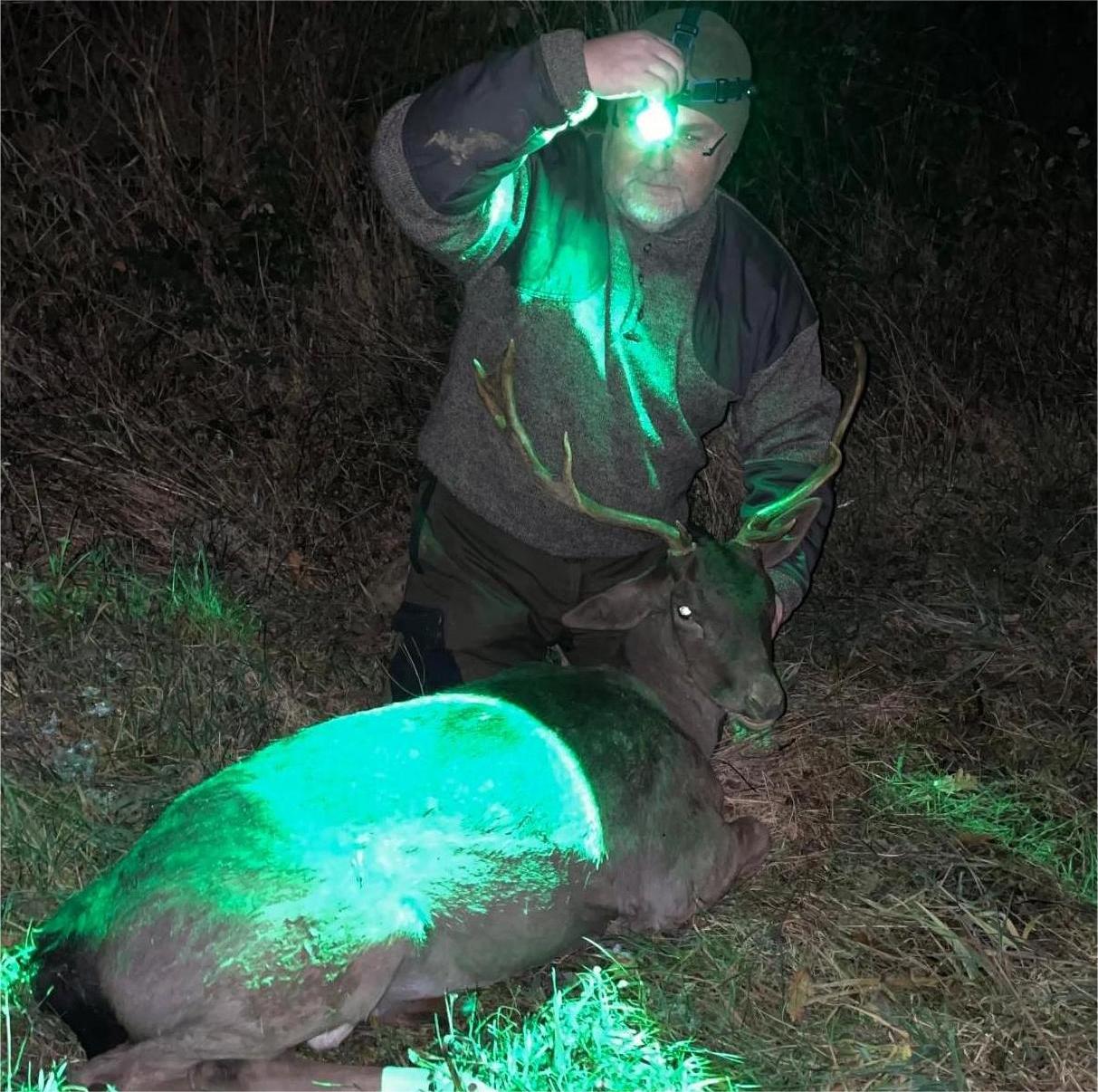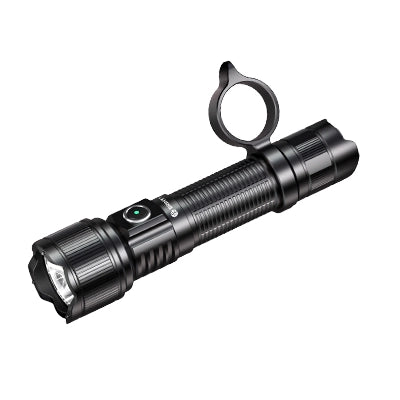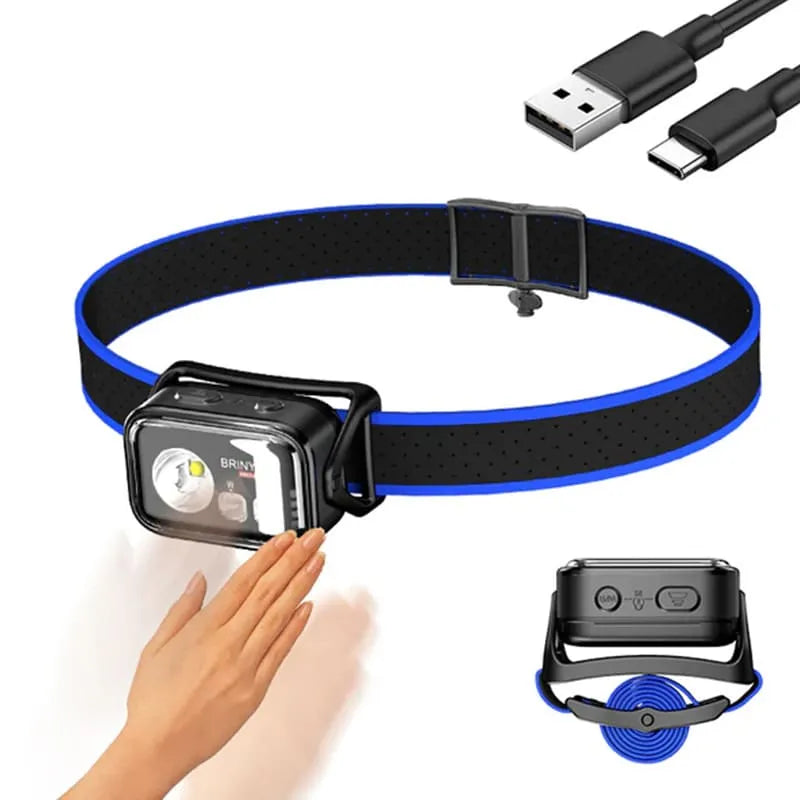


It depends on how you hunt. If you sit at a feeder, you need a solar-powered motion-activated feeder light. If you spot-and-stalk with a rifle, you need a scope-mounted light that's recoil-proof, has a dimmer switch, and switches between red and green. If you hunt from a truck or ATV, you need a light bar — wide flood, high lumens, vehicle power.
Brinyte makes excellent scope-mounted lights (T28, ZT40,T40) but doesn't make feeder lights or light bars. We'll tell you what each type needs so you can choose the right tool for your hunt — even if it's not ours.
✔ The hunter who wants to spot-and-stalk at night but doesn't know what light to mount
✔ Anyone who's lost a blood trail because their flashlight washed it out
1. The Sounder at 2 a.m. — Why Your Light Choice Matters
You're in the blind. It's 2 a.m. The sounder comes in from the east — twelve hogs, maybe fifteen. The boar is pushing 250 pounds. They're tearing up the winter wheat your family has planted since your grandfather's time.
You shoulder the rifle. Hit the light. White light floods the pasture.
The hogs scatter before you can even find the boar in your scope.
That's not hunting. That's working security for the hogs.
There are roughly 6 million feral hogs in the U.S. — 2.6 million in Texas alone. They cause $2.5 billion in damage every year. The USDA calls them "the highest reproductive capability of any hoofed animal in North America."
This is why states like Texas, Georgia, Florida, Alabama, and South Carolina allow night hunting for hogs year-round on private land. The law is on your side. But the law doesn't tell you which light to bring — and the wrong light will ruin your hunt every time.
Searching "hog hunting light" doesn't mean you need a flashlight. It means you need a solution for your specific hunting style. Feeder hunters need different lights than spot-and-stalk hunters. The right answer depends on how you hunt.
2. Quick Pick: Which Hog Hunting Light Do You Actually Need?
Here's a simple table. Find your hunting style → see what you need → check if Brinyte makes it. We're not going to pretend we make everything. That's how you lose trust.
| Your Hunting Style | What You Need | Must-Have Features | Does Brinyte Make It? |
|---|---|---|---|
|
🏠 Feeder-Sitter You sit in a blind waiting for hogs to hit your bait station |
Feeder-mounted light | Solar-powered · Motion-activated · Slow-glow startup · Auto-on at dusk |
Not yet We don't make feeder lights — yet. But we'll tell you what to look for. |
|
🔦 Spot & Stalk You walk or sit scanning fields, then stalk in on foot |
Scope-mounted flashlight | Recoil-proof (.308+) · Dimmer switch · Red/green instant switch · Silent remote |
✅ Yes — T28 Artemis The T40 mounts easily on your rail, while the T28 and ZT40 attach to your shotgun via a mount. |
|
🚜 ATV / Truck Patrol You drive fields scanning for sounders at night |
LED Light Bar / Pods | Wide flood beam · High lumens · Vehicle power · Weatherproof |
Not yet We don't make light bars. Look for a 20–40" bar with at least 10,000 lumens. |
3. Red vs Green: The Real Science — Not the Same Old "Hogs Are Colorblind" Line
You've heard it before: "Hogs are colorblind." That's technically true but useless without context. Here's the real breakdown.
Green Light (520–540 nm) — The Scanning Color
Hogs have dichromatic vision — they only see blue and green wavelengths. Around 520–540 nm, they become effectively colorblind. A green beam at that wavelength registers as light, but not as a threat. This is why guides use green as their primary scanning color — you can sweep a pasture and the hogs keep feeding.
Downside: Green is visible to hogs if it's too bright or turned on too fast. A sudden green blast will spook them just like white light. The key is slow-glow dimming — start at 0% and gradually increase.
Red Light (620–660 nm) — The Stealth Color
Hogs cannot perceive red wavelengths at all. Period. They don't see it, period. This makes red the ultimate stealth approach color. You can walk from 200 yards to 80 yards with red light and the sounder won't even know you're there.
Downside: Red is terrible for blood tracking. Blood reflects red — it blends right in. If you shoot a hog and switch to red to track it, you'll lose the trail.
White Light — The Final Confirmation
White light hits a hog's eyes like a camera flash. It triggers an immediate flight response. Use white only for positive ID right before the shot — never for scanning, never for approach.
Whether you use red or green, the dimmer switch matters more than the color. A sudden blast of any light will spook hogs. Start at 0% and slowly increase brightness over 2–3 seconds. Give the sounder time to accept the light. This is why the T28's stepless dimmer is a big deal.
So Which Color Wins?
Depends on the phase of your hunt:
- Approach / Navigation: Red — preserves your night vision and hogs can't see it
- Scanning / Tracking: Green — best human visibility and blood pops black against leaves
- Final ID / Shot: White — brief pulse, then off
- Blood Tracking: Green + strobe — the Hunt-Drude effect makes droplets pulse against the background
A light that switches between all three, with a dimmer and a zoom, covers every phase. That's why the T28 exists.
4. Scope-Mounted Lights: 3 Hard Requirements for Spot-and-Stalk Hunters
If you're a spot-and-stalk hunter, you need a scope-mounted light. Here are the three non-negotiable requirements — and how the Brinyte T28 meets them.
Requirement 1: Recoil-Proof (Must Survive .308)
Here's the problem with cheap "tactical" lights on rifles: the battery slams forward under recoil, loses contact for a split second, and the light flickers or turns off. On your shot. You'll miss or wound the hog.
The T28 is built for rifle recoil. Double-spring design in the battery compartment keeps contact solid under .308 and 6.5 Creedmoor. It's been tested by hunters on AR-10s and bolt guns.
What to look for in any scope light: Double-spring battery contacts, potted electronics, or a locking battery cap. If the manufacturer doesn't mention recoil testing, skip it.
Requirement 2: Silent Remote Switch
At 2 a.m. in a quiet field, any "click" carries 150 yards. The hogs will hear it and spook before you ever see them. Your remote switch must be completely silent — no tactile click, no audible snap.
The T28's remote pressure switch is a soft-pressure membrane. No click. You press, the light comes on. You let go, it turns off. That's it. You can also use the tail switch for momentary or constant on.
Requirement 3: Instant Color Switching
You don't want to screw on filters in the dark. You don't want to carry separate LED modules. You want one light that instantly switches between red, green, and white — by feel, without looking.
The T28 uses a rotary ring. Center is white. Turn left for green. Turn right for red. One hand, one motion, no fumbling. It's mechanical, not electronic — there's no risk of the mode memory failing or the switch getting confused.
Your scope-mounted light must survive recoil, activate silently, and switch colors instantly. If it fails any of these three, it's not the right tool for spot-and-stalk hog hunting.
5. Common Mistake: Why You Shouldn't Use a "Tactical" Flashlight for Hog Hunting
Tactical lights are designed to blind the enemy. Hog hunting lights are designed to go unnoticed.
Here's the difference:
- Tactical light (like a Streamlight or SureFire): One click, full brightness, blinding. Strobe mode for disorientation. Designed for self-defense. Used for 30 seconds at a time.
- Hog hunting light (like the Brinyte T28): Dimmer knob so you can start at 0% and creep up. Red/green wavelengths so the animal doesn't detect the beam. Zoom so you can flood a field or spot a single animal. Runs for hours.
If you take a tactical light into a hog blind, you'll either scare the hogs with a sudden blast of white light, or you'll run out of battery before the sounder shows up. They're the wrong tool for the job.
A dedicated hunting light has a dimmer — because the hogs need time to adjust. A tactical light doesn't have a dimmer because it's not designed for that. Buy the right tool for the hunt.
6. The Brinyte T28 Artemis — Built for Spot-and-Stalk Hog Hunting
🔦 Brinyte T28 Artemis — Tri-Color Rifle Light
If you spot-and-stalk hogs with a rifle, this is the light you want.
Green mode: 350 meters. Sweep the field. The sounder won't spook.
Red mode: 280 meters. Sneak from 200 to 80 yards. Hogs can't see it.
White spot: 700+ meters. 125,000 candela. Tight enough to pick out a boar's shoulder at 300 yards. White flood: 1,000 lumens for tracking and area lighting.
Zoom: 6° to 70°. Flood for scanning. Spot for locking onto a target.
Dimmer: Stepless, 2% to 100%. Start at 0%, bring it up slowly. The hogs won't even notice.
Remote switch: Silent membrane pressure switch. No click, no spooking.
Battery: 21700, 5000mAh, USB-C. Runtime on green is measured in hours. Standard cell — swap in seconds if it dies.
Kit includes: Remote pressure switch + rail mount. Everything you need to mount it on a rifle.
Warranty: 2 years standard. Register online for 3 more years free — 5 years total.
Shop T28 →Green for scanning. Red for sneaking. White for confirming. One light, three colors, no compromises. The T28 follows all three hard requirements — recoil-proof, silent remote switch, instant color switching — and does it at ~$90–110.
7. Frequently Asked Questions
What color light is best for hog hunting — red or green?
Depends on the phase. Green is best for scanning and tracking — hogs register it less as a threat, and it makes blood show up black. Red is best for approaching — hogs can't see red at all, and it preserves your night vision. White is for final confirmation only. A light that does all three (like the T28) covers the whole hunt.
Can I use a regular tactical flashlight for hog hunting?
Not really. Tactical lights are designed to blind and disorient — one click, full brightness, no dimmer. Hog hunting requires starting at 0% and slowly increasing brightness so the animals don't spook. A tactical light will either scare the hogs or run out of battery before the hunt is over. Get a light with a dimmer.
Does the Brinyte T28 handle .308 recoil?
Yes. The T28 has double-spring battery contacts to prevent the battery from losing contact under recoil. It's been tested by hunters on .308 AR-10s and 6.5 Creedmoor bolt guns. The green laser (on the XP22 MK3 variant) holds zero through multiple shot strings.
Why do hogs spook from my light when I use green?
You're turning it on too fast. A sudden blast of any light — even green — will spook hogs. The key is to start at 0% brightness and slowly increase it over 2–3 seconds. Give the sounder time to adjust. This is why a stepless dimmer is more important than the light color itself.
Does Brinyte make feeder lights?
Not yet. Brinyte specializes in scope-mounted and handheld hunting lights. For feeder lights, look at Moultrie, Wildgame Innovations, or Primos — they make solar-powered, motion-activated feeder lights with slow-glow startup.
Find Your Hog Hunting Light
Spot-and-stalk hunter? The T28 is built for you. Feeder-sitter? We'll tell you what to look for — no hard sell.
Shop Hog Hunting LightsAbout Brinyte
Xuping Feng founded Brinyte in 2009. He's spent 15+ years testing lights in the field — not just on a bench. Every product in this guide has been run through Texas mud, Georgia humidity, and real night hunts. 50+ patents · ISO9001.
"Engineered for the mission — proven in the field."
Founded 2009 · 50+ Patents · ISO9001