

The 21700 Battery Flashlight — Why You're Only Using a Third of Its Value
Most 21700 flashlight owners are using about a third of what their battery can do. They bought the right cell. They never learned the system. The 21700 battery flashlight is not just a brighter beam — it's a platform for cross-device energy sharing, strategic charge management, and multi-day runtime planning. This guide covers all three.

✔ The 18650 user staring at the upgrade decision, wondering if the switch is really worth it
✔ Anyone who's ever found a dead light in their pack and sworn it had charge the night before
1. You Already Won. You Just Don't Know It Yet.
You brought home your first 21700 battery flashlight three weeks ago. The beam was brighter than your old 18650. The runtime was longer. You thought: good purchase. Next topic.
Then the questions started showing up — not in the manual, but in real life. Should I top it off after every use, or let it drain? Why does this one charge faster from my truck than from my power bank? Is there a way to keep a spare battery around that works in my other lights too, or am I carrying a different backup for every device? The light was better than your old one. But the system — the way the battery fits into your actual life, across multiple pieces of gear, across multiple scenarios — nobody had explained that part.
Most 21700 flashlight owners are using about a third of what their battery can do. They bought the right cell. They never learned the system. The internet is drowning in articles telling you which 21700 light to buy. It is silent on what to do after you've bought it. This guide fills that gap — not by reviewing products, but by teaching you the three-layer operating system that turns a 21700 battery from a spec in a product page into the most versatile power platform you've ever carried.
Selecting a 21700 battery flashlight is the starting line. Mastering charge strategy, runtime planning, and cross-device compatibility is the race. Most articles stop at the starting line. This one runs the full course — with Brinyte's seven-light ecosystem as the demonstration platform.
2. Charge Strategy — When to Go Fast, When to Go Slow, and Why the Port Design Matters More Than the Chip
The Fast vs. Slow Decision That Most Owners Get Wrong
A 21700 cell can accept charging current at 2 amps, 3 amps, even 5 amps with the right circuitry. Faster charging means more heat. More heat, repeated over months, accelerates the degradation of the electrolyte — reducing the battery's total cycle life. This is not a flaw. It's physics. And it creates a decision framework that most 21700 battery flashlight owners never receive.
Fast charge when time is the bottleneck. You're in the truck between stands. You've got forty minutes before the next sit. Plug into the vehicle USB-C at full speed and get the cell back to 80% before you need it. This is what fast charging is for — mid-mission replenishment where the alternative is a dead light.
Slow charge when battery longevity is the priority. You're back at camp. It's midnight. The hunt resumes at five. You have hours. Plug into a low-current source — a power bank, a laptop, a solar panel trickling at 1A — and let the cell fill gently overnight. The electrolyte stays cooler. The anode experiences less stress. The battery retains more of its original capacity into its second and third year.
| Scenario | Charging Strategy | Why | Matching Brinyte Light |
|---|---|---|---|
| Mid-hunt emergency top-up | Fast charge (2A+) via vehicle USB-C | Time-critical. 40 min = ~80% capacity. Acceptable tradeoff. | T28, ZT40 |
| Overnight camp recharge | Slow charge (~1A) via power bank | Maximizes cycle life. No time pressure. Battery stays cool. | ZT40, PT16A |
| Power outage backup | Slow charge via solar panel or generator | Unreliable grid. Sustained low-current input = stable multi-day refill. | PT16A (300h low runtime) |
| Multi-light rotation | Single charger base, rotate cells | One spare 21700 feeds the entire fleet. No proprietary docks. | Any Brinyte 21700 model |
The Hidden USB-C Port — Why It Exists and Why Rubber Flaps Fail
Most flashlights with USB-C charging use a rubber flap to cover the port. The flap works — until it doesn't. Rubber ages. It loses elasticity. It catches on pocket seams, gets pried open by debris, and eventually no longer seals. When that happens on a rainy night patrol or a creek crossing during a blood track, the port behind it becomes a direct path for water into the driver cavity.
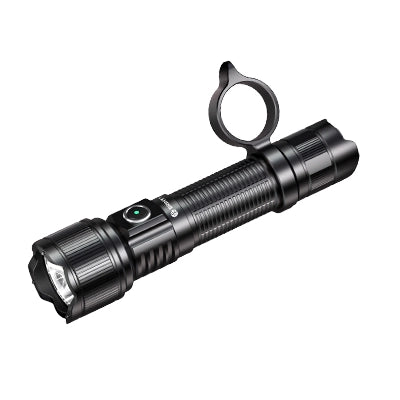
Brinyte's solution is mechanical, not material. The ZT40, T28, and several other Brinyte 21700 models use a hidden USB-C port — the charging interface is concealed beneath a threaded section of the head. You rotate the upper barrel to expose the port. There is no rubber cover to age, tear, or fail. The waterproofing is structural — the same O-ring that seals the battery compartment seals the charging port when the head is tightened. This is the single most important design difference between a 21700 battery flashlight built for the field and one built for a desk drawer.

A charging port is only as reliable as its seal. A rubber flap is a countdown. A hidden threaded port is structural waterproofing. Choose your 21700 battery flashlight accordingly — because the moment you need the charge most is the moment the weather will test the seal.
3. 300 Hours Is Not a Number. It's a Contract Between You and the Dark.
Amazon listings for 21700 battery flashlight models love to headline "2000 lumens!" and bury the runtime in a footnote that says "3 hours on high." Three hours. That's not a hunting window. That's a dinner reservation — and it ends with you standing in the dark, fumbling for a spare battery that you may or may not have remembered to charge.
The number that matters is not how long your light runs on turbo. It's how long it runs on the setting you'll actually use for 90% of its life.
The Runtime Management Framework
Every 21700 flashlight owner should operate on four inputs: when to raise output, when to drop it, when to kill the beam entirely, and how to maintain a reserve.
| Decision | Trigger | Action | Impact on Battery Life |
|---|---|---|---|
| Rise | Threat check / target ID / terrain scan | Brief turbo burst, immediately return to prior mode | High drain is brief. Net impact on overall runtime is negligible if under 10 seconds per event. |
| Drop | Close-range navigation / in-stand / camp tasks | Reduce to lowest usable output (20-100 lumens) | Low mode extends practical runtime by 2-3× compared to medium. A 300-hour low mode means 12.5 continuous days of light. |
| Kill | Reaching safe zone / established camp / no movement needed | Switch off entirely | Preserves 30-40% reserve for genuine emergencies rather than comfort illumination. |
| Reserve | Always — this is a standing state | Maintain one fully charged spare 21700 cell in your pack or vehicle | Single spare = full system redundancy across every Brinyte light you own. |
Brinyte Products in the Runtime Framework
The PT16A holds the system's endurance record: 300 hours on its lowest 5-lumen setting. That is twelve and a half continuous days of light from a single 5000mAh 21700. For context: a power outage lasting a week, a remote hunt camp with no resupply, or a natural disaster kit — scenarios where access to charging is zero and light is survival currency. The PT16A covers all of them on one cell.
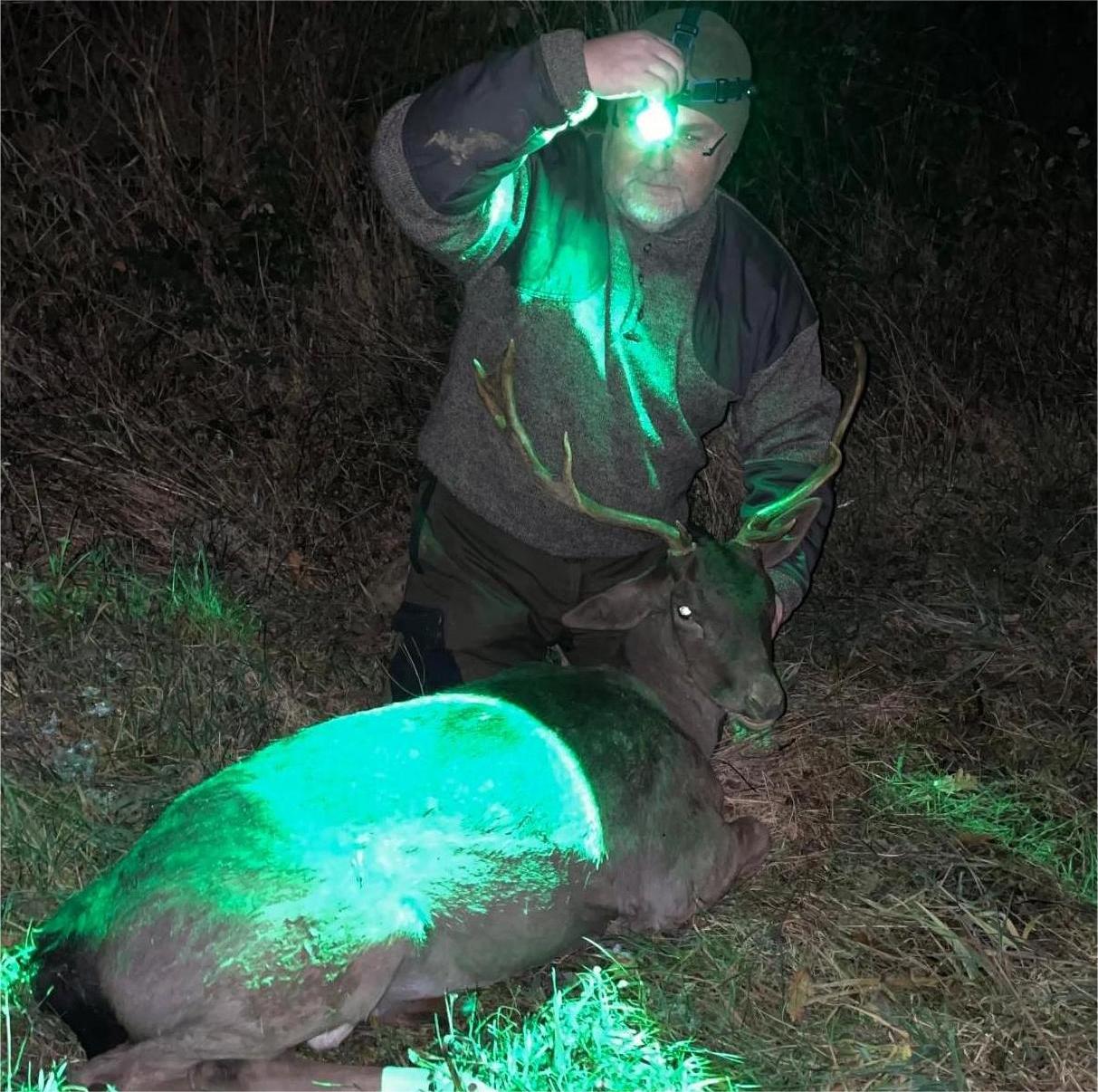
The T28 in green hunting mode runs beyond 5 hours — sufficient for two complete nights of hog or predator hunting without a battery change. The T5X at full tracking power delivers over 4 hours of continuous blood trailing — enough to work a sparse whitetail trail from impact to recovery with margin to spare. These are not theoretical runtimes. They are field-validated performance numbers that define the difference between finishing the track and leaving a deer in the woods overnight.
Turbo is for seconds. Low is for days. A 21700 battery flashlight that only quotes its turbo runtime is telling you it wasn't designed for real use. Learn the low-mode numbers. They're the ones that will save your hunt — and your night.
4. One Battery. Seven Lights. This Is What "Ecosystem" Actually Means.
The 18650 era had a problem nobody talks about: compatibility was a lie. Different brands used subtly different cell dimensions. Some required button-top cells. Others only accepted flat-top. Protection circuits tripped at different current thresholds. You ended up carrying three different spare batteries for three different lights — which defeated the purpose of a standard.
The 21700 format was supposed to solve this. Brinyte actually did.
The Brinyte 21700 Platform — Seven Lights, One Cell
| Model | Role | 21700 | USB-C | Battery Shared With |
|---|---|---|---|---|
| PT16A | Law enforcement patrol / 3000lm long throw / 300h endurance | ✓ | ✓ Hidden | All models |
| PT16 | EDC candela-first / 92,500cd threat ID | ✓ | ✓ | All models |
| T28 | 3-color deer hunting main / Rotary switch | ✓ | ✓ Hidden | All models |
| ZT40 | Outdoor zoom / Search & rescue / IPX8 | ✓ | ✓ Hidden | All models |
| T5X | Blood tracking specialist / 120° flood / Strobe | ✓ | ✓ | All models |
| T18 | Wireless remote hunting | ✓ | ✓ | All models |
| T40 | Lightweight hunting / 1650lm 490m throw | ✓ | ✓ Hidden | All models |
Here's what this table means in the field. You are a deer hunter. Your T28 is your primary light — red for walk-in, green for scanning, white for identification. Your T5X is in your pack for post-shot blood tracking. Your ZT40 is in the glove box as a backup. All three run on the same 21700 cell. You carry one spare battery. If any light dies, that single spare revives it. If a cell in one light is low and you need maximum output in another, you swap.
This is not a feature. This is a logistics philosophy. And it's the reason law enforcement agencies — including the Cyprus Police, which has procured the PT16A in operational quantities — are moving toward unified battery platforms. When an officer's patrol light, a rescue swimmer's waterproof backup, and a hunter's main beam all share the same power source, the supply chain collapses into a single inventory item. That's not a consumer convenience. That's institutional-level efficiency.
A 21700 battery flashlight purchased in isolation is a good product. Seven lights that share one battery platform is a system. Brinyte didn't design individual flashlights around the 21700. They designed the platform first, then built every light into it. The difference is invisible on a spec sheet. It's undeniable in a dark forest at 3 a.m.
5. Beyond the Spec Sheet — Why the 21700 Conversation Needs to Change
Type "21700 battery flashlight" into Google. You will find battery chemistry guides. You will find product lists. You will find comparison articles that tell you a 21700 is 3mm wider and 5mm longer than an 18650, with 30-40% more capacity.
You will not find a single article that explains what to do with that extra capacity once you own it. The entire internet is stuck at the purchasing decision.
This is the gap Brinyte can fill — not because we write better SEO, but because we build products that span the full use-case spectrum of the 21700 format. From the PT16A's 300-hour endurance to the T5X's blood tracking strobe to the ZT40's IPX8 waterproof zoom, the 21700 cell is the common thread. One battery technology. Seven completely different missions. No proprietary packs. No locked-in ecosystems that force you to buy the same brand's charger. Just a standard cell, a hidden USB-C port, and the knowledge — gained from reading this guide — that you can manage the power better than the guy next to you.
Q: Should I upgrade from 18650 to 21700?
A: Only if you plan to use more than one light. A single 18650 light is fine for casual use. The 21700's real value unlocks when you have multiple devices sharing the same cell platform — because then you're not just buying a brighter beam. You're buying system compatibility, reduced spare inventory, and unified charging. If you hunt, patrol, or maintain a vehicle kit, the upgrade pays for itself in reduced logistical overhead the first time you swap a battery between lights and keep moving.
6. The 21700 Is Not the Destination. It's the Vehicle.
A cell measuring 21 millimeters by 70 is not what you paid for. You paid for the ability to charge strategically — fast when the hunt demands it, slow when battery longevity matters more than speed. You paid for a runtime architecture that gives you 300 hours on low and 5+ hours in the field modes you actually use. And you paid for an ecosystem where seven different lights — from patrol to tracking to backup — all drink from the same power source.
The 21700 battery flashlight market is saturated with articles telling you what to buy. This one told you what to do after you've bought it. That's the part nobody else is writing. That's also the part that actually determines whether your light is a tool — or just a bright object in a drawer.
Put the 21700 Ecosystem to Work
Explore Brinyte's seven-light 21700 platform — PT16A, PT16, T28, ZT40, T5X, T18, and T40. One battery. USB-C hidden-port charging. Cross-device interoperability that turns a cell into a system.
Explore Brinyte 21700 LightsAbout Brinyte
Founded in 2009 — 50+ patents, ISO9001 certification. Brinyte designs its entire tactical and hunting lineup around the 21700 lithium-ion platform. All products tested to ANSI/NEMA FL1 standards. No companion app. No firmware updates. No proprietary battery packs. Just a standard cell, a hidden USB-C port, and a seven-light ecosystem that shares everything.
"Engineered for the mission — proven in the field."
Founded 2009 · 50+ Patents · ISO9001
❓ 21700 Battery Flashlight FAQ
What is the advantage of a 21700 battery flashlight over 18650?
A 21700 battery flashlight offers approximately 30-40% more capacity than 18650 — typically 4000-5000mAh versus 2600-3500mAh — in a cell only 3mm wider and 5mm longer. The real advantage is not just runtime, but ecosystem potential: 21700 cells can power multiple device types (flashlights, headlamps, power banks) from a single battery platform. Brinyte's seven-light 21700 system demonstrates this — a single spare cell works in every light they make.
How should I charge my 21700 flashlight to maximize battery life?
Use fast charging (2A+) only when time-critical — mid-hunt top-offs, emergency replenishment. Use slow charging (~1A) overnight when time is not a factor. Slower charging generates less heat, which reduces electrolyte degradation and extends total cycle life. Brinyte's hidden USB-C port design (on the ZT40, T28, T40, and PT16A) ensures the charging interface remains waterproof regardless of charging speed. Never charge a lithium-ion cell in freezing temperatures.
How long does a 21700 battery last in a flashlight?
It depends entirely on output mode. On turbo (2000-3000 lumens), a 21700 may last 60-90 minutes. On medium (200-500 lumens), 4-8 hours. On low (5-20 lumens), a Brinyte PT16A can run 300 hours — over 12 continuous days — from a single 5000mAh cell. The key to long runtime is mode discipline: use turbo in short bursts, medium for active navigation, low for everything else. Carry one spare cell and you double every number above.
Can I swap 21700 batteries between different flashlight brands?
Sometimes — but not always. Some brands use button-top cells, others flat-top. Some have proprietary charging circuits that only recognize their own cells. Within the Brinyte ecosystem, every 21700 model shares the same flat-top, unprotected cell platform — PT16A, PT16, T28, ZT40, T5X, T18, T40 are all interchangeable. A spare cell from your T28 works in your ZT40. A fresh battery from your PT16A powers your T5X. This compatibility is not accidental — it was designed into the platform from the beginning.
What is a hidden USB-C charging port and why does it matter?
A hidden USB-C port is concealed beneath a threaded section of the flashlight body rather than behind a rubber flap. You rotate the head to expose it. This design eliminates the single most common failure point in field-use flashlights: rubber cover degradation. The waterproofing is structural — the same O-ring that seals the battery compartment seals the port. Brinyte uses this design on the ZT40, T28, T40, and PT16A. If you hunt in rain, track blood across creeks, or patrol in wet conditions, this is the charging port design you want.
Do law enforcement agencies use 21700 flashlights?
Yes — and increasing adoption. The Brinyte PT16A has been procured in operational quantities by the Cyprus Police. The Brinyte ZT40 is listed on the U.S. General Services Administration's GSA Advantage procurement platform. Law enforcement agencies favor the 21700 platform for a specific reason: unified logistics. When every officer's primary light, backup light, and vehicle light share the same battery, the department stocks one cell type, one charger type, and one training protocol. This is the same interoperability advantage that civilian hunters and outdoor users get from the Brinyte ecosystem.